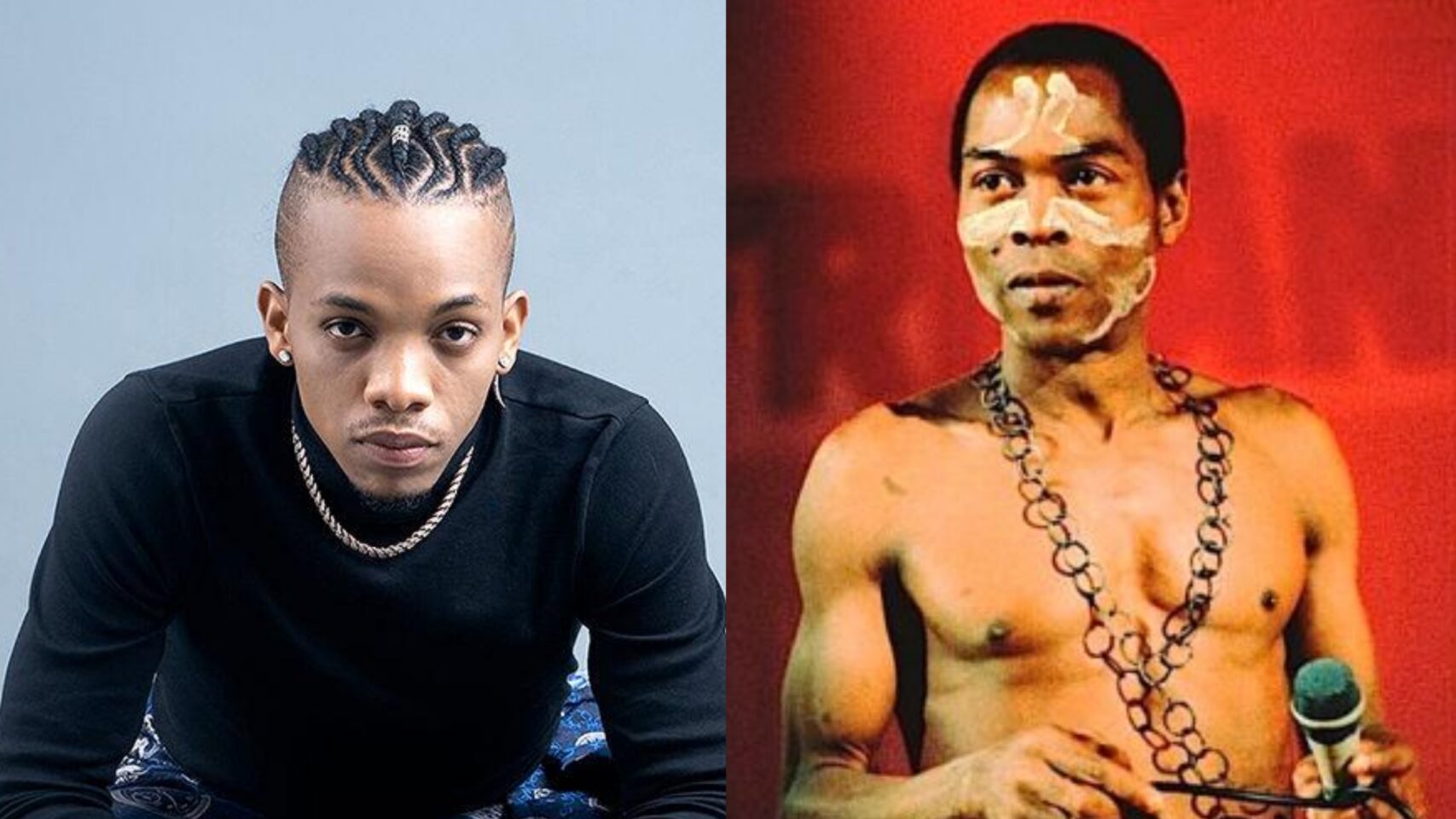
Nigerian singer Augustine Miles Kelechi, popularly known as Tekno, has stirred controversy in the Nigerian music industry after questioning the widely held belief that the late Afrobeat pioneer, Fela Anikulapo-Kuti, was the originator of Afrobeats.
Tekno made the comments during a recent interview with Hot 97 FM in New York, where he argued that the history and evolution of African popular music should not be attributed to a single artiste.
According to the singer, several Nigerian musicians contributed significantly to the development of the sounds now broadly associated with Afrobeats, particularly highlife musicians from the eastern part of the country.
Tekno specifically mentioned the late highlife musician Oliver De Coque, insisting that his music and the works of other Eastern legends deserve greater recognition in discussions about the roots of contemporary African music.
He acknowledged Fela Kuti’s enormous contribution to Afrobeat and credited him with taking the sound to an international audience. However, he maintained that Fela should not be regarded as the sole originator of the broader Afrobeats tradition.
“Fela is not the originator of Afrobeats. Lagos people and the Yorubas might say he is the one, but I am from the East, and we had legends like Oliver De Coque,” Tekno said.
He explained that Oliver De Coque was a major figure in highlife music, a genre he considers part of the wider musical foundation from which modern Afrobeats developed.
Tekno’s comments have reignited an old and often complex debate about the origins of African popular music. While Fela Kuti is internationally recognised as the pioneer of Afrobeat—a politically charged fusion of traditional Nigerian music, jazz, funk and other influences—the modern term “Afrobeats” generally refers to a broader family of contemporary African popular sounds that emerged decades later.
For Tekno, however, the contribution of musicians from different regions should be considered when tracing the evolution of the sound.
The singer said his own music had been influenced by both Fela and Eastern highlife musicians. He cited his song “Rara” as an example of Fela’s influence on his artistic development, noting that he grew up listening to the music of the legendary artiste.
“My song ‘Rara’ is heavily inspired by Fela because I heard his music while growing up. He is a legend. He was the one who took Afrobeat international,” he said.
Despite his admiration for Fela, Tekno argued that other musicians who preceded or operated alongside him had also created music that influenced subsequent generations.
He particularly recalled listening to Oliver De Coque while growing up, saying his father frequently played the highlife musician’s records.
“I feel like these legends deserved more recognition. I would say I was more inspired by Oliver De Coque and his peers from the East. My dad used to play his music a lot,” Tekno said.
The singer also argued that Fela’s international visibility contributed significantly to the perception that he was solely responsible for the development of the African sound.
According to him, Fela had greater opportunities to travel internationally and perform with his band, allowing his music to reach audiences beyond Nigeria and Africa.
“Fela gets all the credit because he travelled and performed with his band around the world,” he said.
Tekno maintained that many other Nigerian musicians produced innovative sounds that might surprise contemporary listeners if they were exposed to the recordings today.
He noted that some Eastern musicians created distinctive forms of music long before the global explosion of Afrobeats, but their contributions have not received comparable international attention.
“To some people, he is the originator of Afrobeats, but to me, there are a bunch of them—legends that no one speaks about,” he added.
The comments are likely to generate further debate among music historians, fans and practitioners, particularly because the terms Afrobeat and Afrobeats are sometimes used interchangeably despite referring to different musical traditions.
Fela Kuti’s Afrobeat emerged in the late 1960s and became synonymous with extended compositions, political commentary, jazz and funk influences, powerful horn sections and socially conscious lyrics. His music and activism eventually earned him a global following and established him as one of Africa’s most influential musicians.
Afrobeats, meanwhile, is a much broader contemporary movement that incorporates elements of highlife, hip-hop, R&B, dancehall, traditional African rhythms and other influences. Artists such as Wizkid, Davido, Burna Boy, Tiwa Savage and Tekno have helped take the contemporary sound to audiences around the world.
Tekno’s argument therefore appears to centre less on denying Fela’s historical importance and more on challenging what he considers an overly narrow account of the musical traditions that contributed to contemporary African pop.
His reference to Oliver De Coque has also highlighted the significant role played by Eastern Nigerian highlife musicians in the country’s musical history.
As Afrobeats continues to grow into a global cultural and commercial force, the debate over its roots is likely to continue. For Tekno, recognising the contributions of musicians from different regions is essential to telling a more complete story of Nigerian music.
While Fela Kuti remains an undisputed giant of African music and one of the most influential figures in the history of Afrobeat, Tekno believes the wider musical heritage behind today’s Afrobeats deserves a broader and more inclusive historical narrative.