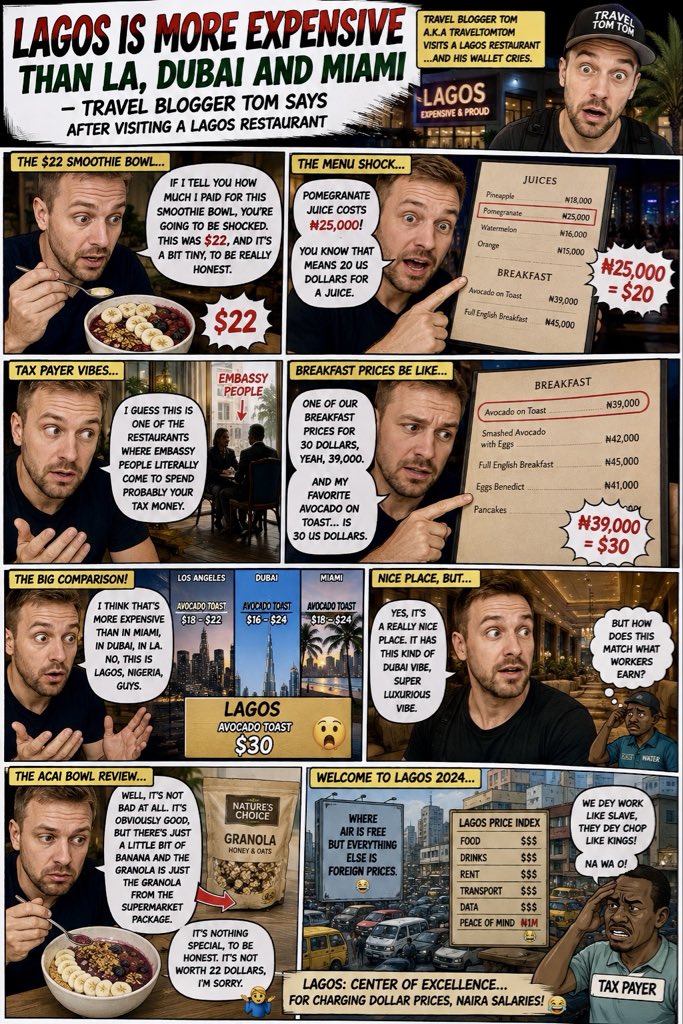
Travel blogger Tom, popularly known as TravelTomTom, has sparked debate online after claiming that some restaurants in Lagos charge prices that are higher than those in major international cities such as Los Angeles, Dubai and Miami.
Tom made the remarks in a video posted after visiting what he described as one of the most expensive restaurants in Lagos. During the visit, he reviewed the menu, sampled some food items and compared the prices with what he said he had encountered in other global destinations.
Expressing surprise at the cost of a smoothie bowl he ordered, the blogger said the item cost him 22 US dollars, which he considered excessive given its size.
“If I tell you how much I paid for this smoothie bowl, you’re going to be shocked because I made it to the most expensive restaurant in all of Lagos,” he said in the video.
“I’ll show you the menu in a second, but this was $22, and it’s a bit tiny, to be really honest.”
Tom later displayed the restaurant’s menu and pointed to the price of pomegranate juice, which was listed at ₦25,000, noting that it was equivalent to roughly 20 US dollars.
“You know that means 20 US dollars for a juice,” he said.
Reacting to the price, the travel blogger jokingly suggested that the restaurant appeared to cater largely to diplomats and affluent visitors.
“I guess this is one of the restaurants where embassy people literally come to spend probably your tax money,” he remarked.
He also highlighted other menu items that caught his attention, including breakfast options priced at about $30, or roughly ₦39,000.
“One of our breakfast prices is 30 dollars, yeah, 39,000,” he said while scrolling through the menu.
Tom appeared particularly astonished by the price of avocado on toast, which he said was also around $30.
“And my favourite avocado on toast, I think we have it here as well, is 30 US dollars,” he added.
Comparing the prices with those in international cities, the blogger said he found the Lagos restaurant more expensive than establishments he had visited in Miami, Dubai and Los Angeles.
“I think that’s more expensive than in Miami, in Dubai, in LA. No, this is Lagos, Nigeria, guys,” he said.
Despite his criticism of the prices, Tom acknowledged that the restaurant was attractive and offered a luxurious atmosphere.
“Yes, it’s a really nice place. It has this kind of Dubai vibe, super luxurious vibe,” he said.
However, he questioned the relationship between such prices and the earnings of many workers in Nigeria, suggesting that the disparity was striking.
Tom also reviewed an acai bowl served at the restaurant. While he said the meal tasted good, he maintained that it did not justify the price charged.
“Well, it’s not bad at all. It’s obviously good, but there’s just a little bit of banana and the granola is just the granola from the supermarket package. It’s nothing special, to be honest. It’s not worth 22 dollars, I’m sorry,” he said.
The video has generated widespread reactions on social media, with many Nigerians debating the rising cost of dining in upscale Lagos restaurants. Some users agreed with the blogger that certain luxury establishments in Lagos now charge prices comparable to, or even higher than, those in major international cities. Others argued that such restaurants target a wealthy clientele, expatriates and business executives rather than the average Nigerian consumer.
The discussion comes amid broader concerns about inflation and the increasing cost of living in Nigeria, where food prices, transportation costs and other expenses have risen sharply in recent years.
Lagos remains Nigeria’s commercial hub and home to a growing number of luxury restaurants, hotels and entertainment venues that cater to affluent residents and international visitors. Tom’s comments have nevertheless reignited conversations about affordability, consumer pricing and the widening gap between luxury spending and average household income in the country.