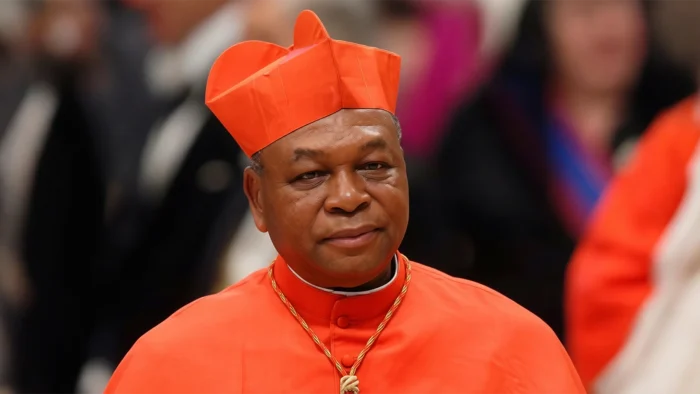
The Human Rights Writers Association of Nigeria (HURIWA) has come to the defence of the Archbishop Emeritus of the Catholic Archdiocese of Abuja, John Cardinal Onaiyekan, following criticism from two presidential aides over comments he made after a meeting between President Bola Ahmed Tinubu and the Catholic Bishops Conference of Nigeria (CBCN).
The rights organisation accused the presidential aides of showing disrespect to one of Nigeria’s most senior clerics and elder statesmen, insisting that Cardinal Onaiyekan acted in the public interest by speaking openly on issues affecting Nigerians.
In a statement issued on Sunday and signed by its National Coordinator, Comrade Emmanuel Onwubiko, HURIWA criticised the Special Adviser to the President on Policy Communication, Daniel Bwala, and the Senior Special Assistant to the President on Media and Publicity, Temitope Ajayi, over their reactions to the cardinal’s television interview.
The controversy followed an interview granted by Cardinal Onaiyekan in which he analysed the recent meeting between President Tinubu and members of the Catholic Bishops Conference of Nigeria at the Presidential Villa in Abuja.
During the interview, the cardinal discussed the concerns raised by the bishops regarding the economy, insecurity, governance and the future of democracy in Nigeria.
Reacting to the interview, Bwala reportedly argued that the cleric merely expressed the views of Catholics and should not be seen as speaking for all Nigerians.
Ajayi, on his part, faulted the cardinal for publicly discussing what he described as a private engagement with the President.
According to Ajayi, the bishops had fulfilled their moral responsibility by presenting their concerns directly to President Tinubu, while the President responded to the issues raised in a manner consistent with constitutional democracy.
He maintained that the dignity and confidentiality of the engagement ought to have been preserved by all participants and argued that it was inappropriate for one of those present to appear on national television and provide a personal account of the discussions.
Ajayi further contended that clerical office confers moral authority and public influence, but also imposes obligations of restraint and discretion, particularly when dealing with matters of state.
HURIWA, however, rejected the criticisms and described them as unfair, unwarranted and disrespectful to a cleric who has spent decades speaking on national issues without fear or favour.
The organisation said Cardinal Onaiyekan has consistently spoken truth to power under successive administrations and has earned national respect for his independence and moral courage.
“It is unfortunate that the two presidential aides chose to attack one of Nigeria’s most respected clerics,” HURIWA stated.
“Cardinal Onaiyekan spoke in the best public interest and for millions of Nigerians affected by multidimensional poverty, irrespective of their religion or ethnicity.”
According to the rights group, the cardinal’s comments reflected the concerns of ordinary Nigerians struggling with rising living costs, insecurity, unemployment and economic hardship, and should not be reduced to a narrow denominational position.
HURIWA also argued that the criticisms directed at the cleric suggested a poor appreciation of Nigeria’s political history and the longstanding role played by religious leaders in national discourse.
The organisation noted that Cardinal Onaiyekan has engaged with several Nigerian presidents over many decades and has maintained a consistent reputation for independence and frankness regardless of which party was in power.
The group further rejected Ajayi’s assertion that the interview amounted to a breach of privilege or confidentiality.
It pointed out that the meeting between President Tinubu and the Catholic bishops was publicly announced and widely covered by the media, and that the broad positions expressed by both sides had already entered the public domain.
According to HURIWA, discussing matters that were already publicly known cannot reasonably be described as a breach of confidence.
The organisation also observed that other political leaders, including former Vice President Atiku Abubakar and former presidential candidate Peter Obi, had publicly commented on issues arising from the same meeting without attracting similar criticism from the Presidency.
Questioning the basis for the attack on the cardinal, HURIWA asked whether the meeting was intended to be secret and whether participants had been placed under any explicit obligation of confidentiality.
“How did the Archbishop Emeritus abuse any privilege?” the group asked.
“Was the meeting a secret conversation? Is President Tinubu not the President of all Nigerians, and are the Catholic bishops not spiritual leaders of millions of citizens?”
HURIWA maintained that Cardinal Onaiyekan deserved commendation rather than condemnation for using his public platform to advocate free, fair, peaceful and transparent elections ahead of the 2027 general election.
The organisation argued that democracy is strengthened when respected national figures speak honestly about governance, public welfare and electoral integrity.
It urged public officials to develop greater tolerance for constructive criticism and to engage critics through reasoned debate rather than personal attacks.
According to the group, disagreement with the cardinal’s views does not justify attempts to silence or discredit him.
HURIWA concluded by calling on the Presidency to recognise the important role that religious leaders, civil society organisations and elder statesmen play in holding governments accountable and promoting national dialogue.
The group said that in a constitutional democracy, public officials should welcome scrutiny and diverse opinions, especially when such opinions are motivated by concern for the welfare of citizens and the stability of the nation.