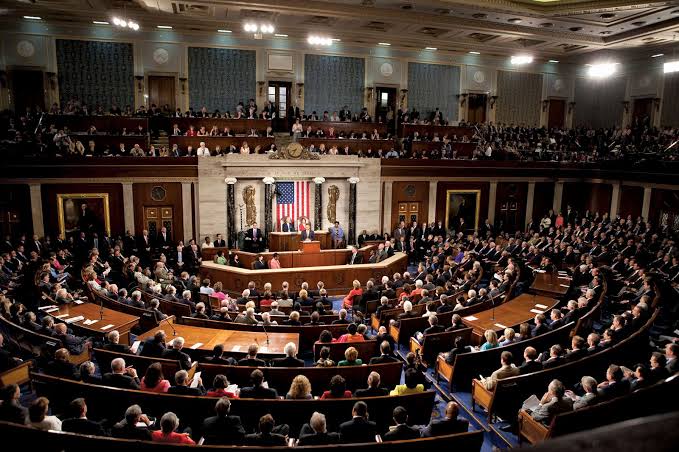
The United States House of Representatives has approved the Fiscal Year 2027 National Defense Authorization Act (NDAA), authorising a record $1.15 trillion in defence spending as the country’s military operations and strategic commitments continue to expand amid the ongoing conflict involving Iran.
The annual defence policy legislation, which sets funding priorities and strategic direction for the Department of Defense, was passed on Wednesday after a closely contested vote of 216 to 212, reflecting deep political divisions within Congress over military spending, foreign policy and national security priorities under President Donald Trump’s administration.
Although the NDAA has historically enjoyed broad bipartisan support because of its importance to the nation’s military, this year’s legislation exposed growing partisan disagreements, particularly over defence expenditure, America’s military engagements overseas and the inclusion of controversial domestic policy provisions.
The bill now proceeds to the United States Senate, where lawmakers are expected to subject it to further scrutiny before it can be sent to President Trump for his signature and become law.
If enacted in its current form, the legislation would authorise approximately $1.15 trillion for defence programmes, representing an increase of about $250 billion over the Fiscal Year 2026 National Defense Authorization Act.
The proposed budget includes significant investments in military readiness, weapons procurement, nuclear modernisation, missile defence systems, troop welfare and strategic defence initiatives intended to strengthen America’s military capabilities amid growing geopolitical tensions.
Among the key provisions contained in the legislation is a proposed salary increase of between five and seven per cent for members of the United States Armed Forces.
Lawmakers backing the measure argued that the pay increase is necessary to improve the welfare of military personnel, enhance recruitment and retention, and recognise the sacrifices of service members deployed across various theatres of operation.
The legislation also provides substantial funding for the modernisation of America’s nuclear deterrence capabilities and the expansion of missile defence infrastructure.
Speaking after the bill’s passage, Speaker of the House Mike Johnson described the legislation as a major investment in national security and military preparedness.
According to Johnson, the bill ensures that members of the armed forces receive long-overdue improvements in compensation while strengthening America’s ability to defend itself against emerging threats.
“This legislation provides our brave servicemembers with an overdue pay raise, strengthens our nuclear deterrence and missile defense — including construction of the Golden Dome,” Johnson said.
One of the centrepieces of the defence package is continued funding for President Trump’s proposed “Golden Dome” missile defence system.
The initiative is designed to provide comprehensive protection for the United States mainland against ballistic missiles, cruise missiles and other advanced aerial threats.
Administration officials have repeatedly described the project as a next-generation defence shield inspired by Israel’s renowned Iron Dome missile defence system, although the proposed American version is expected to operate on a significantly larger scale with broader technological capabilities.
Supporters of the legislation argue that recent military developments around the world underscore the need for enhanced homeland defence systems capable of responding to increasingly sophisticated missile threats.
Republican members of the House Armed Services Committee said the legislation would also help replenish depleted military stockpiles following extensive use of precision-guided munitions and other weapons in ongoing military operations involving Iran.
According to the committee, rebuilding inventories of missiles, ammunition and other critical defence equipment has become an urgent national security priority.
The lawmakers maintained that strengthening America’s defence industrial base would improve military readiness while ensuring that the armed forces remain capable of responding to future threats.
Despite receiving Republican support, the bill encountered strong resistance from Democratic lawmakers, many of whom criticised both the size of the proposed defence budget and the administration’s foreign policy decisions.
Opponents argued that allocating a record amount of public funds to military spending would further increase the country’s fiscal burden while diverting resources away from domestic priorities such as healthcare, education and infrastructure.
Several Democrats also questioned the legal basis of recent military operations and accused the administration of expanding armed conflict without sufficient congressional oversight.
Democratic Representative Jerry Nadler was among those who voted against the legislation.
Explaining his opposition, Nadler argued that the defence bill finances what he described as an unlawful military campaign while granting excessive authority to the executive branch.
“The NDAA is a costly, bad bill that funds an illegal war and undermines our democracy,” Nadler said.
He added, “I could not vote to give Trump and his Defense chief Pete Hegseth $1.15 trillion for their out-of-control military spending and irresponsible actions.”
The legislation has also generated controversy because of the inclusion of President Trump’s proposed SAVE America Act.
The voting measure, which seeks to introduce new nationwide election requirements and restrictions, was attached to the defence bill through a procedural move that drew immediate criticism from Democratic lawmakers.
Critics argued that adding election-related legislation to an annual defence authorisation measure politicises military funding and could complicate efforts to secure Senate approval.
Several Democratic members described the procedural strategy as inappropriate, insisting that electoral reforms should be debated separately rather than being incorporated into defence legislation.
Political observers believe the inclusion of the SAVE America Act could become one of the major obstacles during Senate deliberations, where bipartisan cooperation will likely be required to pass the bill.
Another contentious provision within the NDAA calls for expanded military cooperation between the United States and Israel.
The measure encourages closer collaboration between the armed forces of both countries in areas including defence technology, intelligence sharing, missile defence, joint military training and strategic planning.
Supporters argue that stronger defence cooperation with Israel is essential for maintaining regional stability and protecting shared security interests in the Middle East.
However, critics contend that deeper military collaboration could further entangle the United States in regional conflicts at a time when tensions remain high across the Middle East.
The passage of the House version of the NDAA comes against the backdrop of heightened international security concerns, increasing military expenditures by major global powers and continuing debates over America’s strategic role in global conflicts.
The Senate is expected to begin consideration of the legislation in the coming weeks, where lawmakers may introduce amendments addressing defence spending levels, foreign policy provisions, domestic policy riders and military priorities.
Any differences between the House and Senate versions of the bill would have to be reconciled before the final legislation can be presented to President Trump for approval.
As Congress prepares for the next phase of debate, the proposed record-breaking defence budget is expected to remain at the centre of discussions over America’s military strategy, fiscal priorities and national security agenda in the years ahead.