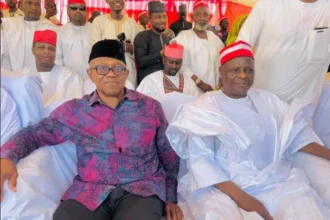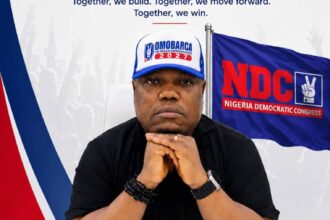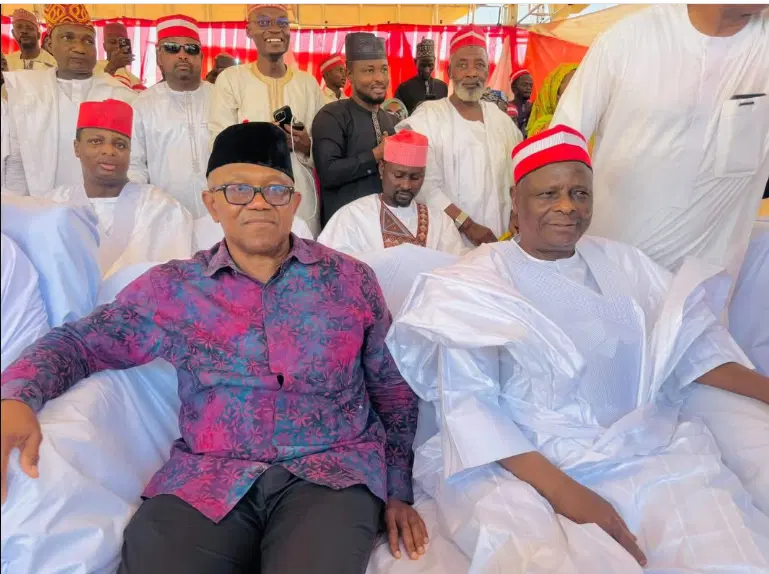
The vice-presidential candidate of the Nigeria Democratic Congress (NDC), Senator Rabiu Musa Kwankwaso, has revealed that he and the party’s presidential candidate, Peter Obi, signed a formal written agreement committing the former Anambra State governor to serving only one four-year term if elected President in the 2027 general election.
Kwankwaso disclosed this during an interview on Channels Television on Monday, stating that the agreement reflects a broader political understanding within the party aimed at promoting equity, national unity and rotational leadership between the North and the South.
According to the former Kano State governor, the decision was reached after extensive consultations and was based on the belief that the presidency should remain in the South for one term before returning to the North in 2031.
He said he had no reason to doubt Obi’s sincerity or commitment to honouring the agreement, stressing that the former Labour Party presidential candidate had consistently demonstrated integrity in their political engagements.
Responding to a question on whether Obi’s promise to serve only four years was binding and non-negotiable, Kwankwaso expressed confidence that the NDC presidential flag bearer would remain faithful to his pledge.
“Oh yes, I personally believe him and I don’t think, based on what I now know about him, that he will change his mind when the time comes. We are all gentlemen, even though we have accepted to put it on paper,” Kwankwaso said.
The former governor further disclosed that the understanding between both leaders was documented through two separate agreements—one involving the party and another signed personally by him and Obi.
Asked whether the arrangement had been reduced to writing, Kwankwaso responded in the affirmative.
“We have done one for the party, and we have done another one between the two of us,” he said.
Explaining the substance of the agreement, Kwankwaso said both leaders had resolved to work together as political partners and brothers to ensure the success of the administration before handing over power to the North after a single term.
“The agreement is what you said, that after four years, we will work together, team together as a group, as a party, as friends, brothers and so on, so that after his term, or our term, of four years—from 2027 to 2031—it comes back to the North, and that is the general agreement,” he explained.
Kwankwaso said the arrangement was designed to strengthen national cohesion and address longstanding concerns over power rotation, adding that it reflected the commitment of the NDC leadership to fairness and inclusiveness.
He noted that the agreement would help build trust among Nigerians while ensuring that every region of the country has a sense of belonging in the nation’s political leadership.
Speaking on why he accepted the vice-presidential position after contesting the presidency in previous elections, Kwankwaso said prevailing political realities made it appropriate for the South to complete another four-year presidential term before power rotates back to the North.
According to him, the decision was reached collectively after consultations with stakeholders who believed it was the best formula for maintaining national stability.
“Together we felt that the presidency should go to the South for four years; thereafter it will come back to the North. We believe that should be the consensus of everybody in this country so that we can move together as a family, both North and South,” he stated.
He added that the arrangement was not merely about political calculations but about creating a stable framework capable of reducing tensions associated with the struggle for power among Nigeria’s diverse regions.
Kwankwaso argued that rotational leadership remains one of the practical mechanisms for preserving unity in a multi-ethnic and multi-religious country like Nigeria.
The former governor also addressed questions about his own political future and whether he intended to seek the presidency after Obi’s proposed four-year tenure.
Rather than making a direct declaration of ambition, Kwankwaso said the party was concentrating on its immediate objective of winning the 2027 election while also planning strategically for Nigeria’s future.
“We have a short-term plan which we are executing now and, of course, we also have our medium and long-term plans for the country, and that is what we are working on now,” he said.
His comments have further fuelled discussions about the internal arrangements within the NDC and the party’s strategy for maintaining political balance across the country’s geopolitical zones.
Political analysts believe the disclosure is intended to reassure northern stakeholders that the party remains committed to power rotation while also presenting Obi as a consensus candidate capable of attracting support from across the federation.
The revelation also comes months after Peter Obi publicly declared that he would not seek more than one term in office if elected president.
Speaking in May, Obi said his objective was to lay a solid foundation for national transformation rather than remain in office for an extended period.
“I want to be a one-term president because of stability. I would not stay a day, with a gun to my head, longer than four years,” Obi had stated.
The one-term commitment has remained one of the defining features of Obi’s campaign, with supporters arguing that it demonstrates his willingness to place national interest above personal political ambition.
The NDC leadership has consistently maintained that its focus is on rebuilding Nigeria’s economy, tackling insecurity, creating jobs, investing in education and restoring public confidence in governance.
The emergence of Obi and Kwankwaso on the same ticket followed months of political realignments ahead of the 2027 elections.
Both politicians had previously contested the 2023 presidential election on different platforms before later participating in opposition coalition talks in 2026.
Although they initially joined an alliance under the African Democratic Congress (ADC), both eventually defected to the Nigeria Democratic Congress, citing unresolved internal disputes and legal challenges within the coalition.
Since their emergence as the NDC presidential ticket, Obi and Kwankwaso have repeatedly insisted that their partnership is built on shared values, mutual respect and a common determination to transform Nigeria through accountable leadership and people-centred governance.
With campaigns expected to intensify in the coming months, the disclosure of the written one-term agreement is likely to become a significant issue in the political debate as parties continue to position themselves ahead of the 2027 general election.