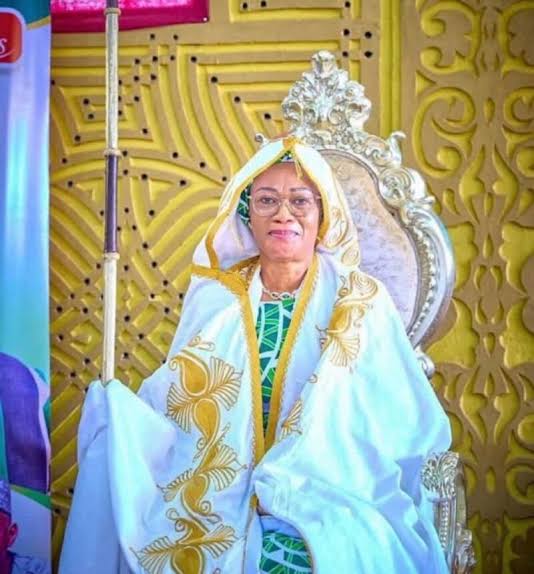
Nigeria’s First Lady, Senator Oluremi Tinubu, has defended her widely debated remarks on empowering women through petty trading, insisting that small-scale businesses remain a practical pathway to economic independence for many Nigerians.
Speaking on Saturday during the launch of the National Community Food Bank Programme in Lokoja, Kogi State, the First Lady reaffirmed her commitment to grassroots economic empowerment, stressing that millions of Nigerians rely on informal businesses for their livelihood and deserve government support.
Her remarks come weeks after comments she made in June sparked widespread public debate. At the time, Tinubu suggested that government grants could help women establish or expand small businesses such as frying akara, roasting corn, and producing kuli-kuli, arguing that such ventures provide sustainable income for families.
The comments generated mixed reactions across the country, with critics accusing the First Lady of trivialising the economic hardship confronting Nigerians. Among those who criticised the remarks was the Yoruba socio-cultural organisation, Ìgbìnmọ́ Májékóbájé Ilé-Yorùbá, which argued that encouraging women to engage in petty trading did not adequately address the country’s growing unemployment and economic challenges.
Despite the backlash, Tinubu made it clear during Saturday’s event that she remained convinced of the value of supporting small-scale entrepreneurs, particularly those operating in local communities.
Addressing participants at the programme, the First Lady explained that the Renewed Hope Initiative, her flagship social intervention programme, was designed to empower ordinary Nigerians by providing financial assistance and support to those engaged in legitimate businesses, regardless of their scale.
She noted that many Nigerians earn an honest living through petty trading and should not be looked down upon because of the nature of their businesses.
According to her, traders dealing in food items and other essential commodities play important roles in the nation’s economy and deserve encouragement rather than ridicule.
While speaking at the event, Tinubu also appealed to successful Nigerians in the entertainment industry to use part of their wealth to improve the lives of less privileged citizens through charitable initiatives.
She specifically urged some of the country’s biggest music stars to establish foundations dedicated to supporting vulnerable Nigerians, saying they possess the financial capacity to make meaningful contributions to society.
“I want to appeal to our young ones in the entertainment industry,” she said.
“I have mentioned it before, and I will use Akon, a music icon who does a lot of great charity work.”
Drawing comparisons with internationally recognised entertainers known for their philanthropic activities, the First Lady encouraged Nigerian celebrities to emulate similar gestures.
“They make the Burna Boys of this world, the Asakes, all of them, Davido, we want to see you with one foundation or the other, helping the poor with your money,” she said.
Tinubu acknowledged that successful entertainers deserved to enjoy the fruits of their labour but maintained that wealth should also be used to uplift disadvantaged members of society.
According to her, owning luxury vehicles and living comfortably should not prevent wealthy individuals from extending assistance to those in need.
“Good cars are good, a Maybach is good, a Rolls-Royce is good, but still, you can help,” she said.
The First Lady reiterated that the government’s responsibility in addressing poverty is enormous and cannot be carried out effectively without support from wealthy individuals and corporate organisations.
She therefore called on affluent Nigerians to complement government efforts by investing in humanitarian projects that would directly improve the lives of ordinary citizens.
Explaining the philosophy behind her empowerment programme, Tinubu broadened the list of beneficiaries beyond akara and kuli-kuli traders, noting that thousands of Nigerians operating small food businesses require financial assistance to expand their enterprises.
She mentioned traders selling pepper, vegetables, okra, melon and other food items as examples of hardworking Nigerians whose businesses could thrive with modest capital support.
“The burden on the government is huge. You can still help. There are pepper sellers, there are vegetable sellers, there are okra sellers, melon sellers, akara sellers. Akara is delicious, I can tell you that,” she said.
To reinforce her argument, the First Lady recounted the story of a university graduate in Abuja who reportedly turned to frying and selling akara after being unable to secure formal employment.
According to her, the young man initially entered the business out of necessity but eventually built a thriving enterprise after receiving additional support.
“There was once I read an article about a young graduate who said he didn’t get a job, and he said he sells akara because he couldn’t get a job. He’s in Abuja,” she said.
Watch video:
“We approached him, I didn’t put my name to it, and we equipped him more. He now has 12 workers working under him, and he’s doing very, very well.”
Tinubu used the story to argue that entrepreneurship, regardless of its starting point, can create employment opportunities and improve livelihoods when adequately supported.
Her renewed defence of the initiative comes after weeks of sustained public discussion surrounding her earlier remarks.
The controversy also attracted attention at the Presidential Press Corps Dinner in Abuja, where President Bola Tinubu jokingly referred to his wife as “Iya Alakara,” a nickname inspired by the debate over her advocacy for supporting akara sellers.
Despite the criticism, the First Lady has continued to implement the grassroots empowerment programme across different states of the federation.
During a visit to Jigawa State in June, she presented grants of N50,000 each to about 2,000 petty traders under the Renewed Hope Initiative, insisting that negative reactions would not deter her from pursuing programmes aimed at improving the welfare of ordinary Nigerians.
The National Community Food Bank Programme, launched in Lokoja, forms part of broader efforts by the Renewed Hope Initiative to strengthen food security, reduce poverty and support vulnerable households across the country.
Tinubu maintained that empowering small business owners remains one of the most effective ways of stimulating local economies, creating jobs and improving household incomes.
She stressed that economic transformation often begins with modest enterprises and encouraged Nigerians not to despise humble beginnings.
The First Lady concluded by urging wealthy individuals, particularly those with significant influence and financial resources, to complement government efforts through sustained charitable activities, saying that collective action remains essential to addressing poverty and improving the quality of life for millions of Nigerians.