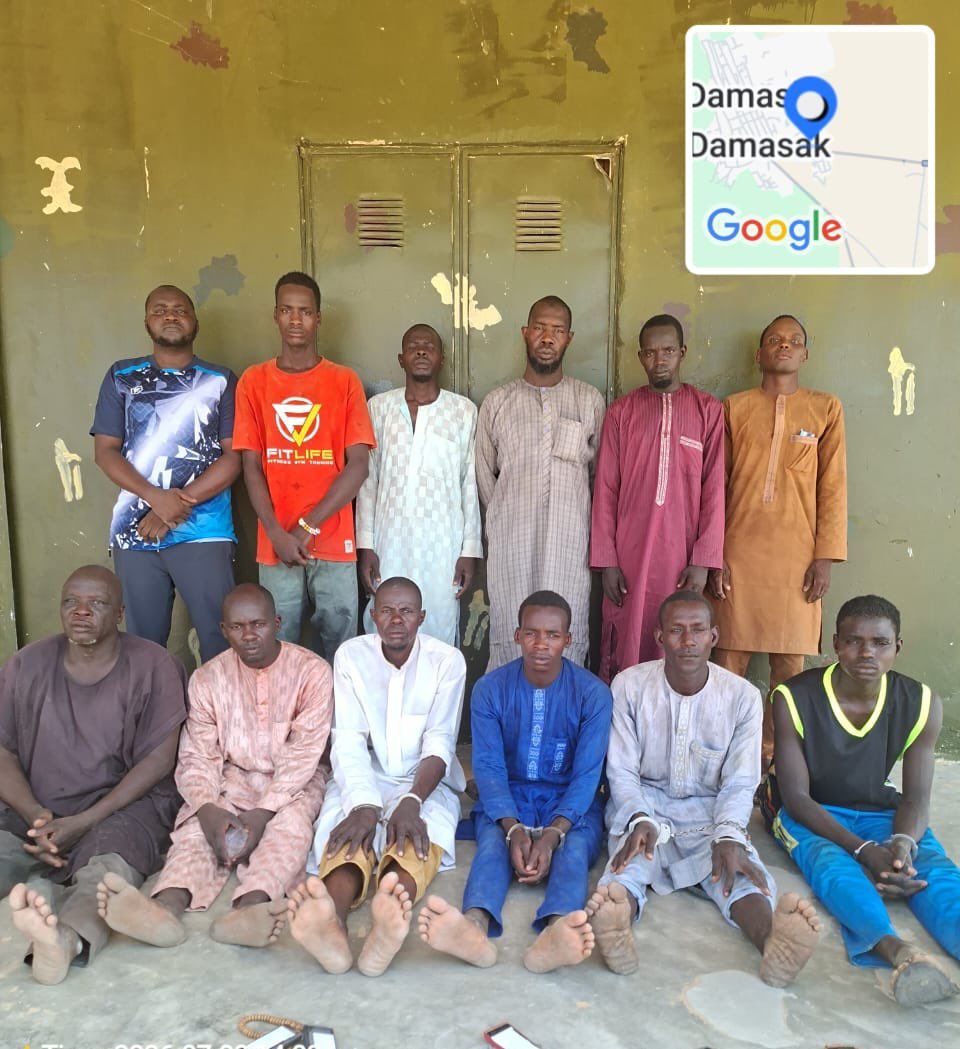
Troops of the Nigerian Army operating under Operation HADIN KAI have arrested 12 suspected collaborators, logistics suppliers, and informants believed to be working for the Boko Haram terrorist group and the Islamic State West Africa Province (ISWAP) during a series of intelligence-driven operations conducted in Damasak, Borno State.
The coordinated operation, executed by personnel of the 5 Brigade, marks another significant breakthrough in the military’s sustained efforts to dismantle terrorist support networks operating across the Lake Chad region, where insurgents have continued to rely on civilian collaborators for logistics, intelligence gathering, recruitment, and the movement of supplies.
Security sources disclosed that the operation was led by the Acting Commander of the 5 Brigade, Colonel S.O. Bello, in the early hours of July 2, 2026, following actionable intelligence generated from the interrogation of an earlier suspect apprehended by troops.
According to the sources, the operation began after soldiers arrested one Mustapha Goni Ahmed at the Kadauri Cattle Market in Damasak during a separate intelligence-led operation. Investigators reportedly subjected Ahmed to extensive interrogation, during which he allegedly provided critical information regarding the activities of suspected terrorist collaborators operating within the brigade’s area of responsibility.
Military intelligence sources said Ahmed identified several locations allegedly being used by members of Boko Haram and ISWAP supporters for meetings, planning sessions, logistics coordination, and the exchange of sensitive information.
The suspect was also said to have provided details concerning individuals allegedly involved in facilitating the movement of supplies, serving as informants, and maintaining communication channels for terrorist elements operating in parts of northern Borno State.
Acting on the intelligence obtained during the interrogation, the military immediately launched carefully coordinated cordon-and-search operations across multiple identified locations within Damasak.
The operations were carried out simultaneously to prevent suspects from escaping or alerting one another, resulting in the successful arrest of 12 additional individuals believed to be linked to the insurgents’ support network.
According to security sources, those arrested include Alhaji Dala Kawomi, 45; Bulama Mallum Kyari, 38; Shatamari Gabo Kyari, 30; Tujja Saloma, 20; Massa Mairami, 70; Bulama Chari Fannai, 36; Mustapha Mohammed, 28; Bukar Bulama, 23; Bunu Madu, 25; Awari Baba Goni, 23; Hassan Madu, 34; and Chellu Malari, 60.
Military authorities believe the suspects played varying roles within the terrorist support structure, including supplying logistics, gathering intelligence, facilitating communications, and providing other forms of assistance that enabled insurgents to sustain their operations in the region.
Although investigators are yet to publicly disclose the specific role attributed to each suspect, security officials described the arrests as a major disruption of an important support network allegedly serving both Boko Haram and ISWAP.
During the operations, troops also recovered several items believed to be of investigative value.
The recovered exhibits include three Tecno mobile phones, one Itel mobile phone, one Infinix smartphone, and a cash sum of N7,360.
Security sources explained that the electronic devices are expected to undergo detailed forensic examination as part of ongoing investigations aimed at identifying communication patterns, financial transactions, contacts, and possible links to terrorist commanders and other collaborators still at large.
Investigators are also expected to analyse digital information stored on the recovered devices in an effort to uncover additional members of the suspected network and establish the full extent of their activities.
According to military sources, the suspects are currently undergoing preliminary screening and documentation by intelligence personnel before being transferred to the Joint Intelligence Fusion Centre (JIFC) in Maiduguri for comprehensive profiling and further investigation.
The Joint Intelligence Fusion Centre serves as one of the military’s specialised intelligence hubs responsible for coordinating information from various security agencies involved in counter-insurgency operations across the North-East.
Officials at the centre are expected to conduct detailed interviews with the suspects, verify intelligence obtained during the initial operation, and determine whether additional arrests or follow-up operations are required.
Security sources indicated that the information gathered from the suspects could assist ongoing efforts to identify financiers, recruiters, logistics coordinators, informants, and other civilian collaborators who provide critical support to insurgent groups operating in the Lake Chad Basin.
Military authorities described the latest operation as another important success in their broader counter-intelligence strategy designed to weaken terrorist organisations by targeting not only armed fighters but also the civilian networks that sustain their operations.
According to the sources, disrupting logistics chains, intelligence gathering mechanisms, financial support systems, and recruitment networks remains central to the operational objectives of Operation HADIN KAI.
They explained that terrorist groups often depend heavily on local collaborators to obtain food supplies, fuel, medicine, transportation, communication equipment, and information on troop movements, making such networks vital targets in counter-insurgency campaigns.
The latest arrests are therefore viewed as a significant blow to the operational capabilities of insurgent groups active in parts of Borno State and neighbouring communities around the Lake Chad region.
Military officials also disclosed that intelligence-driven operations remain ongoing, with additional surveillance and monitoring activities being conducted to identify other suspected collaborators linked to the network uncovered during the investigation.
They noted that further arrests could follow as investigators continue analysing evidence recovered during the operation and interrogating the suspects currently in custody.
The Nigerian military has increasingly relied on intelligence-led operations in recent years as part of its evolving counter-terrorism strategy, combining human intelligence, electronic surveillance, community engagement, and inter-agency collaboration to dismantle insurgent cells and prevent future attacks.
Security analysts have consistently argued that defeating insurgency requires not only confronting armed combatants on the battlefield but also dismantling the extensive support structures that enable terrorist groups to recruit members, procure supplies, raise funds, and evade security operations.
Operation HADIN KAI has continued to intensify military offensives against Boko Haram and ISWAP across the North-East, with troops conducting clearance operations, ambushes, raids on suspected hideouts, rescue missions, and intelligence-based arrests aimed at restoring lasting peace and security to communities affected by years of insurgency.
Military authorities reaffirmed their commitment to sustaining the momentum of ongoing operations and urged members of the public to continue providing credible and timely information capable of assisting security agencies in identifying terrorist elements and their collaborators.
They emphasized that community cooperation remains essential in defeating terrorism and assured residents that every piece of credible intelligence received would be treated with confidentiality and acted upon promptly as security forces continue efforts to eliminate insurgent threats and restore stability across the North-East.