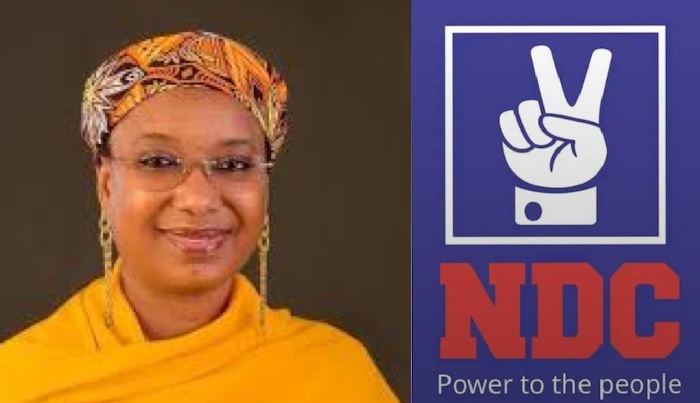
The Nigeria Democratic Congress has recorded a significant political gain with the formal defection of Senator Aishatu Dahiru Ahmed Binani, the 2023 governorship candidate of the All Progressives Congress in Adamawa State, who has now aligned with the party as momentum builds toward the 2027 general elections.
Binani’s move represents the latest in a series of strategic political shifts unfolding across Nigeria’s opposition space. Her decision to join the NDC comes only months after she exited the African Democratic Congress, underscoring the fluidity of alliances and the ongoing recalibration of political forces nationwide.
Party leaders within the NDC have described her defection as a major boost, both symbolically and structurally, as the party continues efforts to expand its national footprint and consolidate its position as an alternative platform for emerging coalitions.
The former senator was formally received into the party in Abuja at a ceremony attended by key figures, including the party’s National Leader, Henry Seriake Dickson, the National Chairman, Moses Cleopas, and members of the National Working Committee (NWC). The event marked a high-profile endorsement of her entry into the party and signaled the leadership’s readiness to integrate influential political actors into its structure.
Speaking during the reception, Binani explained that her decision was guided by a careful assessment of the NDC’s ideological framework and governance principles. She pointed to the party’s constitutional provisions and emphasis on structured, policy-driven governance as key factors that influenced her choice.
“The answer is very simple,” she said. “Going by the constitution of the NDC, I saw that the party focuses on structured, policy-driven governance.”
Beyond ideological alignment, Binani indicated that her move was also shaped by grassroots political realities. She emphasised that the interests and preferences of her supporters played a central role in her decision-making process, noting that many of them had already gravitated toward the NDC prior to her formal declaration.
“My priority and my first interest is the interest of my supporters,” she stated, adding that the political base she commands in Adamawa had already begun repositioning itself within the new party framework.
In a notable claim, she asserted that Adamawa State now ranks among the states with the highest number of registered members within the NDC, reflecting a growing acceptance of the party at the grassroots level. This development, if sustained, could significantly alter the political dynamics in the state ahead of the next election cycle.
Binani expressed appreciation to the party leadership for the reception accorded her and pledged to play an active role in strengthening the NDC’s structures both within Adamawa State and across the country. She stressed the importance of building a cohesive and inclusive political platform capable of competing effectively on the national stage.
“We will try our best to see that we build this NDC back at home in Adamawa State, and also at the national level, we will contribute our quota,” she said.
She also underscored the need for internal party discipline and democratic integrity, calling on the leadership to uphold principles of fairness, transparency, and inclusiveness in its operations. According to her, sustaining these values will be critical to the party’s credibility and long-term success.
Welcoming her into the party, Senator Henry Seriake Dickson described the NDC as an open and inclusive platform designed to accommodate Nigerians seeking credible political alternatives. He emphasised that the party is committed to harnessing the energy, experience, and ideas of new entrants in order to build a robust and forward-looking political organisation.
“This party is open, inclusive, and ready to harness your energy, ideas, and strength,” Dickson said, highlighting the importance of unity and collaboration in achieving the party’s broader objectives.
As part of her integration into the party structure, Binani was immediately assigned a leadership role in Adamawa State, with a mandate to work alongside other party stakeholders to strengthen grassroots mobilisation, deepen party structures, and foster internal cohesion.
Dickson also used the occasion to call for increased participation of women and young people in the political process. He noted that the NDC has adopted affirmative action measures aimed at enhancing the representation of these groups, positioning the party as a progressive platform committed to inclusive governance.
“Every Nigerian has the constitutional right to join any political party at any time—and to leave at any time,” he stated, reinforcing the democratic principles underpinning political participation.
Employing a metaphor to illustrate the rationale behind political defections, Dickson added, “If the vehicle you boarded is no longer taking you to your destination, you have every right to step down and board a better one. The NDC is that better vehicle.”
Binani remains one of the most prominent political figures in Adamawa State and across northern Nigeria. Her political profile was significantly elevated during the 2023 governorship election, where she emerged as a formidable challenger to the incumbent governor, Ahmadu Fintiri. Her performance in that election consolidated her reputation as a major force within the region’s political landscape.
Analysts believe her defection could have far-reaching implications for political alignments in Adamawa State, particularly as parties begin early preparations for the 2027 elections. Her influence, combined with her established support base, is expected to strengthen the NDC’s presence in the North-East and enhance its competitiveness.
At a broader level, her move reflects a continuing trend of political realignments as parties and individuals reposition themselves in response to evolving electoral dynamics. For the NDC, attracting high-profile figures such as Binani is a strategic step toward building national relevance and credibility.
As the countdown to 2027 gathers pace, developments such as this are likely to reshape alliances, redefine party strengths, and influence the trajectory of Nigeria’s political contest. Binani’s entry into the NDC not only reinforces the party’s expansion drive but also signals the emergence of new political configurations that could play a decisive role in the next general elections.