Fresh divisions have emerged within Nigeria’s opposition landscape following the high-profile Ibadan summit, as factions within major political parties ADC and PDP have openly disowned the gathering and rejected its resolutions, including a proposed plan to field a single presidential candidate against President Bola Tinubu in the 2027 general elections.
Key factions of the Peoples Democratic Party (PDP), African Democratic Congress (ADC), Labour Party Nigeria, and the Accord Party Nigeria have all distanced themselves from the summit, insisting that it does not reflect their official positions or strategic direction. The development has cast doubt on the viability of a united opposition front ahead of the next electoral cycle.
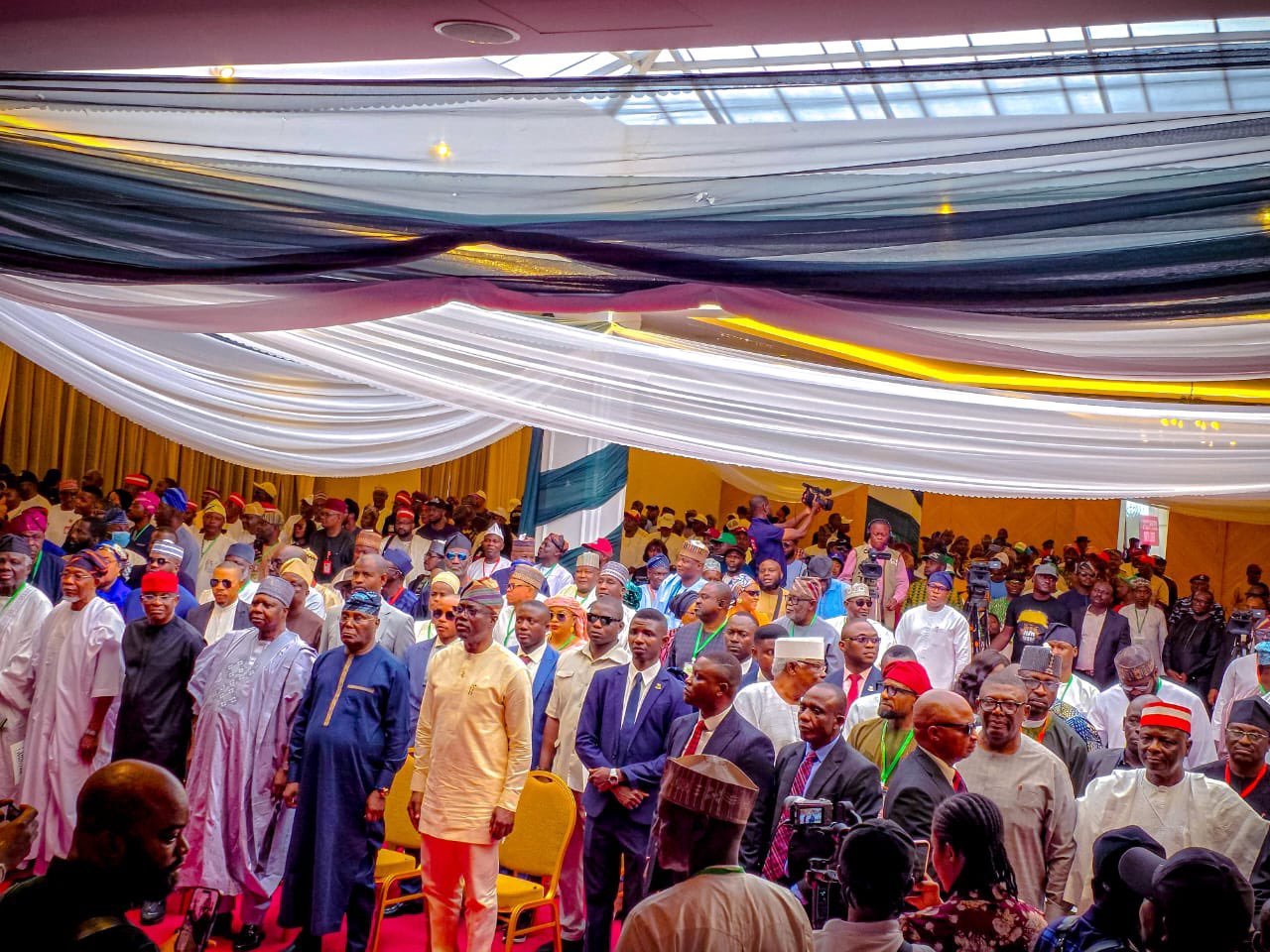
The controversy stems from the opposition summit held in Ibadan, Oyo State, where a coalition of political actors resolved to work toward presenting a single presidential candidate in 2027. The meeting, attended by several prominent opposition figures, was framed by its organisers as a decisive step toward consolidating political forces against the ruling All Progressives Congress (APC).
However, almost immediately after the summit, dissenting voices emerged from within the participating parties, exposing deep internal fractures and competing claims to legitimacy.
The PDP’s National Working Committee faction aligned with the Minister of the Federal Capital Territory, Nyesom Wike, strongly rejected the summit, describing its conveners as “impostors” who lacked the authority to represent the party. The group further alleged that notable opposition figures, including former Vice President Atiku Abubakar, former Senate President David Mark, and other political leaders, had been misled into participating.
In a pointed reaction, the PDP faction maintained that while it remains open to alliances, any such engagement must be conducted through legitimate party structures. Its National Publicity Secretary criticised those who attended the summit under the PDP banner, insisting they were acting outside the bounds of party authority and, in some cases, were restrained by court orders from assuming leadership roles.
The faction further emphasised that the PDP has not entered into any coalition arrangement with other political parties and remains committed to fielding its own presidential candidate in 2027. According to the group, the party retains its status as Nigeria’s leading opposition platform and should be at the centre of any credible alliance discussions.
The dispute also exposed internal tensions within the ADC, where multiple factions rejected any association with the Ibadan meeting. A bloc aligned with former presidential candidate Dumebi Kachikwu, represented by key figures within the party, denied participation in the summit and dismissed its resolutions.
Leaders of the faction argued that the party’s priority should be resolving its internal leadership crisis rather than engaging in premature coalition-building. They stressed that without internal cohesion, any external alliance would lack credibility and sustainability.
Another faction of the ADC, led by Nafiu Gombe, took a similar position, categorically rejecting both the summit and its outcomes. Representatives of the group insisted that the party remains independent and will field candidates for all elective positions, including the presidency.
According to the faction, the Ibadan summit was more of a convergence of aggrieved politicians than a legitimate gathering of party representatives. They maintained that the ADC, with its long-standing presence in Nigeria’s political system, would not subordinate its structures or decisions to an externally driven coalition.
The Labour Party Nigeria also distanced itself from the summit, signalling a cautious approach to coalition politics. The party’s Interim National Chairman, Nenadi Usman, clarified that the party did not authorise participation in the meeting and is currently focused on internal restructuring ahead of its forthcoming convention.
Through her media aide, Usman stated that while the party remains open to future alliances, its immediate priority is to stabilise its leadership and organisational framework. She added that any decision regarding coalition politics would be formally communicated to Nigerians when appropriate.
Similarly, the Accord Party Nigeria rejected any link to the summit, warning that its name and identity may have been used without authorisation. The party indicated that it is considering legal action against individuals or groups falsely claiming to represent it at the gathering.
Despite the backlash from opposition factions, the summit itself attracted several prominent political figures, including Atiku Abubakar, Peter Obi, Rabiu Kwankwaso, Rotimi Amaechi, and other influential actors. The meeting was hosted by Oyo State Governor Seyi Makinde, who used the platform to caution against what he described as attempts to suppress political pluralism in Nigeria.
Makinde referenced the historical “Operation Wetie” crisis of 1965—a period of intense political violence in Western Nigeria—as a reminder of the consequences of political exclusion and electoral manipulation. His remarks, however, drew sharp criticism from the ruling APC, which accused him of making inflammatory statements capable of inciting unrest.
In its response, the APC rejected what it described as attempts by opposition leaders to use “blackmail” to gain political advantage. The ruling party also questioned the legitimacy of the summit and dismissed the coalition effort as lacking coherence.
The communique issued at the end of the Ibadan meeting had warned against the emergence of a one-party state and pledged resistance to any such development. It also outlined a plan for opposition parties to unite behind a single presidential candidate in 2027, a strategy seen by some analysts as necessary to challenge the APC’s electoral dominance.
However, the swift rejection of the summit by multiple party factions underscores the depth of fragmentation within Nigeria’s opposition. Analysts note that without internal unity and clear leadership structures, efforts to build a broad-based coalition may struggle to gain traction.
The unfolding developments highlight a familiar challenge in Nigerian politics—balancing individual ambitions with collective strategy. While the idea of a unified opposition front has gained traction in public discourse, the practical realities of party politics, legal disputes, and leadership rivalries continue to complicate its realisation.
As the 2027 elections approach, the ability of opposition parties to reconcile their differences and present a cohesive alternative will likely play a decisive role in shaping the country’s political trajectory. For now, the fallout from the Ibadan summit suggests that such unity remains elusive.