Tensions between the United States and the United Kingdom have escalated following fresh threats by President Donald Trump to impose sweeping tariffs on British goods in response to the UK’s Digital Services Tax (DST), a policy that has long been a source of friction between Washington and London.
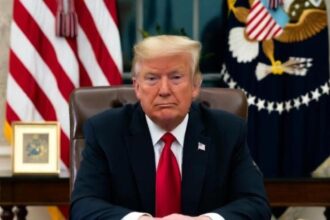
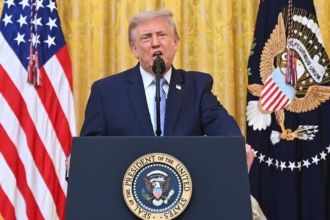
Speaking during a press briefing at the White House, Trump sharply criticised the UK’s tax regime, which imposes a 2 per cent levy on the revenues of large digital technology companies operating within British territory. Many of the firms affected by the policy are major American corporations, a point that has consistently drawn objections from successive US administrations.
Trump made it clear that his government views the tax as unfairly targeting American businesses. “We don’t like it when they target American companies because basically you’re talking about our great American companies,” he said. He went further to warn that the United States could retaliate economically if the policy remains unchanged. “We can meet that very easily by just putting a big tariff on the UK, so they better be careful,” he added.
The UK’s Digital Services Tax was introduced in 2020 as part of efforts to ensure that multinational technology firms pay a fair share of tax in jurisdictions where they generate significant revenue. The measure was designed to address perceived gaps in international tax rules, which often allow large digital companies to report profits in low-tax jurisdictions despite substantial operations elsewhere.
Since its introduction, the tax has reportedly generated approximately £800 million annually for the British government. However, it has been a persistent point of contention with the United States, which argues that the policy disproportionately affects American technology giants and undermines fair trade principles.
Trump reiterated this position during his remarks, suggesting that the UK was attempting to extract revenue unfairly from US firms. “They think they’re going to make an easy buck—that’s why they’ve all taken advantage of our country,” he said. “If they don’t drop the tax, we’ll probably put a big tariff on the UK.”
He emphasised that his administration has a responsibility to defend American economic interests, stating that he has an “obligation to protect” US companies from what he perceives as discriminatory policies abroad.
The dispute comes at a time when relations between the two long-standing allies are facing increasing strain over a range of issues. While the US and UK have traditionally maintained a close strategic and economic partnership, recent disagreements—including diverging positions on global security matters such as tensions involving Iran—have added complexity to the bilateral relationship.
Trump’s latest comments have heightened concerns that trade tensions could further complicate diplomatic ties, particularly if retaliatory measures are implemented.
In response to the US president’s remarks, the UK government, led by Prime Minister Keir Starmer, adopted a more conciliatory tone. A government spokesperson sought to downplay the dispute, emphasising the importance of maintaining strong transatlantic relations.
“The US is our closest ally, and we’ll always talk to them about any issues,” the spokesperson said. “We’ve got a very constructive relationship with the US across many issues.”
The current standoff reflects a broader, ongoing global debate over how to tax digital economies effectively. Several European countries have introduced or considered similar digital taxes, prompting repeated objections from Washington. The United States has argued that such unilateral measures should be replaced by a coordinated international framework, rather than country-specific taxes that may trigger trade disputes.
Trump has previously warned that digital taxes imposed by foreign governments could lead to retaliatory actions, including tariffs and restrictions on technology exports. His latest comments suggest that such measures remain firmly on the table.
Business leaders have also expressed concern about the potential economic fallout from an escalating trade conflict. William Bain of the British Chambers of Commerce noted that uncertainty surrounding tariffs is already creating challenges for companies trying to plan ahead.
“While a new 10% tariff rate, instead of the threatened 15%, will provide some relief, it shows how difficult it is for businesses to plan ahead,” Bain said. “It is far from clear what will happen next and whether a higher tariff rate is still on the way.”
He warned that the risk of further escalation remains significant, urging policymakers to prepare for multiple scenarios, including the possibility of more aggressive trade measures.
Analysts say that any move by the United States to impose tariffs on UK goods could have wide-ranging consequences, affecting industries on both sides of the Atlantic. Key sectors such as manufacturing, agriculture, and technology could face increased costs, disrupted supply chains, and reduced market access.
For the UK, the dispute comes at a sensitive time as it continues to recalibrate its global trade relationships in the post-Brexit era. Maintaining stable economic ties with the United States is widely seen as a strategic priority, making the potential for a tariff dispute particularly concerning.
At the same time, the UK government faces domestic pressure to ensure that multinational corporations contribute fairly to public finances, especially in an era of rising economic demands and fiscal constraints.
Despite the heated rhetoric, observers note that both countries have strong incentives to avoid a full-scale trade conflict. Diplomatic engagement and negotiation are likely to remain central to resolving the dispute, particularly as global efforts continue toward establishing a unified approach to digital taxation through international bodies.
For now, however, Trump’s threat underscores the fragility of the current situation. As both sides weigh their options, the outcome of this dispute could set an important precedent for how digital taxation conflicts are handled in the future.
Whether through compromise or confrontation, the evolving standoff between Washington and London highlights the growing intersection of technology, taxation, and geopolitics in the modern global economy.