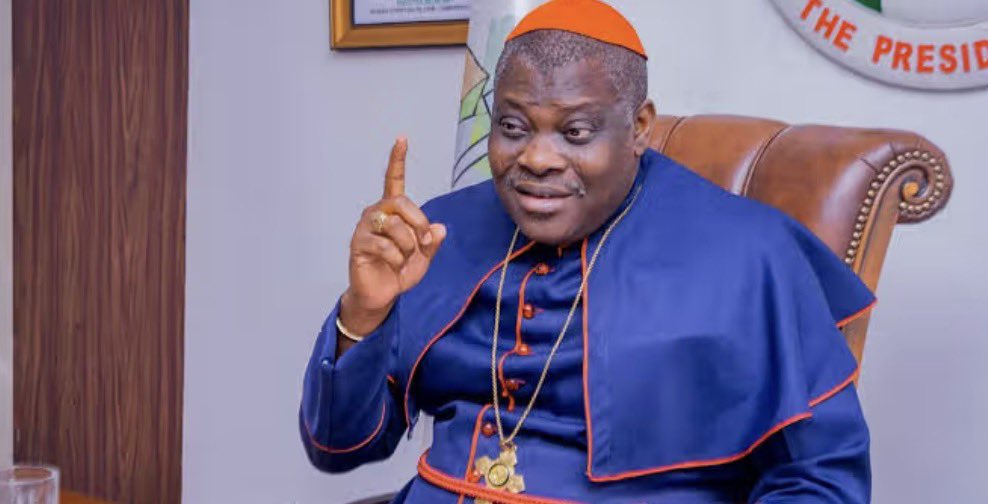
The Executive Secretary of the Nigerian Christian Pilgrims Commission (NCPC), Bishop Stephen Adegbite, has said that supporting a preferred presidential candidate should not involve denigrating other contenders, urging political and religious leaders to promote their candidates based on their achievements rather than through attacks on opponents.
Adegbite, who is also a Methodist bishop, made the remarks on Friday during an interview on TVC while reacting to recent comments by Cardinal John Onaiyekan, former Archbishop of Abuja, following a meeting between the Catholic Bishops’ Conference of Nigeria (CBCN) and President Bola Tinubu at the Presidential Villa.
The controversy arose after the leadership of the CBCN, led by Archbishop Matthew Ndagoso, met with President Tinubu on July 28 and raised concerns about the country’s security situation, economic hardship, governance challenges and other national issues.
Speaking after the meeting, Cardinal Onaiyekan said some individuals around the President were presenting a “rosy picture” of the country that did not reflect the realities faced by many Nigerians. He also expressed concern that the government appeared determined to win future elections “by all means,” remarks that generated widespread public debate.
The cardinal’s comments prompted reactions from several government officials and political figures, some of whom accused him of partisanship and questioned the propriety of his public remarks after the meeting.
Reacting to the development, Adegbite said every Nigerian has the constitutional right to support any political candidate of choice, including religious leaders, but stressed that such support should not be used as a basis for attacking other candidates or questioning the legitimacy of elected officials.
Referring to events after the 2023 presidential election, Adegbite recalled that Onaiyekan had said he would not recognise Tinubu as president until the Supreme Court delivered its judgment on the election petitions.
“In 2023, when Tinubu was declared winner, Cardinal Onaiyekan said he would not recognise Mr President until the Supreme Court verdict, which is normal,” Adegbite said.
“But we said Nigerians have voted. That is what the people decided. To now say we do not have a president is where we differed with him because we believe Nigeria has a president.”
He maintained that disagreement over electoral outcomes is permissible within a democracy, but insisted that once constitutional processes have run their course, political actors and citizens should respect the outcome.
Adegbite emphasised that having a preferred candidate is not a problem, adding that democracy allows citizens to campaign freely for those they believe can provide better leadership.
“We have no problem with you having your own candidate,” he said.
“You can have your preferred candidate, but do not run down other people’s candidates. Sell your own candidate. Let people see what your candidate has done that qualifies him to become president of Nigeria.”
According to him, supporters of President Tinubu are equally entitled to campaign for him by highlighting what they regard as his accomplishments in office.
“The people who believe in Mr President should also be allowed to present what they see as his achievements. Let the public assess those achievements for themselves,” he added.
The NCPC boss argued that President Tinubu should ultimately be judged by his performance in office rather than by criticism from political opponents or commentators.
“The work of Mr President will speak for him, and that is what people want to see,” he said.
Beyond the issue of political preference, Adegbite also criticised Onaiyekan for speaking publicly about the discussions that took place during the CBCN’s visit to the President.
While acknowledging that the bishops were right to engage the President on national issues, he argued that details of such meetings should remain confidential.
“Their visit is very good, and religious leaders should continue to engage government on national issues,” he said.
“But for anybody to take what happened during the visit outside the Villa and begin making public comments about it after the meeting, I believe that is not proper.”
He added that meetings between religious bodies and the President are often intended to encourage frank and constructive dialogue, which could be undermined if participants immediately provide their own public interpretations of the discussions.
“If a body has visited Mr President, that discussion should remain in confidence,” Adegbite said.
The debate surrounding Onaiyekan’s remarks has reignited broader conversations about the role of religious leaders in politics, freedom of expression, political neutrality and the relationship between faith institutions and the Nigerian state.
Supporters of the cardinal have argued that religious leaders have a moral responsibility to speak truth to power and raise concerns about national conditions, while critics maintain that clergy should avoid statements that could be interpreted as partisan political commentary.
The CBCN has for decades commented on issues such as corruption, insecurity, economic hardship, electoral integrity and social justice under successive administrations, often describing its interventions as part of its pastoral responsibility to promote the common good.
Adegbite said that despite differences in political opinion, religious leaders should continue to pray for the country, encourage peaceful democratic participation and contribute to national development through constructive engagement rather than divisive rhetoric.
He urged all political actors, clergy and citizens to respect differing opinions while working toward peace, stability and the strengthening of Nigeria’s democratic institutions.