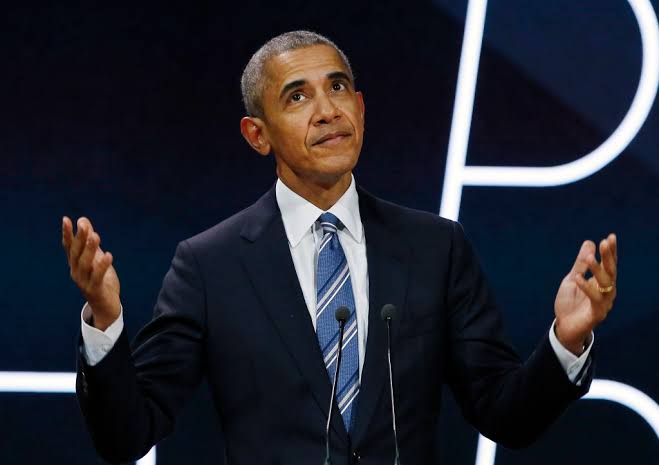
Former United States President Barack Obama has said he believes governments around the world could perform better if women were given an opportunity to lead for two years.
Obama made the remarks during a conversation with Pulitzer Prize-winning historian Doris Kearns Goodwin at Salem State University in Massachusetts on Monday, September 21, 2026. A clip from the discussion was later shared by C-SPAN, generating renewed interest in the former president’s views on women and political leadership.
The event, which formed part of the Salem State Series, attracted about 3,600 people to the university’s O’Keefe Sports Complex, while hundreds of others watched from a satellite location on campus.
Obama was discussing leadership and the importance of creating opportunities for younger generations when he recalled an idea he had while serving in the White House.
“Even when I was president, I sometimes fantasised about if you put women in charge of every government for like two years and then just kind of saw, all right, how are things going?” he said.
The former president acknowledged that such an arrangement would not necessarily result in perfect governments but said he believed the overall outcome would be better.
“I have a strong belief that things would — they wouldn’t be perfect. But they’d be better. I’m confident about that. I really do,” Obama said.
His comments were made in the broader context of a discussion about leadership and the need to provide younger people with opportunities to occupy positions of influence.
Obama has continued to speak publicly about generational change since leaving the White House, including through programmes associated with the Obama Foundation that focus on supporting emerging leaders. Salem State University also noted that the former president used the event to emphasise the importance of giving younger voices greater platforms.
The former president’s latest remarks are not the first time he has expressed the view that greater female leadership could improve governance.
In 2019, during a leadership event in Singapore, Obama similarly suggested that countries could benefit if women were placed in charge for two years. His comments at the time also generated discussion about gender, leadership and political representation.
The subject remains significant globally as women continue to be underrepresented in many political institutions and executive offices.
At the Salem State event, however, Obama did not propose a specific political programme or policy for replacing male leaders with women. Rather, his comments were presented as a hypothetical reflection on what he believed might happen if women were given greater opportunities to lead governments.
The discussion also touched on the political climate in the United States and the degree of division within American society.
Obama argued that Americans at the grassroots level were not as divided as political discourse and media coverage sometimes suggested.
“We’re not as divided as our politics or our media would indicate,” he said, adding that people across the country continued to treat one another with respect.
The observation formed part of a wider conversation about democracy, political disagreement and leadership. Salem State University said the event was designed to encourage civic engagement and dialogue around leadership, democracy, citizenship and public service.
Goodwin, who moderated the conversation, has spent decades studying political leadership and the American presidency. Her work includes biographies of several US presidents and extensive research into leadership during periods of political and social change.
Obama, the 44th president of the United States, served two terms in office from 2009 to 2017. Since leaving the presidency, he has remained active in public discussions on democracy, leadership, civic participation and the development of younger generations.
His comments at Salem State have since circulated widely online, with excerpts from the event attracting renewed attention to his longstanding position on female leadership.
The remarks have also reopened discussion about whether gender affects leadership outcomes and whether greater representation of women in political institutions can influence government decision-making.
Obama’s statement, however, remains a personal assessment and hypothetical proposition rather than a claim based on a controlled comparison of governments led by men and women.
The former president did not identify a particular country or government as an example during the Salem State discussion. Instead, he used the hypothetical scenario to express his belief that giving women greater access to political leadership could produce better results.
As the video continues to circulate, the comments have become part of a broader international conversation about women’s participation in politics, generational leadership and the qualities required to govern effectively.
For Obama, the issue is closely connected to his continuing call for younger generations and people from different backgrounds to receive opportunities to participate in public life.
His Salem State appearance ultimately combined reflections on leadership, political divisions and generational change, with his remarks about women in government emerging as one of the most widely discussed portions of the conversation.