Former presidential candidate Peter Obi has said state visits by world leaders should be focused on delivering measurable economic and developmental benefits to citizens rather than serving as ceremonial outings or public relations exercises.
Obi stated that diplomacy should be strategically tied to economic growth, industrial expansion, job creation, technological advancement and increased national productivity.
According to him, every foreign trip undertaken by a government ought to result in concrete outcomes capable of improving the lives of ordinary citizens.
“State visits by leaders are not tourism, and diplomacy is not a fashion parade,” Obi said.
He stressed that international engagements should produce visible gains such as investments, industrial partnerships, trade agreements, factory expansion, technology transfer and employment opportunities for young people.
The former Anambra State governor referenced the recent visit of United States President Donald Trump to China as an example of how serious nations approach diplomacy with clear economic objectives.
According to Obi, the American delegation reportedly consisted not only of senior government officials but also some of the world’s leading business and technology executives.
He noted that the visit reportedly led to the signing of multi-billion-dollar trade deals, including approximately 200 Boeing aircraft orders.
Obi listed members of the American delegation to include President Donald Trump, Secretary of State Marco Rubio, Secretary of Defence Pete Hegseth, Tesla and SpaceX CEO Elon Musk, Nvidia CEO Jensen Huang, Apple CEO Tim Cook, BlackRock CEO Larry Fink and Blackstone CEO Stephen Schwarzman, among several others.
Other business leaders reportedly present included executives from Boeing, Goldman Sachs, Qualcomm, Visa, Mastercard, Micron Technology, Citigroup, General Electric and Meta.
“That is how serious nations approach diplomacy,” Obi said.
He explained that advanced economies align their foreign policy objectives with economic expansion, innovation, industrial development and national productivity.
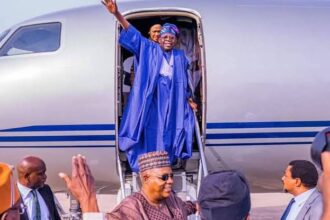
The former governor said he hoped lessons would be learned from such examples when compared with President Bola Tinubu’s recent state visit to the United Kingdom.
Obi questioned the economic value of the Nigerian delegation’s trip, arguing that many Nigerians were yet to see any clear benefits from the visit.
“A large entourage of politicians, aides, and government officials travelled, yet Nigerians are still asking a simple question: what exactly did Nigeria bring home?” he asked.
He demanded clarity on what economic gains were secured during the trip, including investments, industrial agreements and job opportunities.
“Which factories are coming to Nigeria?” Obi asked.
“What power, technology, manufacturing, agricultural or industrial agreements were secured? How many direct jobs will this visit create for Nigerian youths? What investments were attracted? What measurable economic outcomes can the ordinary Nigerian point to?”
According to him, the Nigerian delegation reportedly included President Tinubu and his wife, 12 governors, nine ministers, seven members of the National Assembly, more than 20 senior State House officials, over 30 security personnel, domestic staff and several political associates.
Obi criticised what he described as excessive focus on ceremonial activities during foreign visits while the country continued to grapple with worsening economic conditions.
“It is not enough to ride horses, wear matching uniforms, attend royal banquets, and release glossy photographs,” he stated.
“Symbolism without substance cannot feed hungry citizens.”
The former presidential candidate warned that Nigeria was facing serious national challenges requiring practical and productive leadership.
According to him, the country is currently battling insecurity, rising poverty, unemployment, food shortages, weakening industrial productivity and the declining value of the naira.
He argued that government spending on foreign trips must be justified by visible economic returns, especially at a time when millions of Nigerians are struggling with rising living costs.
“At a time when millions of Nigerians struggle daily to afford food and survive economic hardship, every kobo spent on foreign trips must produce tangible national value,” Obi said.
He maintained that such value should come in the form of investments, factories, infrastructure, export opportunities and jobs capable of improving the country’s economy and lifting citizens out of poverty.
Obi also called for a shift in leadership priorities, urging public officials to place greater emphasis on productivity and measurable outcomes rather than political optics.
“Nigeria needs leadership that is focused less on optics and more on productivity; less on ceremony and more on measurable economic results,” he added.
The former governor concluded by reiterating his long-standing message of hope and national transformation.
“A New Nigeria is Possible,” he said.