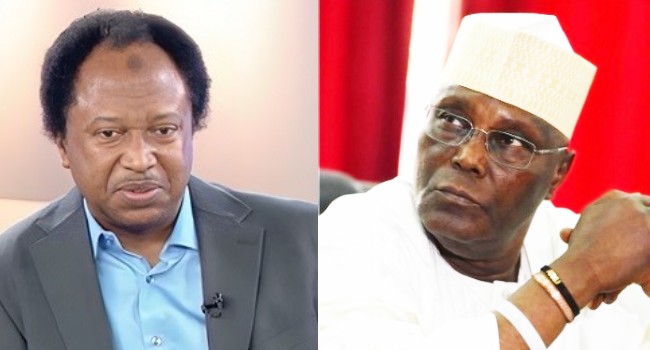
Former Kaduna Central Senator, Shehu Sani, has argued that Nigeria’s informal arrangement of rotating the presidency between the northern and southern parts of the country could be undermined if the presidential candidate of the African Democratic Congress (ADC), Atiku Abubakar, wins the 2027 presidential election.
Sani made the comment during an interview on Channels Television’s Politics Today on Friday, September 25, 2026, while discussing the zoning of presidential tickets and the political implications of the 2027 election.
The former lawmaker said political parties should consider fielding candidates from the southern part of the country in the forthcoming presidential election, arguing that such an arrangement would allow the South to complete what he described as an eight-year tenure before power returns to the North.
“If Atiku wins, it means that is the end of rotational presidency in Nigeria, and there is going to be hard and bitter feelings from the southern part of Nigeria,” Sani said.
He expressed concern that another transfer of presidential power to a northern candidate could generate opposition in parts of the South, particularly given the existing political tensions in the country.
“I don’t think anyone will like to preside over a country full of hate, animosity, and conflict. Right now, the political system is managing a lot of crises,” he said.
Sani, however, stressed that his position should not be interpreted as a call for Atiku to be prevented from contesting the election.
The former senator acknowledged that the Nigerian Constitution does not prohibit Atiku or any other qualified northern politician from seeking the presidency.
“I never said Atiku should not run. Constitutionally, he has a right to run for any election,” Sani said.
He explained that his argument was based on the informal political understanding surrounding rotation rather than a constitutional restriction on eligibility.
“What I said was that a southern part of Nigeria should be allowed to have its eight-year tenure in office, just like the way the North has from 2015 to 2023,” he said.
Sani’s comments reflect an ongoing political debate over zoning and rotational arrangements in Nigeria, where political parties have at different times informally allocated presidential opportunities between the North and South.
Unlike constitutional provisions governing eligibility and tenure, rotational presidency is not a requirement contained in the Nigerian Constitution. It is instead an informal political practice or understanding that parties and political actors may adopt when determining how presidential tickets are distributed.
Sani suggested that political parties should nominate southern candidates for the 2027 election and allow voters to determine the eventual winner.
“The NDC should field Peter Obi, the APM should field Makinde, let the South struggle it out and see who wins for four years,” he said.
He added that after the next four-year term, the North could then have another opportunity to produce the country’s president.
“When the tenure is done by 2031, the North should have its unchallengeable opportunity to produce the leadership of the country,” Sani said.
He also rejected the argument that population or electoral strength should justify continued political dominance by any particular region.
“You cannot say that because you have the largest electorate and population, so you should continue dominating politics,” he said.
Sani’s comments come as political parties intensify preparations for the 2027 general election.
Atiku is the presidential candidate of the ADC, while Peter Obi is the presidential candidate of the Nigeria Democratic Congress (NDC). President Bola Tinubu is expected to seek another term on the platform of the All Progressives Congress (APC), while African Action Congress candidate Omoyele Sowore is also among the declared presidential contenders.
The Independent National Electoral Commission has scheduled the presidential and National Assembly elections for February 20, 2027. INEC formally released the timetable and schedule of activities in February 2026.
The campaign period for presidential and National Assembly elections commenced on September 23, 2026, according to the commission’s published timetable.
As political parties and candidates prepare for the election, questions surrounding zoning, regional representation and the informal rotation of presidential power are expected to remain part of the national debate.
Sani’s intervention adds another perspective to that discussion, while his acknowledgement of Atiku’s constitutional right to contest underscores the distinction between the country’s formal legal framework and informal political arrangements.
Ultimately, whether political parties maintain, modify or abandon zoning arrangements remains a matter for the parties and the electorate within the constitutional and electoral framework governing the 2027 election.