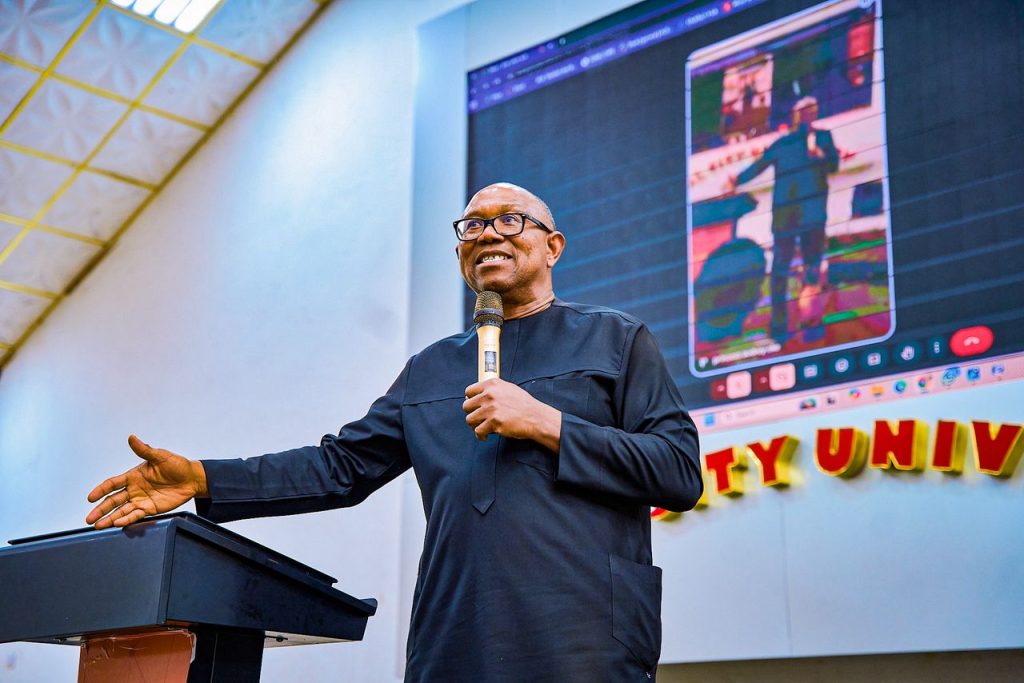
Former presidential candidate of the Labour Party, Peter Obi, has expressed deep concern over what he described as a growing pattern of cancelled academic engagements across Nigerian universities, warning that the trend signals a broader threat to intellectual freedom and open discourse in the country.
In a statement shared on Saturday via his official X (formerly Twitter) account, Obi revealed that he had been scheduled to deliver a keynote lecture at Obafemi Awolowo University by 9 a.m., before proceeding to Ibadan for a major opposition political summit slated for noon. However, he said he was informed shortly before the event that the university engagement had been abruptly called off, without clear justification.
The former Anambra State governor described the incident as part of a disturbing and recurring pattern rather than an isolated development. According to him, similar cancellations have occurred on more than ten occasions in recent times, raising serious concerns about the shrinking space for intellectual engagement within Nigeria’s higher education system.
“While such occurrences may be dismissed individually, it is important to state clearly that this has now happened more than ten times. This is no longer incidental; it points to a troubling pattern that should concern all well-meaning Nigerians,” Obi said.
He further disclosed that even his alma mater, the University of Nigeria Nsukka, had not been spared. Obi cited the cancellation of an inaugural annual lecture organised by the family of the late Professor Frank Ndili, a former Vice Chancellor of the institution. According to him, the event was called off by university authorities on the very day it was scheduled to take place, a move he described as both surprising and disappointing.
Obi’s remarks come amid increasing scrutiny of academic freedom in Nigeria, with critics warning that universities—traditionally seen as bastions of free thought and debate—may be facing subtle but significant pressures that limit open engagement on political and social issues.
Drawing a sharp contrast with his recent international experiences, Obi noted that within the past two years, he had delivered lectures at several of the world’s leading academic institutions without any form of restriction. He listed universities such as University of Oxford, University of Cambridge, Harvard University, Yale University, Princeton University, University of Chicago, University of Pennsylvania, and Imperial College London, among others.
According to him, these institutions continue to exemplify an environment where dialogue, critical thinking, and the exchange of ideas are encouraged, regardless of differing viewpoints. He argued that such openness is essential for intellectual growth and societal development, adding that Nigerian universities should strive to uphold similar standards.
“Those environments continue to demonstrate openness to dialogue, critical thinking, and shared learning—values that should equally define our own institutions,” he stated.
Obi questioned what the repeated cancellations of academic engagements suggest about Nigeria’s broader trajectory, particularly in relation to democratic values and knowledge development. He warned that restricting platforms for intellectual exchange could have far-reaching consequences for the nation’s progress.
“We must ask ourselves: what kind of nation are we building if spaces meant for intellectual engagement are gradually shrinking?” he asked. “A country’s progress is anchored on its ability to encourage knowledge, debate, and the contest of ideas, not restrict them.”
The former governor stressed that universities play a critical role in shaping national discourse and fostering innovation. As such, he argued, any attempt—whether overt or subtle—to limit intellectual engagement within these institutions undermines their core mission.
Observers say Obi’s comments are likely to resonate within academic and civil society circles, where concerns about freedom of expression and institutional autonomy have been growing. While some university authorities may cite administrative or security considerations for event cancellations, critics argue that a pattern of such decisions could point to deeper systemic issues.
Obi, however, stopped short of directly accusing any specific institution or authority, instead calling for a broader reflection on the state of intellectual freedom in the country. He urged stakeholders, including university administrators, policymakers, and the public, to safeguard spaces for open dialogue and ensure that academic institutions remain true to their foundational principles.
He concluded by emphasizing the need for Nigeria to evolve into a society where ideas can be freely expressed without fear of suppression, and where institutions of learning serve as platforms for constructive engagement rather than restriction.
“We must consciously choose to build a society where knowledge is shared without fear, where ideas are exchanged freely, and where our institutions remain faithful to the principles upon which they were founded,” Obi said.
As debates around academic freedom continue to unfold, the recurring cancellations highlighted by Obi may prompt further scrutiny of how universities balance administrative control with their responsibility to promote open and inclusive intellectual discourse.