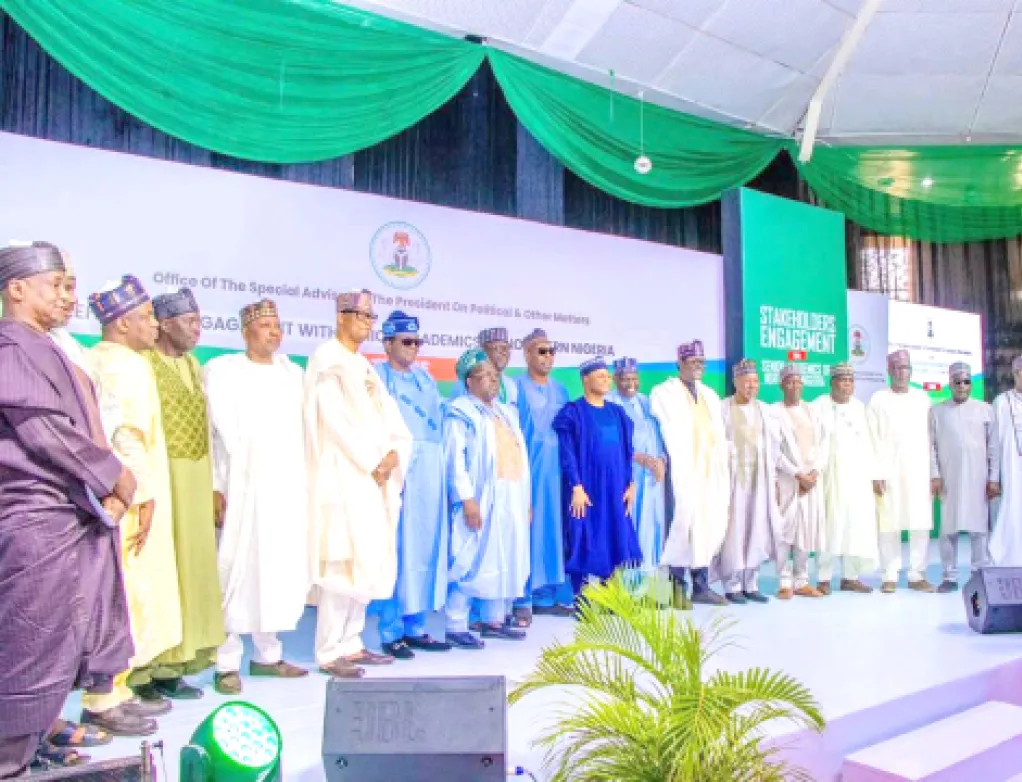
More than 600 senior academics drawn from public universities and higher institutions across Northern Nigeria have endorsed President Bola Ahmed Tinubu for a second term in office ahead of the 2027 presidential election.
The endorsement followed a stakeholders’ engagement convened by the Special Adviser to the President on Political Matters, Ibrahim Masari, to discuss the political, economic and social conditions in the country and assess the performance of the Tinubu administration since it assumed office in May 2023.
The meeting was held behind closed doors at the Umaru Musa Yar’Adua Centre in Kaduna State.
Journalists were initially barred from entering the venue but were later permitted to witness the reading of the communiqué issued at the conclusion of the deliberations.
The gathering attracted senior political figures, academics and government officials, including Masari; Kaduna State Governor, Uba Sani; Zamfara State Governor, Dauda Lawal; Yobe State Governor, Mai Mala Buni; Borno State Governor, Babagana Zulum; and Gombe State Governor, Inuwa Yahaya.
Also present were the Minister of Defence, Bello Matawalle; Minister of Housing and Urban Development, Muttaqha Rabe Darma; and former Katsina State Governor, Aminu Bello Masari.
A source who attended the meeting said most public universities across the 19 northern states were represented, with participants drawn from the North-West, North-Central and North-East geopolitical zones.
The Vice-Chancellor of Kaduna State University, Professor Abdullahi Ibrahim Musa, reportedly spoke on behalf of academics from institutions in the North-West. The Chief Librarian of the Federal University of Lafia, Professor Abdulrazaq Baba Abdulrahman, represented the North-Central, while the Chairman of the Governing Council of the Federal College of Agriculture, Gwoza, spoke on behalf of the North-East.
Professor Mohammed Umar Sanda of the Federal University Dutsinma was also among those reported to have attended.
However, Professor Mainasara Yakubu Kurfi of Bayero University, Kano, whose name was mentioned by a source as an attendee, denied participating in the meeting when contacted. He said he was not aware of such a gathering.
The meeting’s communiqué, read by Professor Musa, stated that the academics had critically reviewed the performance of the Tinubu administration, including its economic policies and its handling of security, education, infrastructure and social development.
The academics acknowledged that Tinubu inherited an economy facing significant fiscal, monetary and structural difficulties, alongside insecurity, infrastructure deficits and gaps in human capital development.
They also recognised that some of the administration’s economic reforms had increased hardship for Nigerians, particularly through higher living and transportation costs and inflationary pressures.
“While these reforms have imposed substantial short-term hardship through higher living and transportation costs and inflationary pressures, we also acknowledge that they have altered government revenues and public finance,” the academics stated.
Despite the difficulties, the academics said they had identified areas where they believed the administration had recorded progress.
Among the areas highlighted were education financing, agriculture, infrastructure development, support for businesses, compressed natural gas, investment and the digital economy.
Following their deliberations, the academics declared their support for Tinubu’s re-election bid.
“We resolved to express our support for the re-election of President Bola Ahmed Tinubu, GCFR, in the 2027 presidential election,” they said.
The endorsement, however, came with conditions.
The academics stressed that their decision should not be interpreted as an unconditional commitment or a “blank cheque” for the administration.
They urged the government to remain responsive to citizens, listen to legitimate criticism and take stronger measures to address the economic pressures confronting Nigerians.
In particular, they called for urgent action to reduce high food and transportation costs, unemployment and insecurity.
They also urged the Federal Government to strengthen its security strategy by combining military operations with intelligence gathering, effective policing, community engagement and the creation of economic opportunities for citizens.
The academics further called for increased investment in agriculture, education, healthcare, roads, electricity, irrigation and other critical infrastructure, particularly across Northern Nigeria.
Meeting Designed to Mobilise Support
The meeting was presented publicly as an opportunity for senior academics to assess the performance of the administration and deliberate on Nigeria’s political future.
However, an invitation letter sighted by Daily Trust indicated that securing the active support of the academic community for Tinubu’s re-election was one of the principal objectives of the engagement.
The letter described the gathering as an “interactive session of senior academics from Northern Nigeria and selected government functionaries” under the theme, “Consolidating the Renewed Hope Agenda: Three Years of President Bola Ahmed Tinubu’s Achievements and the Road to 2027.”
According to the invitation, the meeting had two primary objectives: assessing the administration’s performance in the economy, security, education, infrastructure and social welfare, and securing the endorsement and active support of academics for Tinubu’s re-election in the 2027 general elections.
The letter made the political objective particularly explicit, stating that the purpose of the gathering was “not open-ended debate but mobilisation.”
It also stated that attendance was voluntary and encouraged academics who were favourably disposed towards the objective of the meeting to participate.
Organisers reportedly made arrangements for transportation and other logistics for participants attending the engagement.
A senior staff member of one of the universities, who was not present at the meeting, suggested that participants were likely to be reimbursed for their transportation and other expenses. However, the amount of any reimbursement or payment made to individual participants could not be independently verified.
Masari Urges Academics to Participate in Politics
In his address, Masari urged academics to play a more active role in Nigeria’s political process rather than remaining on the sidelines while criticising government policies.
The presidential adviser argued that the administration’s achievements in the education sector provided a reason for academics to participate in determining the country’s political direction.
He encouraged members of the academic community to contribute to political discussions and become more involved in shaping the nation’s leadership.
The endorsement comes as political activities intensify ahead of the 2027 presidential election.
With the Tinubu administration seeking another term, supporters of the President have increasingly focused on building alliances and securing endorsements from influential groups, particularly across Northern Nigeria.
The academics’ declaration therefore represents another significant endorsement for Tinubu, although their accompanying conditions indicate that their support is tied to expectations of greater government responsiveness on economic hardship, security, employment and infrastructure.
Their position also underscores the growing political importance of the academic community, whose members occupy influential positions in education, research and public discourse across the country.