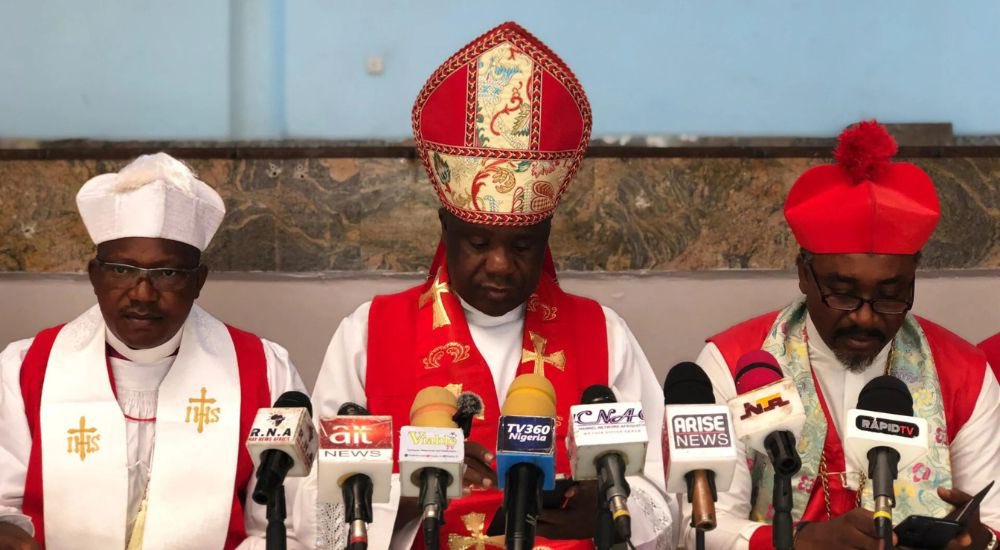
The Charismatic Bishops Conference of Nigeria (CBCN) has endorsed President Bola Ahmed Tinubu for a second term in office ahead of the 2027 presidential election, pledging continued support for his administration through prayers and advocacy.
The endorsement was announced on Wednesday by the President-General of the conference, Archbishop Leonard Bature Kawas, during the organisation’s 2026 synod.
Kawas said the decision followed the group’s assessment of the Tinubu administration and its policies, as well as what he described as the president’s record of inclusiveness in political appointments and support for Christian interests.
According to the archbishop, the bishops did not believe that the administration had demonstrated religious discrimination or nepotism in its appointments, despite the controversy that surrounded the Muslim-Muslim presidential ticket on which Tinubu contested the 2023 election.
He argued that the composition of the administration and the political developments under Tinubu had demonstrated a level of religious balance that, in his view, deserved recognition.
“He did not only appoint at the national level; he also supported the emergence of Christian governors to be the majority in Nigeria. He has stood with Christianity alongside his wife,” Kawas said.
The CBCN leader also commended the ruling All Progressives Congress (APC) for appointing a Christian preacher as its national leader, describing the development as significant for Christians within the political space.
“Also, for the first time, the ruling party appointed a born-again Christian and preacher of the gospel to be the national leader of the party,” he said.
Kawas said the bishops would continue to support Tinubu through prayers and advocacy, particularly for policies and programmes they believe could contribute to Nigeria’s development.
He described the conference’s support as an expression of confidence in the direction of the administration and said the bishops were prepared to maintain their relationship with the president as he seeks another term.
“We are here today to reassure him of our solid support; we are standing with him in prayers and advocacy for the good programmes he has brought forth for the liberation of Nigeria,” Kawas said.
He added that the bishops’ support would continue if Tinubu remained committed to seeking another term in office.
“We stand with the president today, and as long as he’s willing to be our president and even come in 2027, we will still be standing with him,” he said.
Kawas subsequently declared that the conference had formally endorsed Tinubu for the 2027 presidential election.
“On this, this house has endorsed him for the 2027 presidency,” he stated.
The endorsement comes as political activities ahead of the 2027 general elections gradually intensify, with political parties, religious organisations, civil society groups and other stakeholders increasingly expressing positions on the next presidential contest.
The CBCN’s declaration is also significant because religious leaders continue to play an influential role in Nigeria’s political and social affairs. The country is deeply religious, with Christianity and Islam accounting for the overwhelming majority of the population, making statements from prominent religious bodies capable of generating considerable public debate.
The bishops’ decision to support Tinubu also comes against the backdrop of continuing discussions over religious representation and political appointments under the current administration.
Kawas specifically defended the president against accusations of religious or regional bias, arguing that Tinubu’s political decisions should be assessed beyond the religious identity of the president and vice president.
The archbishop further disclosed that Tinubu had responded to the conference’s earlier call for him to engage United States President Donald Trump over insecurity in Nigeria.
The issue of insecurity has remained one of the major concerns raised by religious organisations and other stakeholders, particularly following attacks on communities and places of worship in different parts of the country.
Kawas said the CBCN would continue to advocate policies capable of improving security and promoting national development.
Beyond the endorsement, the bishops urged the Federal Government to broaden its political appointments to include religious leaders from both Christianity and Islam.
According to Kawas, religious leaders should not be excluded when government considers individuals for political appointments because of their potential contribution to national development and social cohesion.
He argued that Christian and Muslim leaders possess significant influence within their communities and could contribute meaningfully to policy discussions and efforts aimed at addressing social challenges.
The call for greater involvement of religious leaders in government also reflects the broader role religious institutions play in public affairs in Nigeria, where churches and mosques frequently participate in discussions concerning governance, security, poverty, education and social welfare.
The 2026 CBCN synod attracted several notable government officials and political figures.
Among the dignitaries present were the Secretary to the Government of the Federation, George Akume, and the Minister of Information and National Orientation, Mohammed Idris.
Their presence underscored the interaction between the Federal Government and Christian leaders at a time when political alignments ahead of the 2027 election are beginning to take shape.
The endorsement by the CBCN is likely to generate reactions from other political and religious groups, particularly those that have yet to take a position on the 2027 presidential contest.
Tinubu is expected to face opposition from several political parties and presidential contenders seeking to challenge the APC’s hold on the presidency.
The 2027 election is already shaping up as a major political contest, with issues such as insecurity, economic hardship, unemployment, infrastructure, governance, religious representation and the welfare of Nigerians expected to dominate political campaigns.
For the CBCN, however, the bishops’ decision is based on their assessment of Tinubu’s administration and their belief that his policies deserve continued support.
Kawas said the conference would continue to engage the government while offering prayers and advocacy on matters affecting the country.
The bishops’ endorsement does not determine the outcome of the election, but it represents an important expression of political support from a religious organisation whose members and networks span different parts of Nigeria.
As preparations for 2027 gather momentum, the declaration is expected to add another dimension to the emerging political debate, particularly around the role of religious organisations in electoral politics and the extent to which faith leaders should publicly endorse political candidates.
For now, the CBCN has made its position clear: it intends to support Tinubu’s bid for a second term and continue advocating for what it considers policies capable of advancing Nigeria’s development.