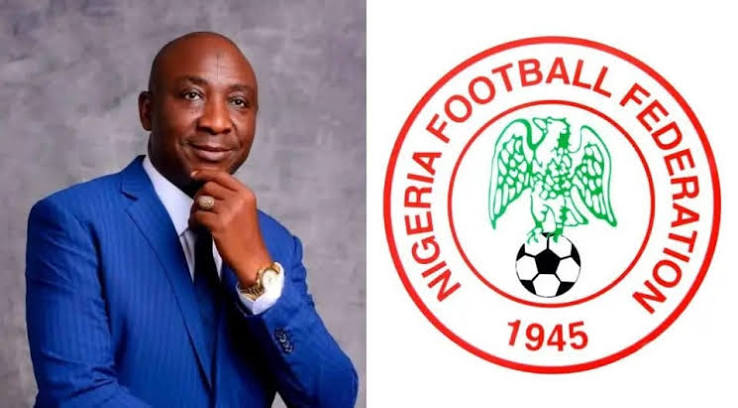
The crisis rocking Nigerian football has deepened following the reported resignation of the President of the Nigeria Football Federation (NFF), Ibrahim Gusau, alongside several members of the federation’s executive committee.
The development comes amid mounting criticism over the administration of Nigerian football, particularly the performance of the country’s national teams and growing concerns over the management of funds allocated to the federation.
According to reports, the NFF leadership had come under increasing pressure in recent months, with the situation reaching a critical point following Nigeria’s historic failure to qualify for the 2027 FIFA Women’s World Cup.
Sources familiar with the development said Gusau and other members of the NFF board were subjected to intense pressure to step aside as concerns over the state of football administration continued to grow.
It was further learnt that as many as eight of the 13 members of the NFF board had allegedly resigned from their positions, leaving the federation facing a major leadership crisis ahead of its scheduled elections.
The reported mass resignation could have significant implications for the NFF’s electoral process, with elections into the federation’s board currently scheduled to take place on September 27 in Lafia, Nasarawa State.
The situation has also attracted the attention of security agencies, particularly over the management and utilisation of funds released by the Federal Government to settle outstanding financial obligations to Nigeria’s national teams.
The Department of State Services (DSS) is reportedly among the security agencies examining the federation’s handling of the funds.
The investigation is said to be focused partly on the N17 billion intervention fund approved by President Bola Tinubu in 2024 to address outstanding payments, including players’ wages and bonuses owed by the national teams.
A source familiar with the investigation told Vanguard that security operatives had requested documents and explanations concerning how the funds released to the NFF were utilised.
The source, however, dismissed concerns that the investigation amounted to a witch-hunt, describing the scrutiny as part of the normal process of examining the management of public funds.
“It’s a normal thing for DSS to go through all documents relating to the funds released to them,” the source reportedly said.
The financial scrutiny comes at a time when Nigerian football has been facing what many stakeholders consider a prolonged period of instability and underperformance.
The country’s senior men’s team, the Super Eagles, have experienced significant setbacks in recent World Cup qualification campaigns, while the Super Falcons have now suffered what is arguably the most damaging setback in their history.
Nigeria had qualified for every edition of the FIFA Women’s World Cup since the competition began in 1991. The country’s failure to qualify for the 2027 tournament therefore represents an unprecedented break in the Falcons’ record of participation.
The setback followed Nigeria’s disappointing campaign at the 2026 Women’s Africa Cup of Nations (WAFCON).
The Super Falcons, who were defending their continental title, suffered a 1-0 defeat to Cameroon in the quarter-finals. The loss ended their title defence and forced Nigeria into the World Cup qualification playoff route.
Nigeria subsequently faced South Africa’s Banyana Banyana in the decisive playoff for a place at the 2027 Women’s World Cup.
The South Africans defeated the Super Falcons 2-1, completing Nigeria’s failure to secure qualification for the tournament in Brazil.
The result generated widespread disappointment among Nigerian football supporters and intensified calls for accountability within the NFF.
Critics have argued that the federation’s leadership should accept responsibility for the declining fortunes of the national teams, while others have called for fundamental reforms in the administration, financing and development of football in the country.
The latest crisis is not limited to the performance of the national teams. It has also raised questions about the internal stability of the NFF, particularly following the reported resignation of more than half of the board members.
With eight out of the 13 board members allegedly having resigned, the federation could be confronted with questions about its ability to continue operating normally and organise its planned elections.
The reported resignation of Gusau would further complicate matters, given his position as head of the federation and the responsibilities attached to the office.
The NFF is responsible for overseeing the administration and development of football in Nigeria, including the national teams, domestic competitions, grassroots development and the country’s relationship with international football governing bodies.
The unfolding developments could therefore have far-reaching consequences for Nigerian football if the leadership vacuum is not resolved quickly.
Beyond the immediate administrative crisis, stakeholders are expected to demand greater transparency in the management of public funds allocated to football, improved accountability and a comprehensive strategy for rebuilding the national teams.
The investigation into the N17 billion intervention fund is also likely to attract considerable public attention as security agencies examine financial records and supporting documentation relating to its utilisation.
For Nigerian football, the combination of poor sporting results, financial scrutiny and an apparent breakdown within the NFF leadership represents one of the most serious crises the federation has faced in recent years.
As the September 27 election date approaches, stakeholders will be watching closely to determine whether the reported resignations will affect the electoral process or trigger a restructuring of the federation’s leadership.
For now, the future of the current NFF administration remains uncertain, with Nigerian football at a critical crossroads following a series of setbacks that have renewed calls for accountability, transparency and institutional reform.