Nearly four decades after first taking power through an armed rebellion, Ugandan President Yoweri Museveni has renewed his grip on the East African nation after being sworn in for a seventh term in office following his victory in January’s controversial presidential election.
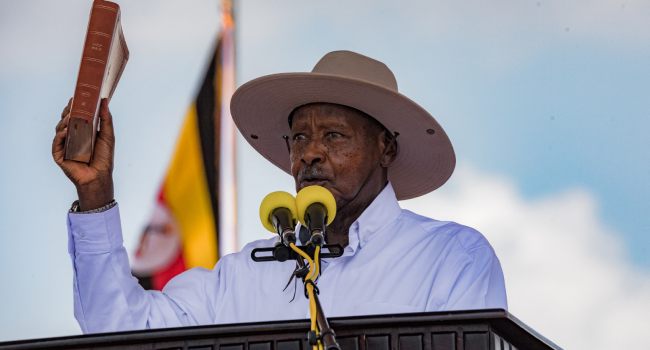
The inauguration ceremony took place on Tuesday at the Kololo Independence Grounds in Uganda’s capital, Kampala, amid tight security, colourful displays and celebrations by supporters of the ruling National Resistance Movement (NRM).
Videos shared on the president’s official social media pages showed thousands of supporters gathered at the venue waving Ugandan flags and chanting slogans in support of the 81-year-old leader as he officially took the oath of office.
Museveni, who has ruled Uganda since 1986, remains one of Africa’s longest-serving presidents and among the continent’s most dominant political figures.
According to Uganda’s Electoral Commission, Museveni secured 71.65 percent of the votes cast in the January presidential election, comfortably defeating his closest rival, opposition politician and musician Bobi Wine, whose real name is Robert Kyagulanyi Ssentamu.
Bobi Wine polled 24.72 percent of the votes but immediately rejected the outcome, alleging widespread electoral irregularities, ballot stuffing and voter intimidation during the exercise.
The opposition leader described the election as fraudulent and accused state institutions of manipulating the process to favour the incumbent president.
His party and supporters also claimed that security operatives disrupted opposition campaigns, intimidated voters and restricted political activities in several parts of the country before and during the election.
Despite the allegations, Uganda’s government and electoral authorities insisted that the election was conducted fairly and reflected the will of the people.
Museveni first came to power in 1986 after leading a successful guerrilla insurgency that overthrew the government at the time following years of political instability and armed conflict in Uganda.
Initially celebrated by many Africans and international observers as part of a new generation of reformist African leaders, Museveni’s government later became increasingly criticised over concerns relating to democratic freedoms, political repression and constitutional manipulation.
Over the years, his administration supervised key constitutional amendments that significantly reshaped Uganda’s political landscape and effectively allowed him to remain in office indefinitely.
Among the most controversial changes were the removal of presidential term limits in 2005 and the later scrapping of the presidential age limit in 2017, both of which cleared legal obstacles that could have forced him out of office.
Critics argued that the constitutional amendments weakened Uganda’s democratic institutions and concentrated excessive power in the presidency.
Museveni’s government has also repeatedly faced accusations from opposition figures, civil society organisations and international human rights groups over alleged intimidation, arbitrary arrests and suppression of political dissent.
Opposition politicians have frequently accused security agencies of targeting critics of the government through arrests, surveillance, abductions and violent crackdowns on protests.
In recent years, tensions between the government and opposition groups have intensified, especially with the growing popularity of Bobi Wine among younger Ugandans frustrated by unemployment, economic hardship and the country’s prolonged political status quo.
Wine, a former musician turned politician, emerged as one of Museveni’s strongest challengers after mobilising large numbers of youths under a campaign message focused on democratic reforms and political change.
However, his political rise has also been accompanied by repeated confrontations with security agencies.
In March, Bobi Wine accused operatives allegedly linked to the Ugandan government of raiding the residence of one of his close aides identified as Najja Sherif.
According to Wine, the operatives stormed the residence in search of Sherif but allegedly abducted his wife after failing to locate him.
In a statement shared on social media at the time, the opposition politician condemned the action and accused the government of intimidation.
“Regime security operatives have raided the home of my assistant, Comrade Najja Sherif. When they found he was not around, they abducted his wife instead after she told them she did not know his whereabouts. What a cowardly regime,” Wine stated.
The incident further heightened concerns among opposition supporters and human rights groups over the shrinking democratic space in Uganda.
Several rights organisations have repeatedly accused Ugandan authorities of using state security institutions to suppress dissent and silence opposition voices.
They also expressed concerns about restrictions on free speech, media freedom and political assembly under Museveni’s administration.
Despite the criticisms, Museveni and his supporters maintain that his leadership has brought stability, economic growth and improved security to Uganda after years of turmoil that preceded his rise to power.
Government officials frequently point to infrastructure development, regional security contributions and economic reforms as evidence of the administration’s achievements over the decades.
Supporters of the ruling NRM also argue that Museveni’s experience and leadership remain important for maintaining stability in Uganda and the wider East African region.
However, critics insist that the country urgently needs democratic transition and stronger institutions capable of ensuring political accountability and protecting civil liberties.
As Museveni begins another term in office, analysts say Uganda remains deeply divided politically, with growing calls for democratic reforms likely to continue shaping national discourse in the years ahead.
The latest inauguration therefore represents not only another milestone in Museveni’s lengthy political career, but also a reminder of the persistent tensions surrounding governance, democracy and political freedom in Uganda.