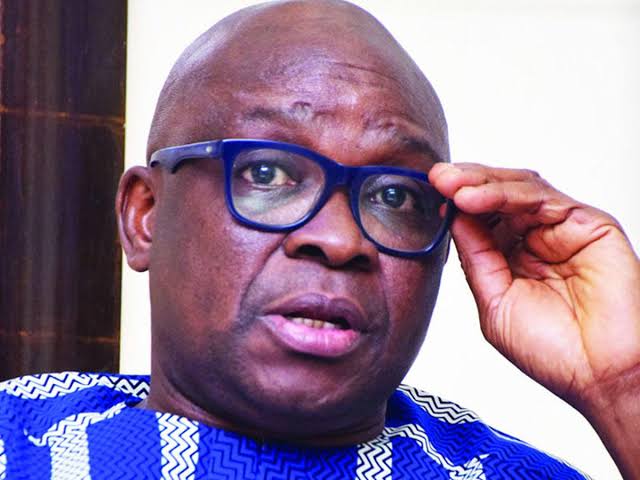
Former Governor of Ekiti State, Ayodele Fayose, has argued that the persistent lack of electricity in many rural communities contributes to early bedtimes, limited social activities and increased population growth.
Fayose made the remarks on Friday in Abuja shortly after he was inaugurated as Chairman of the Board of the Rural Electrification Agency (REA), the federal agency responsible for expanding electricity access to underserved and unserved communities across the country.
Speaking after the inauguration ceremony, the former governor said the absence of reliable electricity in rural areas has significantly restricted nightlife, recreation and other social activities, leaving residents with few alternatives after nightfall.
In a video clip shared by ARISE News on Saturday, Fayose said many rural communities become inactive once darkness sets in, adding that the situation affects social behaviour and family life.
“Why don’t we address this issue of electricity?” he asked.
“The people at that level have no alternative attraction. Nothing else matters to them. After 7 o’clock, it gets dark there.”
According to him, the lack of electricity means that residents often remain indoors throughout the evening, with little opportunity for entertainment, business or community interaction outside the home.
“Everybody is engaging their wives, and the population simply becomes double. The simple problem is because there is lack of electricity,” Fayose said.
The former governor argued that improving electricity supply in rural communities would encourage people to stay out longer, support small businesses and create alternative recreational opportunities.
“People go to bed early. Their minds are prepared that if this is the only available recreation, let me remain here,” he said.
“But when we address this electricity, there will be nightlife. There will be recreation outside your wife.”
Fayose maintained that access to electricity should not be viewed only as an infrastructure issue but also as a social and economic development tool capable of transforming rural life.
He said electricity would stimulate commercial activities, extend business hours and improve the quality of life in rural communities.
The remarks have generated public discussion because they linked electricity supply to demographic and social outcomes, a perspective not commonly emphasised in public debates on power sector reforms.
Fayose’s comments came as he officially assumed office as chairman of the REA board, a position that places him at the centre of the Federal Government’s rural electrification programme.
The inauguration ceremony was conducted by the Minister of Power, Joseph Tegbe, who charged the new board to support efforts aimed at improving electricity access across Nigeria.
Also sworn in were Ahmadu Abubakar and Ilyasu Makinta as members of the governing board, alongside three other non-executive directors. In addition, Abba Aliyu was formally inaugurated as the Managing Director of the Rural Electrification Agency.
The REA is tasked with implementing projects designed to bring electricity to communities that are either completely without power or poorly served by the national grid.
Over the years, the agency has focused on mini-grid projects, solar installations and other off-grid solutions intended to improve electricity access in rural and remote areas.
Fayose said the board would work to support the Federal Government’s objective of expanding electricity infrastructure to communities that have remained without reliable power for decades.
He stressed that rural electrification has implications beyond lighting homes, noting that it can improve education, healthcare delivery, security, communication and economic productivity.
According to him, communities with electricity are more likely to attract investment, retain young people and create opportunities for entrepreneurship.
Nigeria continues to face significant electricity challenges, with millions of households, particularly in rural areas, lacking access to reliable power despite repeated government interventions and reform programmes.
The Federal Government has repeatedly identified rural electrification as a key component of its economic development strategy, with a focus on renewable energy and decentralised power systems.
Fayose’s inauguration comes at a time when the government is seeking to accelerate electricity access and reduce the number of Nigerians living without reliable power supply.
He expressed optimism that improved rural electrification would help transform communities socially and economically, while creating new opportunities for recreation, commerce and development across the country.