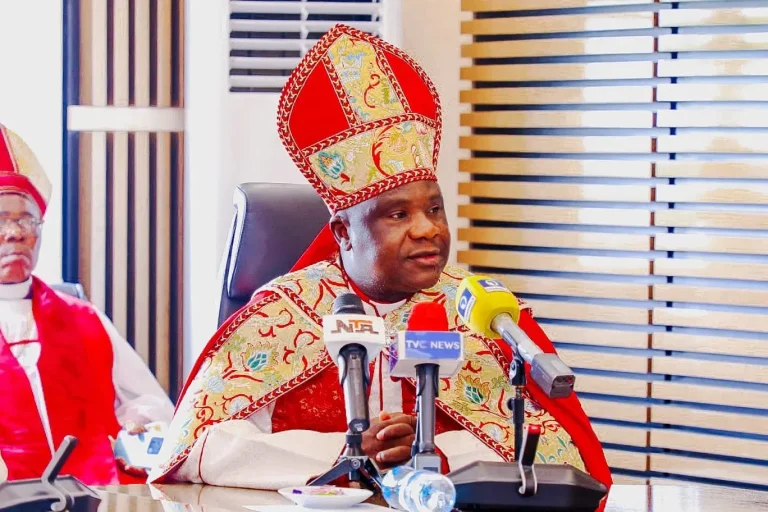
Archbishop Leonard Bature Kawas has defended his decision to support President Bola Tinubu, dismissing criticisms that his political alignment has made him “fake” or inconsistent.
Kawas, who spoke during an interview on Arise News, said he had previously supported Peter Obi’s presidential ambition without receiving financial assistance from the former Anambra State governor. He questioned why his decision to support Tinubu should now attract accusations of hypocrisy or insincerity.
The cleric explained that during the 2023 presidential campaign, he travelled extensively across Nigeria to mobilise support for Obi, often paying his own expenses and, on some occasions, covering the transportation costs of other clergymen who accompanied him.
“When I was supporting Peter Obi initially, he never gave me one naira. Now that I am supporting Tinubu, people are calling me fake,” Kawas said.
According to him, his support for Obi was based on his personal conviction at the time and was not motivated by financial considerations.
He recalled attending Obi’s campaign events, offering prayers and participating in activities organised to promote the former presidential candidate’s ambition.
Kawas said he sometimes personally financed the participation of other members of the clergy who joined him at campaign events.
“He would just see me at the campaign. We would pray for him. I would pay the transportation of six clergymen. We would come there and support him. He never asked me, ‘How did I come? Which hotel did I sleep?’ Yet I did it, and nobody called me fake,” he stated.
The archbishop argued that his previous support for Obi should not be interpreted as a permanent political commitment. He maintained that individuals can reassess their political positions based on their convictions, circumstances and understanding of what they believe is best for the country.
Kawas also recalled his longstanding involvement in Nigerian politics, particularly his relationship with former President Goodluck Jonathan.
He said his political support for Jonathan dated back to the former president’s time as Deputy Governor of Bayelsa State and continued through his rise to the presidency.
According to Kawas, he actively participated in Jonathan’s presidential campaign and travelled to different parts of the country to mobilise support for his candidacy.
“I was the only bishop in Goodluck Jonathan’s presidential campaign council. And I took campaign everywhere. Nobody called me fake,” he said.
The archbishop’s comments come amid intense political realignment ahead of the 2027 general elections, with politicians, religious leaders and other influential figures increasingly declaring support for different political candidates and platforms.
Kawas questioned the basis for describing him as fake simply because his current political preference differs from the position he held during the previous presidential election.
He said his decision to support Tinubu was informed by his personal convictions and what he described as divine guidance.
“Is it now, because I have prayed and God has led me that it is Tinubu, that I suddenly now become fake?” he asked.
The cleric maintained that political support should not necessarily be viewed as a transaction in which individuals remain permanently tied to candidates because of previous endorsements.
He suggested that his record of supporting different political figures demonstrates that his involvement in politics has not been restricted to one individual or political party.
Kawas’s defence also highlights the broader debate surrounding the role of religious leaders in Nigerian politics. Clerics have historically participated in political campaigns, offered prayers for candidates and publicly expressed preferences during elections. Their endorsements can generate significant public attention, particularly when they subsequently shift their support.
For Kawas, however, changing political allegiance does not amount to dishonesty. He believes his previous support for Obi and Jonathan and his current support for Tinubu can coexist with a sincere commitment to his understanding of Nigeria’s political interests.
He therefore rejected the suggestion that his current position was motivated by personal gain, pointing to his earlier financial sacrifices while supporting candidates without receiving direct monetary assistance.
The archbishop urged critics to judge his political decisions based on his convictions rather than assumptions about financial inducements.
His comments are likely to fuel further discussion about political endorsements, the independence of religious leaders and the factors that influence influential Nigerians as the country moves towards the 2027 elections.