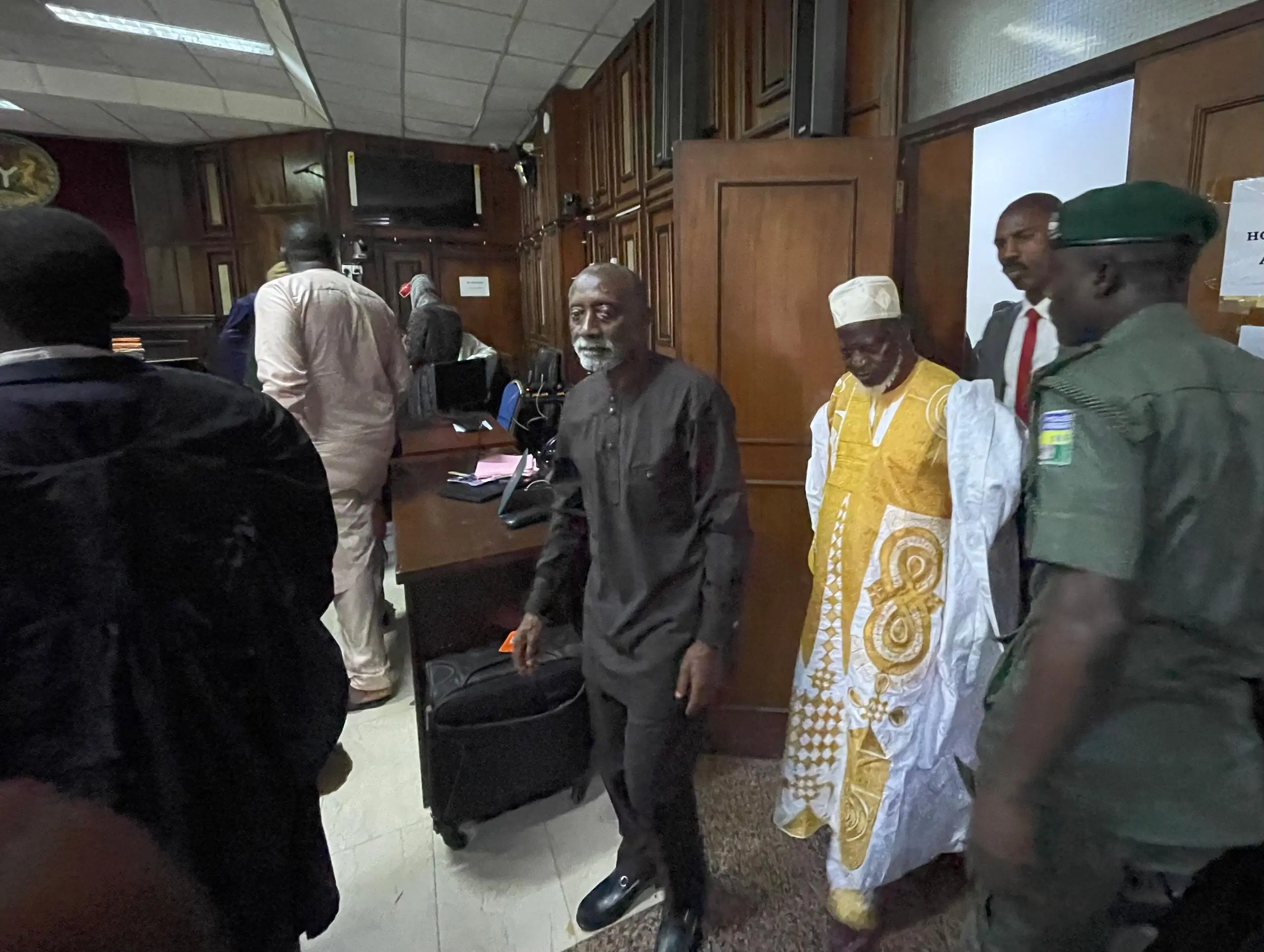
An Islamic cleric, Sheikh Bukar Kashim Goni, has told a Federal High Court sitting in Abuja that the sum of ₦10 million traced to his bank account was payment for spiritual consultations and not linked to any alleged plot to overthrow the administration of Bola Ahmed Tinubu.
Sheikh Goni is among six individuals currently standing trial on a 13-count charge bordering on treason, terrorism, and conspiracy. The case, instituted by the Attorney-General of the Federation, centres on allegations that the defendants were involved in a coordinated effort to destabilise the Nigerian government.
At the resumed hearing on Tuesday, May 5, presided over by Justice Joyce Abdulmalik, the court examined video evidence presented by the prosecution. The footage reportedly showed investigators confronting the cleric with financial records indicating multiple inflows into his account, allegedly linked to the principal suspect in the case, Col. Mohammed Ma’aji.
In his defence, Sheikh Goni firmly denied any involvement in a coup plot, maintaining that all funds he received were strictly tied to religious services. He explained that his relationship with the military officer was purely spiritual, stating that Col. Ma’aji had approached him for prayers concerning personal issues, including career progression and delayed promotions within the military.
According to the cleric, the financial transactions were voluntary offerings for spiritual assistance and charitable causes. He insisted that at no point was he involved in political discussions or activities related to national security or governance.
However, the prosecution challenged this narrative, pointing to banking records which, according to investigators, suggest a pattern of transactions inconsistent with the cleric’s explanation. The court was told that transfers into his account dated back to March 2023—well before the timeline of events cited by the defendant. Notably, a payment of ₦10 million was reportedly made in October 2024, raising further questions about the nature and purpose of the funds.
Prosecutors also drew attention to certain communications allegedly retrieved during the investigation. These included references to terms such as “access” and “work tools,” which, according to the prosecution, may indicate a level of coordination beyond spiritual engagement. They argued that such language could suggest involvement in a broader operational framework tied to the alleged plot.
Despite these claims, Sheikh Goni maintained his innocence, reiterating that he had no knowledge of any plan to overthrow the government. He told the court that he neither participated in nor was aware of any illegal activities, stressing that his role was limited strictly to religious guidance and prayer.
In a related development, the court also reviewed video evidence involving another defendant—a staff member of Julius Berger Nigeria assigned to duties at the Presidential Villa. The individual similarly denied involvement in any coup-related activities, stating that he had been misled regarding the nature of certain financial transactions.
The defendant admitted to receiving substantial sums of money, including a “Ghana Must Go” bag reportedly containing ₦8.8 million. However, he insisted that he believed the funds were connected to legitimate business dealings and had no awareness of any alleged conspiracy.
Court proceedings revealed that earlier sessions had included additional video evidence in which some of the accused were allegedly seen discussing movements and coded communications around sensitive government locations. Nonetheless, all defendants have consistently denied any involvement in a coordinated effort to seize power.
The Federal Government alleges that the accused persons conspired in September 2025 to overthrow the administration of President Tinubu, an offence that carries severe penalties under Nigeria’s criminal and anti-terrorism laws. According to the prosecution, the defendants not only participated in planning activities but also failed to report knowledge of the alleged plot to relevant authorities.
The charges further claim that some of the accused provided indirect support to the conspiracy by withholding critical information that could have aided security agencies in preventing the alleged plan.
All six defendants pleaded not guilty when they were arraigned on April 22. They have since remained in the custody of the Department of State Services pending the conclusion of the trial.
Adding another layer of complexity to the case, a former governor of Bayelsa State and ex-Minister of State for Petroleum Resources, Timipre Sylva, has also been named in the charge sheet. Authorities have indicated that he is currently at large, though no further details have been provided regarding efforts to secure his arrest.
Legal analysts observing the proceedings note that the case raises significant questions about the interpretation of financial transactions and associations in the context of national security. The defence has emphasised the importance of distinguishing between legitimate religious or personal interactions and activities that may be construed as conspiratorial.
The trial is expected to continue with further examination of evidence and witness testimonies. Justice Abdulmalik has adjourned the matter to May 11, 12, and 13 for continuation of proceedings.
As the case unfolds, it is likely to attract heightened public attention, given the gravity of the charges and the high-profile individuals involved. The outcome may also have broader implications for how allegations of treason and terrorism are investigated and prosecuted in Nigeria, particularly where they intersect with religious, social, and professional relationships.