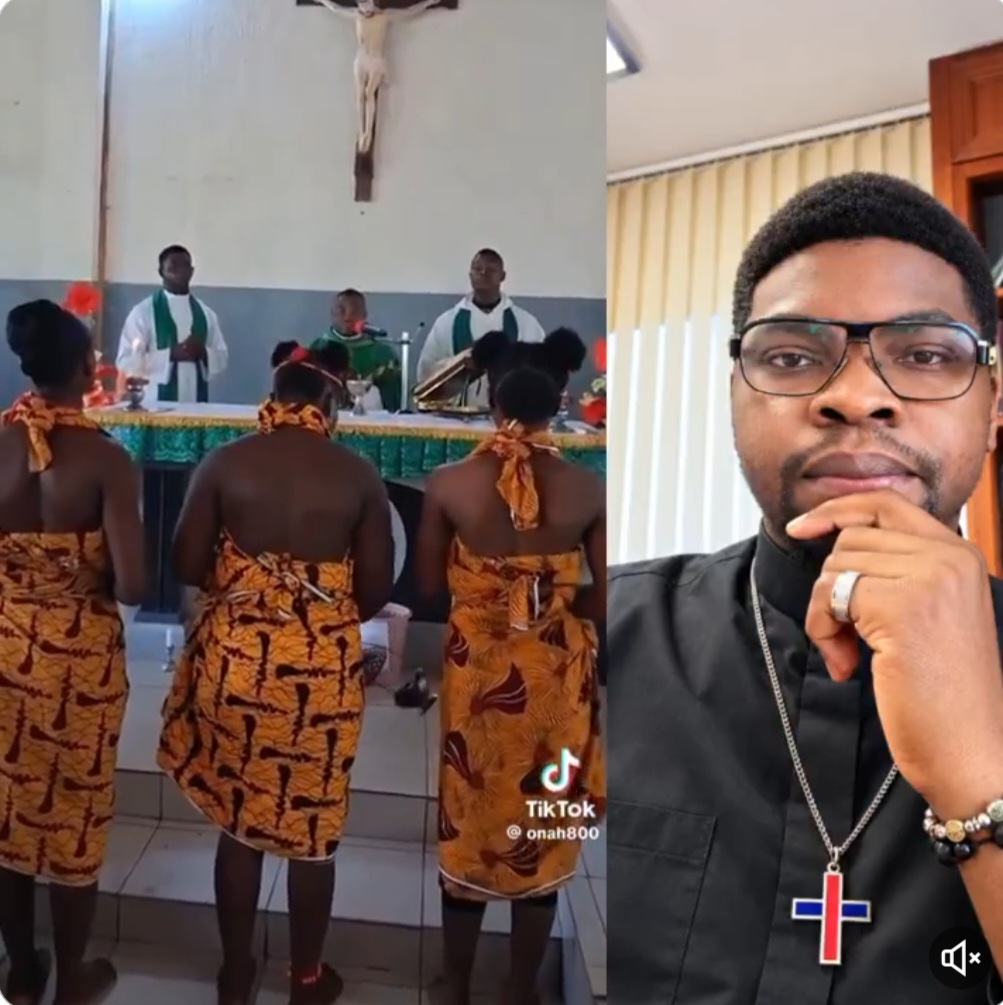
The priest expressed concern over the traditional outfits worn by the girls, particularly the exposed backs, which he described as inappropriate for the sacred liturgy.
However, Father Vitus clarified that his objection was not directed at the participation of girls in altar service or the celebration of Mass according to different cultural traditions. Rather, he said his concern centred on the suitability of the clothing worn by the altar servers during the religious ceremony.
In his reaction to the video, the priest called on members of the public to consider the issue from the perspectives of cultural identity, modesty and the reverence expected during Catholic worship.
“Let’s judge this together. First of all, I am not against girls serving at Mass, nor am I against the celebration of Mass in different cultures. The Vatican has approved the celebration of Mass in traditional languages. However, here’s my problem,” he wrote.
Father Vitus said he considered the outfits worn by the three girls unsuitable for their liturgical responsibilities, arguing that the clothing did not reflect the modesty he believed should characterise service at the altar.
“The way these altar girls are dressed is, in my opinion, inappropriate for the sacred liturgy. Their clothing does not seem suitable for serving at the altar because, from my point of view, they are practically half-naked,” he stated.
The priest acknowledged that the outfits appeared to be traditional cultural attire but maintained that cultural expression should be balanced with expectations of modesty during religious ceremonies.
He suggested that adjustments could be made to the clothing to preserve its cultural significance while ensuring that the altar servers were appropriately covered.
“I understand that this is traditional cultural attire, but it should be adapted to ensure modesty. The girls could wear something underneath before putting on their traditional garments,” he added.
He concluded that, in his view, the manner in which the girls were dressed during the Mass was unacceptable and required reconsideration.
“However, this way of dressing during the celebration of the sacred liturgy is, in my opinion, inappropriate and highly unacceptable,” Father Vitus said.
Debate Over Culture and Church Traditions
The priest’s comments highlight a broader discussion about how cultural traditions can be incorporated into Catholic worship while respecting the Church’s liturgical expectations.
Across different communities, traditional clothing is sometimes worn during religious celebrations as an expression of cultural identity. However, questions may arise over how such attire should be adapted for particular roles and settings within the church.
The participation of female altar servers is a separate issue from the debate over their clothing. Father Vitus explicitly stated that he had no objection to girls serving at Mass, focusing his criticism on what he regarded as the inappropriate nature of the outfits.
His remarks may prompt differing reactions among Catholics, particularly those who view traditional attire as an important expression of cultural heritage and those who emphasise modesty during worship.
The discussion ultimately raises questions about how churches can accommodate cultural diversity while maintaining standards of dress and conduct that reflect the sacred nature of the Mass.