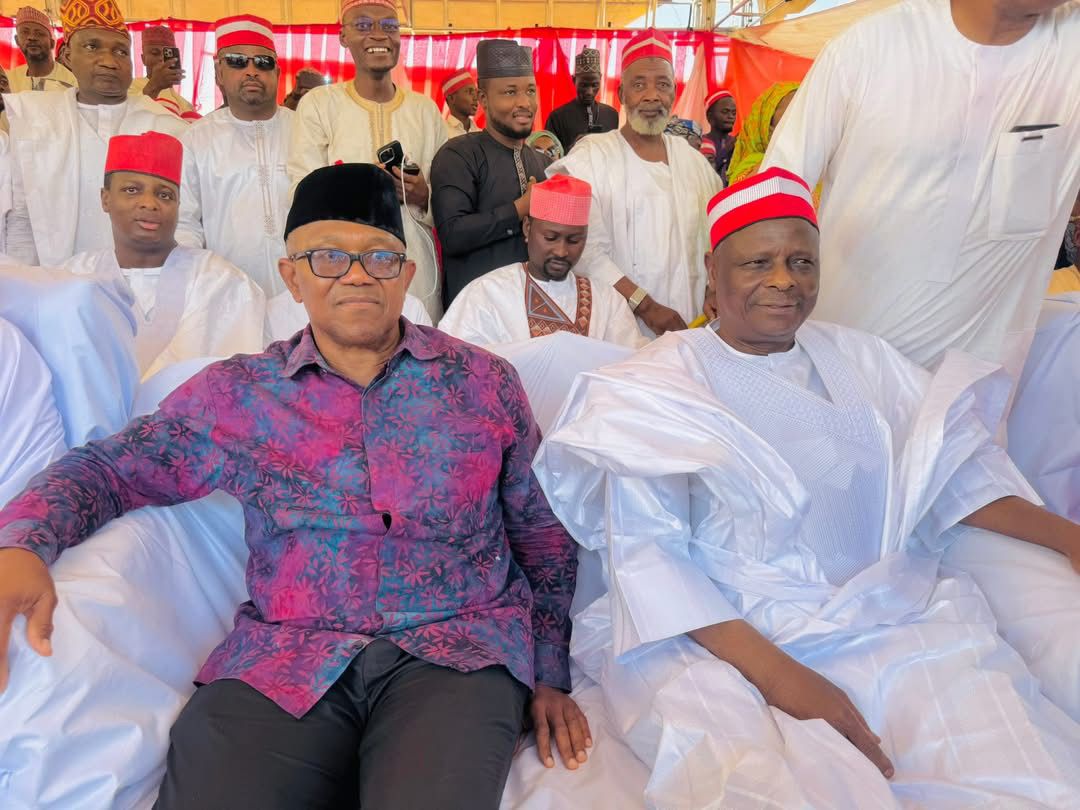
As political maneuvering intensifies ahead of the 2027 general elections, the contest for the presidential ticket of the African Democratic Congress has begun to expose differing narratives within opposition ranks. The Kwankwasiyya movement has now pushed back against recent remarks attributed to former Vice President Atiku Abubakar, particularly suggestions that the political influence of Rabiu Musa Kwankwaso in Kano is waning.
Speaking during a televised programme, the spokesperson of the Kwankwasiyya movement, Habib Mailemo, dismissed such claims and instead advanced a contrasting argument: that only Kwankwaso and Peter Obi currently command what he described as “organic” nationwide followership.
According to Mailemo, the support base enjoyed by both leaders is fundamentally different from that of other political figures, as it is rooted in voluntary public trust rather than inducement, patronage, or dependence on entrenched political structures.
“It is only Peter Obi and my principal, Alhaji Rabiu Musa Kwankwaso, who have organic followers that are not induced by anything,” he said. “Their supporters are driven by belief in their competence, track record, and alignment with the aspirations of the masses.”
Mailemo contrasted this with what he described as the political strength of Atiku, which he argued has historically been tied to institutional backing, particularly from governors and the structure of the Peoples Democratic Party. While acknowledging Atiku’s extensive experience and repeated participation in presidential contests, he maintained that such support cannot be attributed solely to personal popularity.
“It is true that Atiku has contested multiple times, particularly under the PDP, where he enjoyed the backing of governors and an established party machinery,” Mailemo said. “But it would be inaccurate to suggest that all the votes he secured were based on personal appeal alone, given the level of elite consensus and structural support within the party.”
The Kwankwasiyya spokesman argued that a more meaningful comparison between political actors should consider the conditions under which their popularity was built. He pointed out that both Obi and Kwankwaso had contested elections outside dominant party frameworks and still managed to generate significant momentum.
“I am presenting a different scenario,” he explained. “Peter Obi and Kwankwaso stood on their own and became synonymous with the platforms they represented, largely because of their individual appeal. They entered races where they were not initially seen as frontrunners but still made a strong impact.”
He suggested that a similar test would be required to accurately assess Atiku’s independent political strength.
“If he had contested on a platform without an established structure and transformed it into a formidable force, as Obi and Kwankwaso did, then we could properly evaluate the depth of his personal following,” Mailemo added.
Beyond the debate over individual popularity, Mailemo emphasised that the broader objective of opposition politics should not be overshadowed by internal rivalry. He noted that Kwankwaso’s participation in ongoing coalition discussions is driven by a commitment to national recovery rather than personal ambition.
“My principal has made it clear that his involvement in the coalition is about contributing to the rescue of Nigeria,” he said. “The focus should be on building a credible alternative, not on competing narratives of supremacy.”
The remarks come at a time when opposition figures are exploring possible alliances aimed at consolidating their chances against the ruling party in the next election cycle. However, such efforts have also brought underlying tensions to the surface, particularly regarding leadership and candidate selection.
Mailemo addressed concerns that differing viewpoints within the opposition could deepen divisions, arguing instead that open and honest engagement is necessary for building a strong coalition.
“The expectation is that key stakeholders—Atiku, Obi, and Kwankwaso—should come together, understand one another, and conduct a proper assessment of their respective strengths,” he said. “Suppressing these conversations will not help. Honest evaluation is essential if the coalition is to present a credible challenge.”
To further illustrate his point about the role of political structures, Mailemo referenced the emergence of late President Umaru Musa Yar’Adua, noting that his electoral success was significantly influenced by strong party backing.
“Yar’Adua may not have been the most widely popular candidate at the time, but with a robust party structure and broad-based support, he emerged victorious,” he said. “This demonstrates that electoral success is often a combination of personal appeal and institutional backing.”
Despite this acknowledgment, Mailemo maintained that the evolving political landscape in Nigeria increasingly favours candidates who can mobilise grassroots support independently of traditional party systems. He suggested that voter behavior is shifting, with greater emphasis on credibility, performance, and direct engagement with the electorate.
The ongoing debate within the opposition underscores the complexities of coalition politics in Nigeria, where balancing individual ambition with collective strategy remains a persistent challenge. As the race for the ADC presidential ticket gathers momentum, the ability of key actors to navigate these dynamics may prove decisive.
For now, the Kwankwasiyya movement’s position is clear: it views Kwankwaso and Obi as uniquely positioned to galvanise widespread public support, while urging all stakeholders to prioritise unity and strategic alignment over internal competition.
As preparations for 2027 continue, the interplay between personal influence, party structures, and coalition-building efforts is likely to shape the trajectory of opposition politics, with significant implications for the country’s democratic landscape.