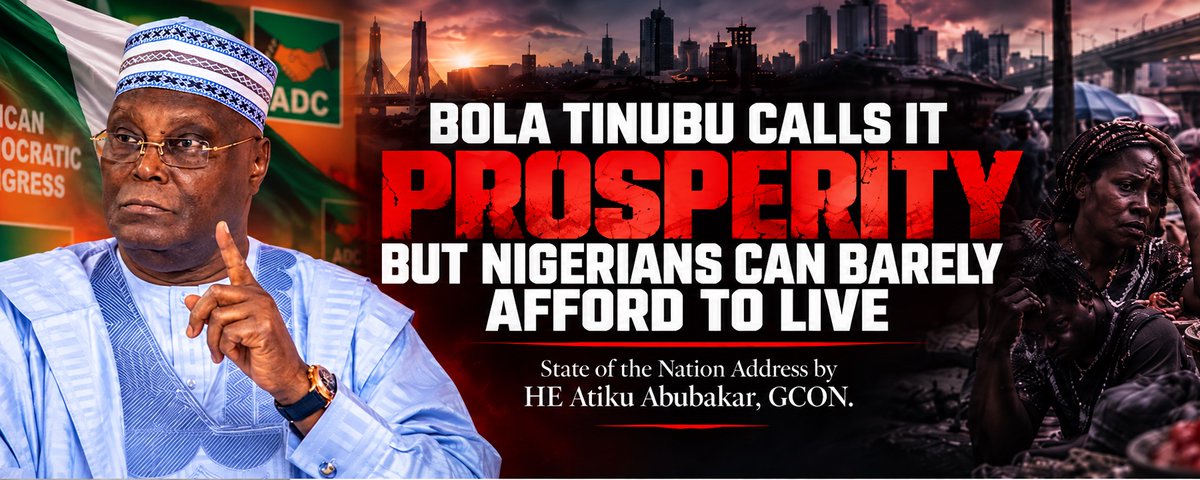
Former Vice-President and presidential candidate of the African Democratic Congress (ADC), Atiku Abubakar, has criticised President Bola Ahmed Tinubu’s 2026 Independence Day address, challenging the administration’s claim that Nigeria’s economy has entered a period of prosperity.
Atiku argued that economic growth figures would mean little to ordinary Nigerians if families continued to struggle to afford food, healthcare, transportation, education and other basic necessities.
In his response to Tinubu’s Independence Day address, Atiku said the past three years of the administration had been characterised by what he described as a severe cost-of-living crisis, with households and businesses facing mounting economic pressure.
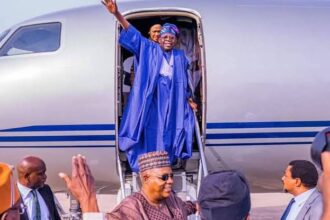
Tinubu, in his October 1 address to Nigerians, said there was “undeniable evidence” that the country’s economic outlook had improved after three and a half years in office. He stated that Nigeria’s economy had grown by more than four per cent during the year, with both the oil and non-oil sectors contributing to what he described as a period of stable growth.
The President also declared that the country had reached a turning point, saying the government’s immediate task had shifted from correcting the nation’s economic course to achieving “shared and widespread prosperity.”
However, Atiku questioned how the claimed economic progress was being experienced by ordinary citizens.
The ADC presidential candidate asked where the promised prosperity was when millions of Nigerians were still finding it difficult to meet basic household expenses.
He also criticised the government’s handling of fuel subsidy removal, taxation and other economic reforms, arguing that their consequences had placed additional pressure on households and businesses.
According to Atiku, Nigeria’s economic difficulties could not be assessed solely through macroeconomic indicators such as growth, exports or inflation. He maintained that the real measure of economic performance should be whether Nigerians could afford food, access healthcare, travel to work and conduct their businesses without overwhelming financial pressure.
“Growth must improve lives,” he argued, saying economic expansion should translate into tangible improvements in citizens’ living conditions.
Insecurity and Economic Hardship
Atiku also linked the country’s economic challenges to insecurity, saying armed groups had killed thousands of Nigerians and displaced families from their communities.
He said farmers were afraid to return to their farms, parents were concerned about the safety of their children in schools, while families continued to live with the fear of receiving ransom demands following kidnappings.
According to him, the ability of government to protect lives and make basic necessities affordable should remain central to any assessment of its performance.
He argued that Nigerians should not be expected to endure prolonged hardship simply because government policies were presented as necessary economic reforms.
Atiku challenged the administration to explain how its policies had improved the lives of Nigerians and questioned why households appeared to have less purchasing power despite the government’s claim of stronger revenues and economic growth.
He also criticised the government’s explanation that inflation was falling, arguing that a slower increase in prices did not reverse the losses already suffered by households.
Fuel Subsidy and Production Proposal
A major part of Atiku’s response focused on the removal of the petrol subsidy.
He said Nigerians were entitled to know when the savings generated from subsidy removal would translate into meaningful reductions in the cost of living.
The former Vice-President proposed a production subsidy tied to verified petrol refined within Nigeria, including fuel produced by modular refineries. Under his proposal, imported petrol would not qualify for the subsidy.
He said the programme would be designed to ensure that the benefit reached consumers through lower pump prices, while the cost of the scheme would be publicly disclosed and subjected to independent auditing.
His stated principle was to encourage domestic production and refining, create employment and reduce the price Nigerians pay for petrol.
Atiku also challenged the Tinubu administration to respond to the proposal on its merits rather than simply dismissing subsidies as harmful to the economy.
He argued that government policies should ultimately be judged by their measurable impact on citizens.
Questions Over Jobs, Loans and Budgets
Atiku further questioned the administration’s employment and loan programmes, saying young Nigerians needed decent-paying jobs rather than policies that merely increased their financial obligations.
He also raised concerns about the cost of education and living expenses, asking the government to provide details on who had benefited from its loan initiatives and what beneficiaries were expected to repay.
The former Vice-President also criticised what he described as confusion surrounding the country’s budgetary process.
He questioned the continued operation of the 2025 budget alongside the 2026 budget and the anticipated 2027 budget, asking how Nigerians could clearly determine what had been funded, completed or left outstanding when multiple budget cycles were operating simultaneously.
According to Atiku, a national budget should function as a clear timetable for government delivery rather than a document whose implementation extends from one year into another.
‘Human Face’ of Reforms
Atiku also challenged the government’s description of its economic reforms as having a human face.
He argued that many Nigerians had yet to experience that claimed human dimension in markets, hospitals, schools and on the roads.
He cited the high cost of food, healthcare, education, electricity and transportation as areas where Nigerians continued to experience pressure.
He further linked insecurity to the broader question of governance, saying communities affected by attacks could not enjoy meaningful economic development when residents remained concerned about their safety.
Atiku said his proposed alternative would focus on making life more affordable, improving access to food, fuel, electricity, healthcare and education, strengthening security and improving accountability in public spending.
He said the success of government should ultimately be measured by the living conditions and safety of Nigerians.
Transport Fares and Accountability
Atiku also questioned the administration’s announcement of cheaper transportation fares, asking the government to provide specific details of the routes affected, previous fares, new fares and the number of Nigerians benefiting from the reduction.
He argued that lower fares on selected routes, if implemented, would be welcome but would not by themselves resolve the wider transportation crisis.
He called on the government to publish the routes, fares and number of beneficiaries so that Nigerians could independently assess the impact of the policy.
The former Vice-President maintained that economic recovery should be visible in people’s daily lives and not limited to official statistics.
He urged the government to account for savings generated by its economic policies and demonstrate how those savings were being converted into tangible benefits for citizens.
Call for Political Freedom and Rule of Law
Beyond economic issues, Atiku also addressed political rights and the rule of law.
He argued that independence should include the freedom of Nigerians to question their leaders, organise peacefully and demand political change.
He called for due process in cases involving Sheikh Sani Khalifa Zaria, former Kaduna State Governor Nasir El-Rufai and Nnamdi Kanu.
Atiku also renewed his call for the release of five young Nigerians reportedly arrested in Borno State over wearing “Tinubu Must Go” T-shirts, arguing that political slogans should not constitute grounds for imprisonment.
His response to Tinubu’s Independence Day speech therefore combined criticism of the administration’s economic policies with calls for greater accountability, security, political freedom and respect for the rule of law.
As Nigeria marked its 66th Independence anniversary, Atiku said the central question for the government should be whether its policies were translating economic growth into improved living standards for ordinary Nigerians.
He maintained that Nigerians deserved measurable results, greater affordability and security, rather than assurances about future prosperity.