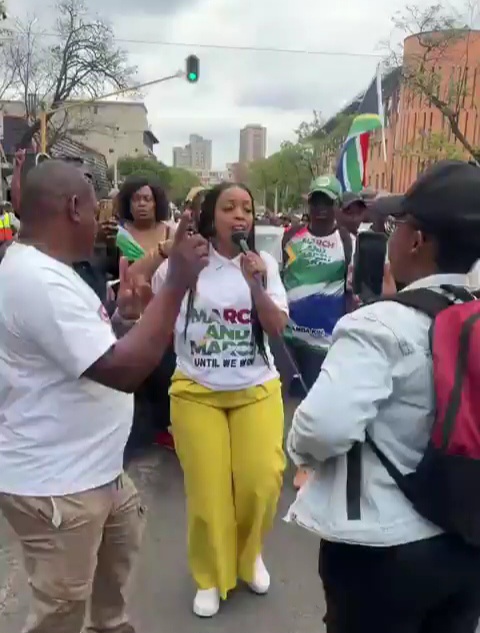
The demonstration, organised by the March and March movement on Wednesday, November 18, targeted Sunnyside, a neighbourhood reportedly home to a significant Nigerian population.
During the protest, demonstrators challenged Nigerians to come out and engage with them, questioning who had authorised their settlement in the area and their alleged description of the neighbourhood as “small Lagos.”
The movement’s leader, Jacinta Ngobese-Zuma, made the remarks while addressing protesters outside buildings occupied by Nigerians.
“I am being told here that we’ve entered Sunnyside, the home of Nigerians. I am inviting Nigerians to come out, let’s talk to each other,” she said.
She further questioned the presence of Nigerians in the neighbourhood, asking: “We want to know who gave you this place and called it Nigeria. Who gave you permission to call this place Lagos or whatever you call it?”
In a Facebook post on Thursday, Ngobese-Zuma also made controversial remarks about Nigerians and their country, alleging that Nigeria was associated with drug-related activities and other forms of crime.
She questioned whether Nigerians had contributions to make to South Africa beyond what she described as drugs, prostitution, human trafficking and food.
Her comments have drawn attention to the increasingly contentious debate surrounding immigration, foreign nationals and the treatment of migrant communities in South Africa.
The protest took place against the backdrop of growing demands by anti-immigration groups for stricter enforcement of the country’s immigration laws and the removal of undocumented foreign nationals.
According to reports, the demonstration began in Sunnyside before moving through Arcadia and heading towards the Department of Home Affairs in Hatfield, Pretoria.
The protesters called for tighter immigration controls and the deportation of foreign nationals without valid immigration documents.
The confrontation has again brought the situation of Nigerian nationals in South Africa into focus, particularly amid concerns over xenophobic rhetoric and hostility towards foreign communities.
While South Africa has the sovereign right to enforce its immigration laws, demands for compliance with those laws have continued to raise questions about the rights, dignity and safety of migrants, including Nigerians who live and work in the country.
The remarks attributed to Ngobese-Zuma reflect the increasingly heated nature of the immigration debate, particularly where entire nationalities are associated with alleged criminal activities.