Ahead of the 2027 general elections, the Nigeria Democratic Congress (NDC) has accused the Independent National Electoral Commission (INEC) of removing some of its duly nominated candidates from the commission’s published list and replacing them with names the party says were not authorised or submitted by its leadership.
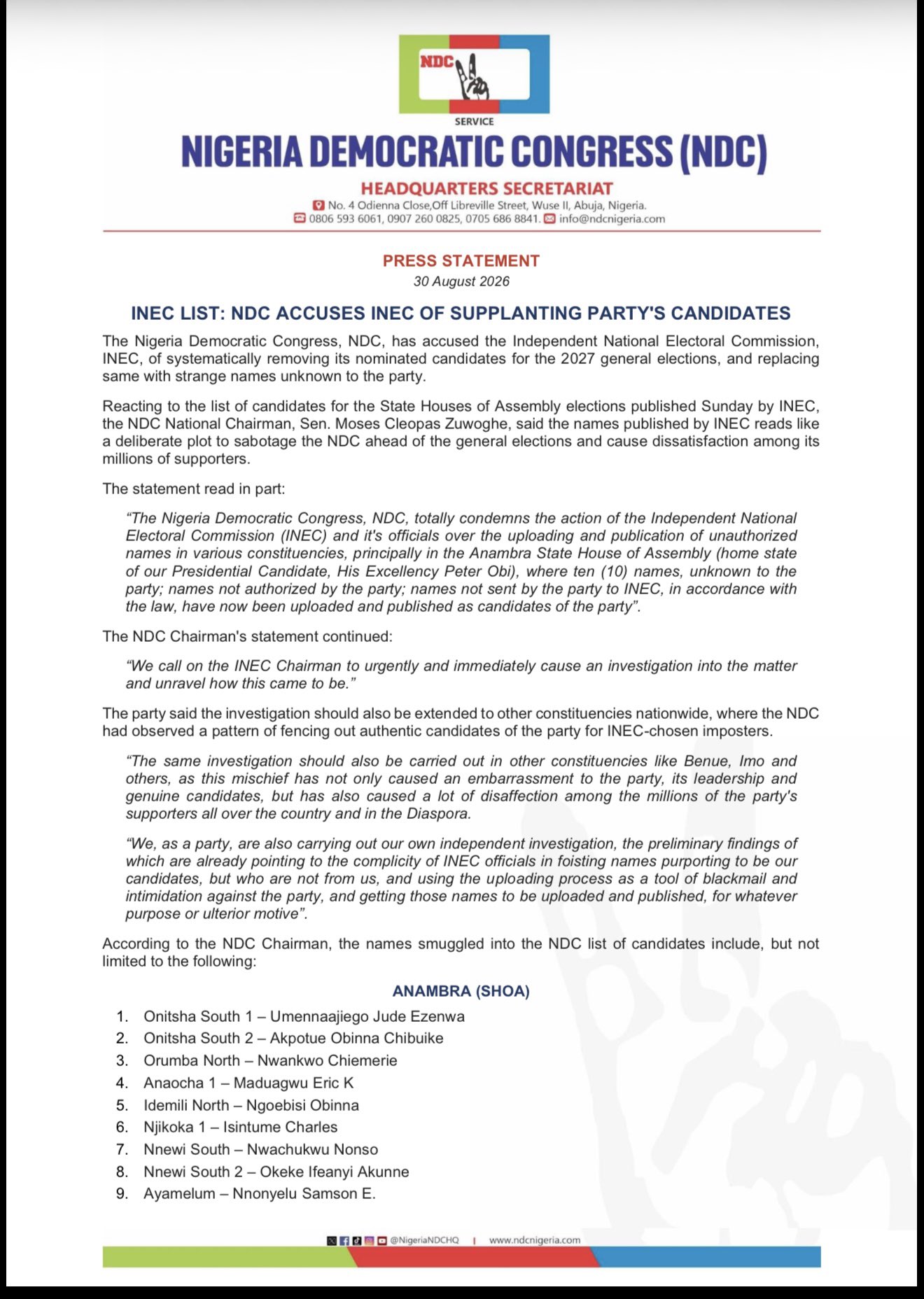
The allegation was made by the National Chairman of the NDC, Senator Moses Cleopas Zuwoghe, in a statement issued on Sunday following INEC’s publication of candidates for the 2027 State Houses of Assembly elections.
Cleopas alleged that the development was particularly pronounced in Anambra State, where he claimed the names of individuals who were not nominated by the party appeared on INEC’s list as NDC candidates.
According to him, the development could undermine the party’s preparations for the 2027 elections, create confusion among its supporters and potentially damage the credibility of the electoral process.
The NDC chairman specifically alleged that 10 names published by INEC in various constituencies in Anambra State were not authorised by the party. Anambra is the home state of the party’s presidential candidate, Peter Obi.
Cleopas called on the INEC Chairman to urgently investigate how the disputed names found their way onto the commission’s candidate list.
He also urged the electoral body to extend its investigation to other states, including Benue and Imo, where he said the party had observed what he described as a similar pattern.
The NDC chairman said the situation had caused embarrassment to the party, its leadership and its genuine candidates, while also generating concern among supporters within Nigeria and in the diaspora.
“We, as a party, are also carrying out our own independent investigation, the preliminary findings of which are already pointing to the complicity of INEC officials in foisting names purporting to be our candidates, but who are not from us,” Cleopas alleged.
He further alleged that the process through which the disputed names were uploaded was being used to intimidate and embarrass the NDC.
The names listed by the party as having been published by INEC include Umennaajiego Jude Ezenwa for Onitsha South 1; Akpotue Obinna Chibuike for Onitsha South 2; Nwankwo Chiemerie for Orumba North; Maduagwu Eric K for Anaocha 1; Ngoebisi Obinna for Idemili North; Isintume Charles for Njikoka 1; Nwachukwu Nonso for Nnewi South; Okeke Ifeanyi Akunne for Nnewi South 2; Nnonyelu Samson E for Ayamelum; and Azotani Chuks Francis for Dunukofia.
Cleopas, however, said the party’s major concern was not only the publication of the names but the process through which they allegedly came to be recognised by the electoral commission as NDC candidates.
He explained that following the conclusion of the party’s primary elections and subsequent appeal process, relevant stakeholders from Anambra, the national leadership of the party, representatives of Peter Obi and members of the appeals panel agreed on a final list of candidates.
According to him, the agreed list was signed off by the relevant stakeholders before being uploaded to the INEC portal using the access code provided to the party by the electoral commission.
Cleopas alleged that INEC officials subsequently kept nine of the disputed names on “Pending” status, claiming that the names were already contained in the commission’s system based on submissions allegedly made by officials who monitored the party’s primaries.
The NDC chairman said the party formally challenged the disputed entries and provided INEC with the identities of the individuals it considered to be its legitimately nominated candidates.
He alleged, however, that the commission declined to replace the disputed names.
Cleopas further alleged that INEC subsequently collected Form EC-9 directly from the individuals whose names were in dispute and uploaded the forms without routing the process through the party.
“To further confirm that there was a predetermined effort on the part of INEC to impose the said nine candidates on the party, and embarrass both NDC and Mr. Peter Obi, INEC went behind the NDC to collect the Form EC-9 directly from the candidates, bypassing the party, and uploading same,” he alleged.
The NDC chairman argued that where discrepancies existed between the candidates submitted by a political party and information obtained independently by INEC from its monitoring teams, the appropriate response should have been to seek clarification from the party.
He maintained that the commission should not have proceeded to publish individuals whose nominations were being disputed by the political party.
“At the very worst, INEC could have left us with no candidates for those positions, if they knew they were unwilling to engage us in addressing any perceived anomaly,” he said.
Cleopas also accused the electoral commission of creating what he described as a pattern in which opposition political parties could be prevented from uploading their preferred candidates, while alternative names were subsequently introduced into their candidate lists.
He said the NDC would not accept what it considered an attempt to undermine its participation in the 2027 elections.
The party chairman assured members and supporters that the leadership was pursuing the matter and would use all available legal channels to challenge the disputed entries.
“We are moving to approach the court of competent jurisdiction to seek redress and restore our authentic candidates. The general public and our millions of supporters should note that these are not our candidates,” Cleopas said.
The allegations have introduced another contentious issue into preparations for the 2027 general elections, particularly regarding the nomination and publication of candidates by political parties.
For the NDC, the dispute goes beyond individual candidacies, with the party insisting that the integrity of its internal nomination process and the identities of its candidates must be respected.
The party is now expected to pursue both administrative and legal avenues to challenge the disputed names and seek the recognition of candidates it says emerged from its legitimate primaries and appeal processes.
The controversy also places renewed attention on the procedures used by INEC to receive, verify and publish candidates submitted by political parties ahead of elections.
As the 2027 elections draw closer, the NDC’s demand for an investigation is likely to keep the issue of candidate nomination, verification and the independence of the electoral process in the public spotlight.