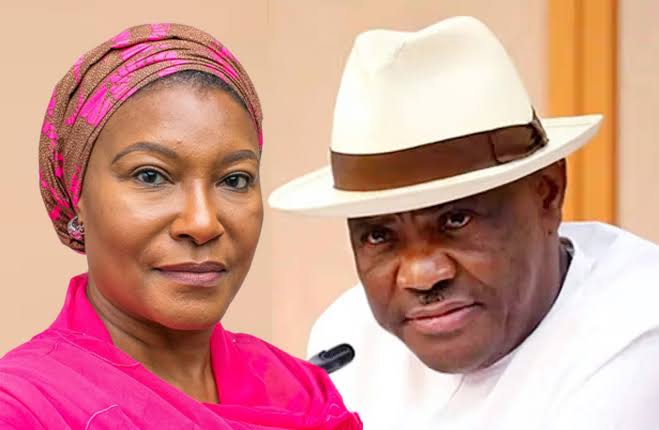
Senator representing the Federal Capital Territory (FCT), Ireti Kingibe, has accused the FCT Minister, Nyesom Wike, of obtaining loans for the nation’s capital without securing the approval of the National Assembly.
Kingibe made the allegation during an interview with Channels Television, where she questioned the process through which the FCT administration had reportedly accessed loans to finance projects within the capital.
The senator said she had previously raised concerns about the issue with the leadership of the Senate, insisting that she was unaware of any instance in which Wike appeared before the upper chamber to seek legislative approval for borrowing on behalf of the FCT.
“I have never seen Wike come to the National Assembly and before the Senate to ask for approval of anything,” Kingibe said.
She explained that although the FCT budget normally passes through the National Assembly for scrutiny and approval, the same procedure, according to her, had not been followed in relation to loans allegedly obtained by the minister.
Kingibe maintained that her position was based on information she obtained from the Debt Management Office (DMO), particularly records covering Nigeria’s borrowings between August 2023 and March 2026.
“I am definitely saying he has been taking loans without the approval of the National Assembly. I don’t know about the House, but certainly not the Senate,” she stated.
The senator challenged anyone disputing her allegation to produce documentary evidence showing that the FCT minister had appeared before the National Assembly to seek approval for the loans.
“If anybody contradicts me, they should bring the Votes and Proceedings of the day that Wike came to the National Assembly to ask for approval for anything,” she said.
According to Kingibe, the issue is particularly important because borrowing by government institutions is subject to constitutional and statutory requirements. She argued that the National Assembly has a constitutional responsibility to scrutinise government borrowing and ensure that public debt is incurred through due process.
The FCT senator also drew a comparison between the borrowing powers of the FCT administration and those of the Federal Government.
She noted that President Bola Tinubu, as the nation’s chief executive, routinely approaches the National Assembly whenever legislative approval is required for loans and other major government actions.
Kingibe argued that if the President himself is required to seek the approval of lawmakers for borrowing, the FCT minister could not exercise greater powers.
She said Wike derives his authority to administer the Federal Capital Territory from the President and, therefore, could not legitimately possess borrowing powers exceeding those of the President.
The allegation is likely to generate further debate over the financial autonomy of the FCT Administration, the legal framework governing its borrowing activities and the extent of the minister’s authority in approving major infrastructure financing arrangements.
Since assuming office as FCT Minister, Wike has embarked on several major infrastructure projects across Abuja, including road construction and rehabilitation, public transportation projects, water infrastructure and other urban development initiatives.
The former Rivers State governor has repeatedly defended the scale of infrastructure development under his administration, arguing that the projects are necessary to address years of neglect and improve the capital city.
However, the financing of such projects has increasingly attracted public attention, particularly amid concerns over Nigeria’s rising debt burden and the need for greater transparency in public expenditure.
Kingibe’s allegation therefore raises questions about whether loans reportedly secured for FCT projects were subjected to the same legislative scrutiny required for other federal borrowing arrangements.
The senator did not provide details during the interview on the specific loans she alleged were obtained without approval, including their lenders, amounts or purposes. She, however, maintained that the DMO records she reviewed provided the basis for her concerns.
She also appeared to distinguish between the approval of the FCT’s annual budget and approval for borrowing, stressing that the fact that the National Assembly considers and approves the territory’s budget does not automatically amount to approval for additional loans.
Kingibe has in the past had public disagreements with Wike over the administration of the FCT, including issues relating to infrastructure, representation and the welfare of residents of the territory.
Her latest allegation could further intensify scrutiny of the financial operations of the FCT Administration and prompt demands for clarification from the minister and relevant government agencies.
If confirmed, borrowing without the requisite legislative approval could raise significant constitutional and administrative questions. However, Kingibe’s claims remain allegations, and the FCT Administration has yet to publicly respond to the specific accusations contained in her interview.
The controversy also comes at a time when lawmakers, civil society organisations and economic analysts are increasingly demanding greater transparency in Nigeria’s borrowing and debt-management processes.
For now, Kingibe has maintained that the records of the National Assembly should provide a clear basis for determining whether the FCT minister ever sought approval for the loans in question.
Her challenge remains direct: if Wike obtained the required legislative authorisation, she wants the relevant Votes and Proceedings of the National Assembly produced as evidence.