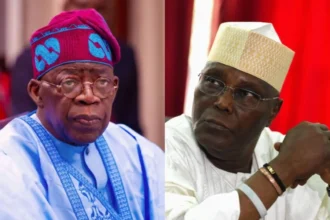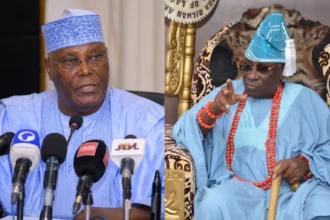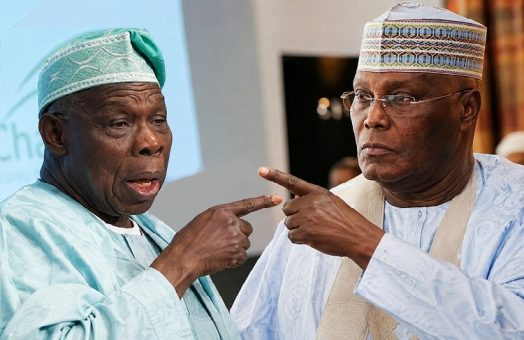
Former Vice President Atiku Abubakar has responded to former President Olusegun Obasanjo’s recent claim that selecting him as running mate in the 1999 presidential election was the greatest mistake of his administration, describing the remark as an unsuccessful attempt to distort historical events.
In a statement issued on Saturday by his Senior Special Assistant on Public Communication, Phrank Shaibu, Atiku said Obasanjo’s comments reflected lingering resentment over his opposition to the former president’s controversial third-term agenda.
According to the former vice president, his refusal to support the constitutional amendment that would have allowed Obasanjo to seek a third presidential term remains one of the defining decisions of his political career.
“I am proud that I stood against the third-term agenda,” Atiku said in the statement. “I am proud that I stood by the Constitution of the Federal Republic of Nigeria. I have no apology whatsoever for frustrating every attempt to subvert our democracy for personal ambition.”
Atiku maintained that his opposition to the proposed tenure extension was not driven by personal hostility but by a commitment to constitutional order and democratic governance.
He argued that no political leader, regardless of stature or past achievements, should be placed above the nation’s constitution.
“No individual, regardless of his status or accomplishments, is bigger than the Federal Republic of Nigeria,” he stated. “The Constitution is supreme, and I chose Nigeria over personal loyalty.”
The former vice president further said that if Obasanjo’s criticism was motivated by his refusal to endorse the third-term project, he regarded such criticism as a source of honour rather than regret.
“If Chief Obasanjo’s bitterness stems from my refusal to support an unconstitutional third term, then I wear that resentment as a badge of honour,” he added.
Atiku stressed that the struggle against the third-term agenda was fundamentally about preserving Nigeria’s democratic institutions and preventing the concentration of power in the hands of one individual.
He said those who resisted the proposal acted to protect the country’s constitutional democracy and ensure the continuation of civilian rule.
The former vice president also used the statement to reflect on his past relationship with Obasanjo, recalling that he had stood by the former military ruler during difficult periods of his life.
According to Atiku, he supported Obasanjo during his imprisonment under the military regime, assisted his family and worked actively for his release and political rehabilitation ahead of the 1999 transition to civilian rule.
He said he had no regrets about the support he offered despite the eventual breakdown of their relationship.
“I stood by him when he was in prison, supported his family, worked for his release and contributed to rebuilding his political career,” Atiku said. “I do not regret those actions because they were taken in good faith.”
The statement came days after Obasanjo reportedly said that choosing Atiku as his running mate in 1999 was the biggest mistake of his presidency, a remark that has reignited public debate over the once influential political alliance between the two leaders.
Obasanjo and Atiku were elected on the platform of the Peoples Democratic Party in 1999 and served together for eight years. Their relationship deteriorated sharply during Obasanjo’s second term, particularly after the emergence of the third-term controversy.
The proposed constitutional amendment, which sought to extend presidential tenure beyond the existing two-term limit, generated intense opposition from lawmakers, civil society groups and political leaders across the country before eventually failing in the National Assembly in 2006.
Atiku’s response signals that the dispute over that episode remains unresolved nearly two decades later and continues to shape perceptions of the relationship between the two former national leaders.
Political observers note that the renewed exchange is occurring at a time when both men remain influential voices in national affairs and are frequently consulted on major political developments.
Atiku concluded his statement by reiterating that his actions during the third-term controversy were motivated by what he considered a higher obligation to Nigeria’s democratic future.
He insisted that defending constitutionalism and resisting attempts to alter the democratic order for personal political advantage was a duty he would perform again if faced with the same circumstances.
According to him, history should remember that the resistance to the third-term agenda was a collective effort to preserve Nigeria’s democracy, and he remains proud of the role he played in that struggle.