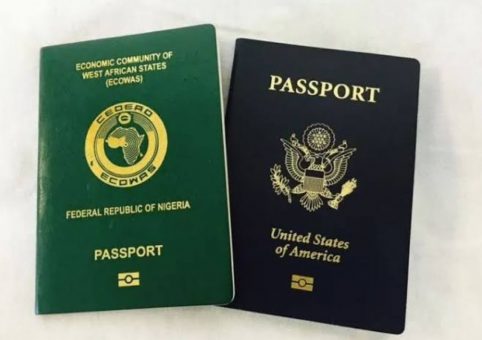
The United States Mission in Nigeria has reminded Nigerians who are also American citizens that they are legally required to use a valid U.S. passport whenever they enter or leave the United States, regardless of whether they also hold Nigerian citizenship.
The advisory was issued in a statement published on the mission’s official X account on Sunday, where it emphasised that the requirement applies to all U.S. citizens, including children with dual nationality.
According to the mission, holding citizenship of another country does not exempt American citizens from U.S. travel regulations, which mandate the use of a valid American passport for travel into and out of the United States.
“U.S. citizens are REQUIRED to enter and depart the United States on a U.S. passport. This requirement applies equally to U.S. citizens, including children, who are dual nationals,” the mission stated.
The advisory forms part of ongoing efforts by U.S. authorities to educate dual nationals on immigration and travel requirements to prevent avoidable disruptions during international travel.
The mission also cautioned dual-national U.S. citizens against attempting to use their foreign passports to obtain travel authorisation through the Electronic System for Travel Authorization (ESTA), stressing that such applications are not permitted under U.S. immigration regulations.
ESTA is an automated system that determines the eligibility of travellers from participating Visa Waiver Programme countries to travel to the United States without obtaining a visa.
However, the U.S. Mission explained that American citizens, including those with dual nationality, are not eligible to apply for ESTA using a foreign passport.
“Dual national U.S. citizens may NOT use their foreign passport to apply for an electronic travel authorization (ESTA). The Department of Homeland Security routinely denies or cancels ESTAs for dual national U.S. citizens,” the statement added.
The mission noted that the U.S. Department of Homeland Security regularly identifies and rejects such applications, warning that travellers who ignore the requirement may encounter delays or complications when making travel arrangements.
In addition, the U.S. Mission advised American citizens residing outside the United States, including those living in Nigeria, to verify the validity of their U.S. passports well ahead of any planned journey.
It urged travellers whose passports have expired or are approaching their expiration dates to complete the renewal process before booking or undertaking international travel.
“If you are a U.S. citizen or national and live abroad and plan to travel to the United States, make sure you do so with a valid U.S. passport. If your U.S. passport is expired or expires soon, renew before your trip!” the mission advised.
The statement further highlighted another important travel consideration, reminding passengers that many countries enforce passport validity requirements as a condition for entry.
According to the mission, several destinations require travellers’ passports to remain valid for at least six months beyond the date of arrival, making it essential for international travellers to confirm passport validity before departure.
The advisory serves as a reminder to dual Nigerian-American citizens to familiarise themselves with applicable U.S. travel regulations and ensure they possess the appropriate travel documents before embarking on international trips.
The U.S. Mission encouraged affected travellers to plan ahead to avoid disruptions, denied boarding, or immigration complications that could arise from travelling with expired passports or using documents that do not comply with U.S. entry and exit requirements.