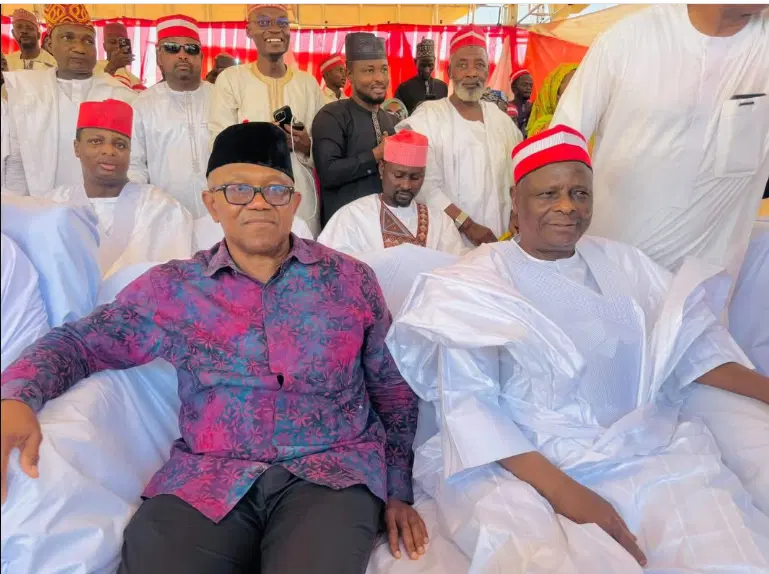
The presidential candidate of the Nigeria Democratic Congress (NDC), Peter Obi, has explained the rationale behind selecting former Kano State Governor and leader of the Kwankwasiyya Movement, Senator Rabiu Musa Kwankwaso, as his running mate for the 2027 presidential election, saying the decision was based on their shared commitment to eradicating poverty through education, human capital development and economic transformation.
Obi made the remarks during an interview with The Sun published on Sunday, where he outlined the principles that informed the partnership, describing it as an alliance built on common values rather than political convenience.
According to the former Anambra State governor, both he and Kwankwaso are driven by the belief that education remains the most effective tool for lifting millions of Nigerians out of poverty and repositioning the country for sustainable development.
He said the choice of Kwankwaso was influenced by the former governor’s longstanding commitment to education and social empowerment, noting that they share a common philosophy on governance and national development.
“Kwankwaso has the philosophy of pulling people out of poverty,” Obi said.
“I have the same philosophy. Kwankwaso believes in education. You cannot change society without education.”
Obi stressed that education would occupy a central place in an NDC administration if elected into office, maintaining that Nigeria could only unlock its vast potential by investing heavily in its human capital.
He noted that successive governments had failed to adequately prioritise education, resulting in rising poverty, unemployment and underdevelopment across the country.
Referring to his previous public statements on social media, Obi reiterated that education would remain one of the pillars of his policy agenda.
“If you look at my X, formerly Twitter, I made it clear that I will emphasise education. Education is going to change society,” he said.
“Nigeria must be seen to form its innermost human capital, which we need to develop. Kwankwaso believes in this. I do. We have synergy.”
The NDC presidential candidate said the partnership between himself and Kwankwaso goes beyond politics, describing it as a convergence of ideas aimed at addressing Nigeria’s deep-rooted socio-economic challenges.
Obi dismissed suggestions that differences existed between him and his running mate, insisting that reports of tension within the ticket were unfounded.
According to him, the two leaders have maintained a cordial working relationship and remain focused on their common objective of building a better Nigeria.
“I don’t know why people talk about differences between people who are working together. Have you ever seen us quarrelling?” he asked.
He argued that many political disagreements in Nigeria stem from what he described as transactional politics, where public office is pursued for personal gain rather than public service.
Obi said his administration would pursue transformational governance focused on delivering measurable improvements in the lives of Nigerians instead of sharing political patronage.
“You see, people quarrel even in offices because of transactional governance,” he said.
“The country is in a mess because of transactional governance. I am not into transactional government. I am into transformational governance.”
According to him, the objective of the NDC presidential ticket is to create opportunities that will enable millions of Nigerians to escape poverty and become economically productive.
“We want to change the society and make it better. We want to pull people out of poverty, not the other way around,” he stated.
Obi and Kwankwaso were among the leading contenders in Nigeria’s 2023 presidential election.
Obi contested under the Labour Party platform and finished third, while Kwankwaso, who flew the flag of the New Nigeria Peoples Party (NNPP), placed fourth behind President Bola Ahmed Tinubu of the All Progressives Congress (APC) and former Vice President Atiku Abubakar, who contested on the platform of the Peoples Democratic Party (PDP).
Following the 2023 elections, the three opposition leaders became part of a broader coalition that emerged in 2026 under the African Democratic Congress (ADC), aimed at presenting a united front against the ruling APC.
However, political disagreements, internal leadership disputes and legal controversies within the coalition later led Obi and Kwankwaso to leave the ADC and join the Nigeria Democratic Congress, where they eventually emerged as the party’s presidential and vice-presidential candidates for the 2027 general election.
Responding to questions about why a similar alliance between himself and Kwankwaso did not materialise before the 2023 elections, Obi declined to dwell on past political events, saying his attention is firmly fixed on Nigeria’s future.
According to him, effective leadership requires looking ahead rather than becoming distracted by missed opportunities or previous political calculations.
“Those who think about yesterday and today will miss tomorrow,” he said.
“The past is gone. We are talking about the present.”
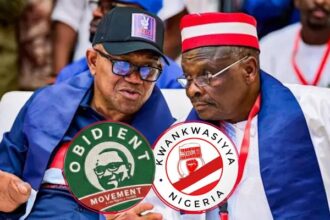
Obi also dismissed concerns that merging two influential political movements—the Obidient Movement and the Kwankwasiyya Movement—could create internal conflicts within the NDC.
According to him, both groups are united by a common aspiration for national renewal and are committed to supporting policies capable of improving the welfare of ordinary Nigerians.
He maintained that supporters of both camps are motivated not by political patronage but by a shared desire to see a country that works for everyone.
“We do not just have large followers alone,” Obi said.
“People are gravitating to what is right.”
Addressing concerns about managing the interests of both political blocs, Obi expressed confidence that there would be no difficulty because the alliance was founded on shared ideals rather than competing ambitions.
“How are we going to manage them? We have no problem whatsoever,” he said.
“We want to change the society. Our followers want a changed and better society.”
Political analysts have described the Obi-Kwankwaso alliance as one of the most significant developments ahead of the 2027 presidential election, given the electoral strength of both politicians in different regions of the country.
While Obi commands substantial support among young voters and urban populations across the South-East, South-South and parts of the South-West, Kwankwaso remains a dominant political figure in Kano State and enjoys considerable influence across Northern Nigeria through the Kwankwasiyya Movement.
Supporters of the alliance argue that combining both political structures could broaden the NDC’s national appeal, while critics contend that the coalition will face stiff competition from the ruling APC and other opposition parties.
Despite the differing assessments, Obi insisted that the partnership is not merely about winning elections but about laying the foundation for a government focused on education, economic growth, poverty reduction and transformational leadership.
He reiterated that the ultimate objective of the NDC ticket is to build a Nigeria where governance prioritises human development, creates opportunities for citizens and restores hope in the country’s future.