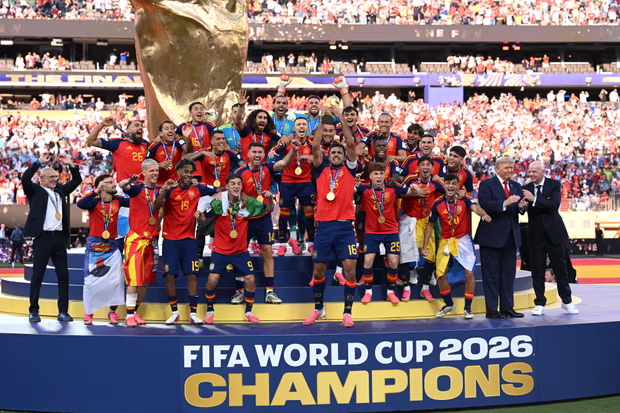
Spain were crowned FIFA World Cup champions for the second time after defeating Argentina 1-0 in a tense and hard-fought final that was ultimately decided in extra time. In a match that offered few clear-cut chances during regulation time, Barcelona winger Ferran Torres emerged as the hero, scoring the decisive goal in the 106th minute to hand La Roja another historic triumph on the global stage.
The victory capped an impressive tournament for Spain, who had earlier dismantled tournament favourites France in the semi-finals before overcoming a resilient but increasingly defensive Argentine side in the final. The result also secured Spain’s second World Cup title, adding to the European Championship they won two years earlier, making it the second time in their history they have simultaneously held both the European and world titles, having previously achieved the feat following their 2010 World Cup success.
Despite the significance of the occasion, the final itself struggled to live up to expectations for much of the contest. The match was characterised by cautious play, physical battles and limited attacking quality, with Spain dominating possession while Argentina focused primarily on frustrating their opponents through disciplined defending and tactical fouls.
Spain controlled proceedings from the opening whistle, creating the majority of the opportunities while Argentina rarely ventured forward. The European champions consistently pressed high, controlled midfield possession and forced Argentina deep into their own half, but they repeatedly found themselves denied by an inspired performance from goalkeeper Emiliano Martínez.
Martínez produced a string of outstanding saves throughout normal time and extra time to keep Argentina in the contest. The Aston Villa goalkeeper frustrated Spain’s attackers on several occasions, denying efforts from Rodri, Nico Williams, Dani Olmo and Lamine Yamal as Spain searched relentlessly for a breakthrough.
Argentina, by contrast, struggled to impose themselves offensively. Their attacking players found little space against Spain’s organised defensive structure, and they managed only a handful of attempts on goal during the entire encounter.
As frustration mounted, the South American side increasingly resorted to physical challenges and tactical fouls to disrupt Spain’s rhythm. The aggressive approach culminated in midfielder Enzo Fernández receiving a second yellow card late in normal time, reducing Argentina to ten men just before the end of the initial 90 minutes.
The dismissal significantly shifted the balance of the contest heading into extra time, with Spain enjoying numerical superiority and pressing even harder in search of the winning goal.
Their persistence was finally rewarded in the 106th minute.
Right-back Pedro Porro delivered an inviting cross toward the far post, where Nico Williams displayed remarkable composure to keep the ball in play before squaring it across the face of goal. Ferran Torres reacted quickest, firing a clinical finish beyond Martínez to spark jubilant celebrations among the Spanish players and supporters.
The goal proved decisive, as Argentina struggled to mount a meaningful response despite throwing additional players forward during the closing stages of extra time.
The defending runners-up finally managed to create two opportunities in the dying minutes, but Spain’s defence remained resolute to preserve the slender advantage and secure a memorable victory.
Statistics highlighted Spain’s complete dominance throughout the contest.
Luis de la Fuente’s side registered 20 shots compared to Argentina’s two efforts, both of which came only after Torres had given Spain the lead. Spain also controlled possession for long periods, dictated the tempo of the match and consistently forced Argentina onto the defensive.
Many observers agreed that without Martínez’s exceptional goalkeeping display, Spain would likely have wrapped up the contest long before extra time.
While the football itself was largely tactical and attritional, the final moments of the match descended into controversy.
Immediately after the final whistle, tempers flared following an incident involving Argentine midfielder Leandro Paredes, who pushed Spain’s Gavi and Eric García to the ground, triggering a mass confrontation between players from both sides.
The altercation resulted in Paredes receiving a straight red card, joining Enzo Fernández in being sent off, as Argentina finished the match with nine players.
The scenes reflected the growing frustration within the Argentine camp after their disciplined defensive strategy ultimately failed to prevent Spain from lifting the trophy.
Elsewhere, the post-match celebrations also attracted significant attention.
United States President Donald Trump, who attended the final alongside FIFA President Gianni Infantino, was met with loud boos from sections of the crowd when he appeared for the trophy presentation.
Trump joined Infantino in presenting the championship trophy to Spain captain Rodri but appeared reluctant to step away as the Spanish players celebrated their triumph on the podium.
The trophy ceremony also reflected FIFA’s expanding commercial and geopolitical relationships.
Individual awards, including the tournament’s Best Player honour won by Rodri, were presented by Yasir Al-Rumayyan, Governor of Saudi Arabia’s Public Investment Fund and Chairman of Newcastle United Football Club.
His prominent role during the ceremony highlighted Saudi Arabia’s growing influence within international football ahead of its hosting of future major FIFA events.
For Argentina, the defeat marked an emotional end to their campaign.
Captain Lionel Messi was warmly applauded by supporters throughout the stadium as he collected his runners-up medal, with the veteran forward visibly overcome by emotion and seen in tears following the defeat.
However, the mood within the Argentine squad contrasted sharply with the sportsmanship displayed by supporters.
Rather than facing the podium as Spain received their medals, several Argentine players turned away toward their own supporters behind one of the goals, a gesture that some observers interpreted as an expression of disappointment and frustration.
The action drew criticism from sections of the football community, who viewed it as an unfortunate conclusion to an otherwise memorable tournament.
Among the distinguished guests present for the final was King Felipe VI of Spain, who watched the match from President Trump’s private hospitality suite at the New York New Jersey Stadium.
Also in attendance were Canadian Prime Minister Mark Carney, Mexican President Claudia Sheinbaum, FIFA President Gianni Infantino and several members of the Trump family, underscoring the global significance of the tournament’s showpiece event.
Although the final itself lacked the drama and attacking spectacle that characterised many earlier matches in the competition, Spain emerged as deserving champions after producing consistently dominant performances throughout the tournament.
Their impressive run included victories over several of the world’s strongest footballing nations, culminating in another World Cup triumph that further cements Spain’s place among the elite teams in international football.
For head coach Luis de la Fuente and his players, the victory represents the continuation of a golden era for Spanish football, built on technical excellence, tactical discipline and a new generation of talented stars.
Meanwhile, Argentina leave the tournament with questions to answer after a performance that relied heavily on defensive resilience and outstanding goalkeeping but ultimately lacked the attacking ambition needed to retain football’s biggest prize.
As Spain celebrated another historic World Cup success, the tournament concluded with the European champions firmly established as the world’s leading football nation, having once again conquered both Europe and the global stage.