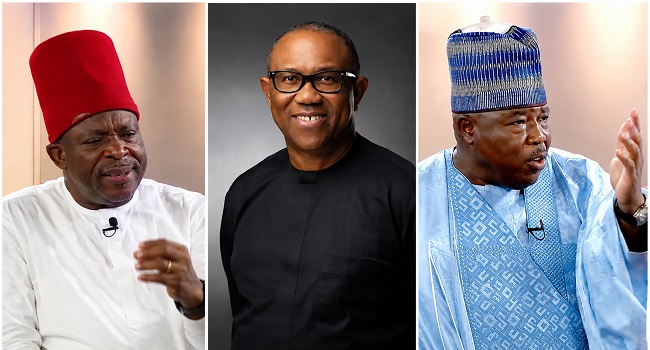
The Senator representing Anambra Central Senatorial District, Victor Umeh, has accused former Borno State Governor, Ali Modu Sheriff, of attempting to incite Northern Nigerians against the presidential candidate of the Nigeria Democratic Congress (NDC), Peter Obi, ahead of the 2027 general elections.
Umeh made the allegation while responding to comments made by Sheriff during an appearance on Channels Television’s Politics Today on Monday, where the former governor asserted that Obi would not receive the support of Northern voters in the next presidential election.
According to Sheriff, Peter Obi stands little chance of winning votes in the North because, in his view, the former Anambra State governor remains a divisive political figure.
“I am not worried about Peter Obi at all because I know that Northerners will never vote for Peter Obi,” Sheriff stated during the programme.
When the programme’s host reminded him that Obi had secured significant votes across several Northern states, including Nasarawa and Plateau, during the 2023 presidential election, Sheriff dismissed the comparison, insisting that the political climate had changed.
“The situation is different now, you know why? Peter Obi, when he was a governor, chased all the Northerners out of Anambra State,” Sheriff alleged.
The claim immediately generated reactions from political observers and supporters of the former Labour Party presidential candidate, many of whom rejected the allegation as misleading.
Appearing on the same television programme on Tuesday, Senator Umeh strongly criticized Sheriff’s comments, accusing the former governor of reviving outdated narratives capable of deepening ethnic and regional divisions in the country.
According to Umeh, Nigeria has progressed beyond the politics of ethnic polarization and should instead focus on reconciliation, national unity and inclusive development.
He argued that attempts to discourage Northerners from supporting Peter Obi amounted to deliberate political propaganda aimed at undermining the former presidential candidate’s growing popularity ahead of the 2027 elections.
“Anybody who gets up to say the North will not vote for Peter Obi, they are inciting their people against Peter Obi to use that and weaponise a war that ended 56 years ago, that the North should not vote for Peter Obi,” Umeh said.
He maintained that such rhetoric belonged to a bygone era and had no place in a modern democratic society striving for national cohesion.
“Let them remain in the stone age. Nobody is in the stone age anymore. Nigeria is moving. And if you don’t do reconciliation and healing, you cannot move forward,” the senator added.
Umeh accused Sheriff of attempting to exploit historical divisions for political advantage instead of promoting national unity and issue-based campaigns.
According to him, the former governor was intentionally seeking to whip up regional sentiments against Obi before the commencement of full-scale campaigns for the 2027 presidential election.
“So, what he (Ali Modu Sheriff) is trying to do is to whip up sentiment against Peter Obi ahead of the election,” Umeh stated.
The senator went on to describe Obi as one of Nigeria’s most peaceful and non-violent political leaders, saying his message has consistently centered on national renewal, good governance and peaceful coexistence.
“Peter Obi is one of the finest souls Nigeria has had. Somebody who is non-violent, somebody who preaches peace, somebody even if you slap him he will smile and he continues with his message of change. Let this country be turned around,” Umeh said.
The exchange between the two politicians comes against the backdrop of Peter Obi’s sustained criticism of President Bola Ahmed Tinubu’s administration, particularly over the country’s worsening security situation and economic hardship.
In recent weeks, Obi has repeatedly questioned the Federal Government’s handling of insecurity, arguing that the protection of lives and property remains the primary responsibility of any government.
The former Anambra governor has also suggested that President Tinubu should consider resigning if he is unable to effectively address the nation’s growing security challenges.
Sheriff, however, rejected Obi’s position, insisting that the President has been making sincere efforts to combat insecurity and stabilize the country.
The former Borno governor argued that Obi was not in the best position to demand the resignation of the President, maintaining that the Tinubu administration inherited complex security problems that could not be resolved overnight.
But Umeh defended Obi’s comments, stressing that freedom of expression and political criticism are fundamental components of democracy.
According to him, every Nigerian, including opposition leaders, has the constitutional right to assess the performance of those in government and express opinions on issues affecting the country.
“He has a right to say the president has not met the expectations of the Nigerian people,” Umeh said.
The senator further argued that calling on a sitting president to resign over perceived poor performance is not unprecedented in Nigerian politics.
“It is politically allowed to say resign because the current president asked Jonathan to resign when he was in office,” he added.
Umeh also criticized the economic policies of the current administration, saying many Nigerians continue to face severe hardship due to rising inflation, increasing transportation costs and the persistent high price of Premium Motor Spirit (PMS), popularly known as petrol.
According to him, the rising cost of fuel has triggered increases in the prices of food, transportation and other essential goods and services, placing enormous pressure on households across the country.
He argued that despite repeated assurances by the Federal Government that economic reforms would eventually produce positive outcomes, many Nigerians have yet to experience any meaningful improvement in their living conditions.
The lawmaker maintained that opposition politicians have a responsibility to hold governments accountable and offer alternative policy options where they believe the administration has fallen short of public expectations.
The latest war of words between Sheriff and Umeh reflects the intensifying political realignments and rhetoric ahead of the 2027 general elections, as parties and political figures continue to position themselves for what is expected to be another fiercely contested presidential race.
Political analysts say the exchange also highlights the growing contest over regional narratives and voter mobilization strategies as political actors seek to consolidate support across Nigeria’s diverse ethnic and geographical blocs before the next election cycle.