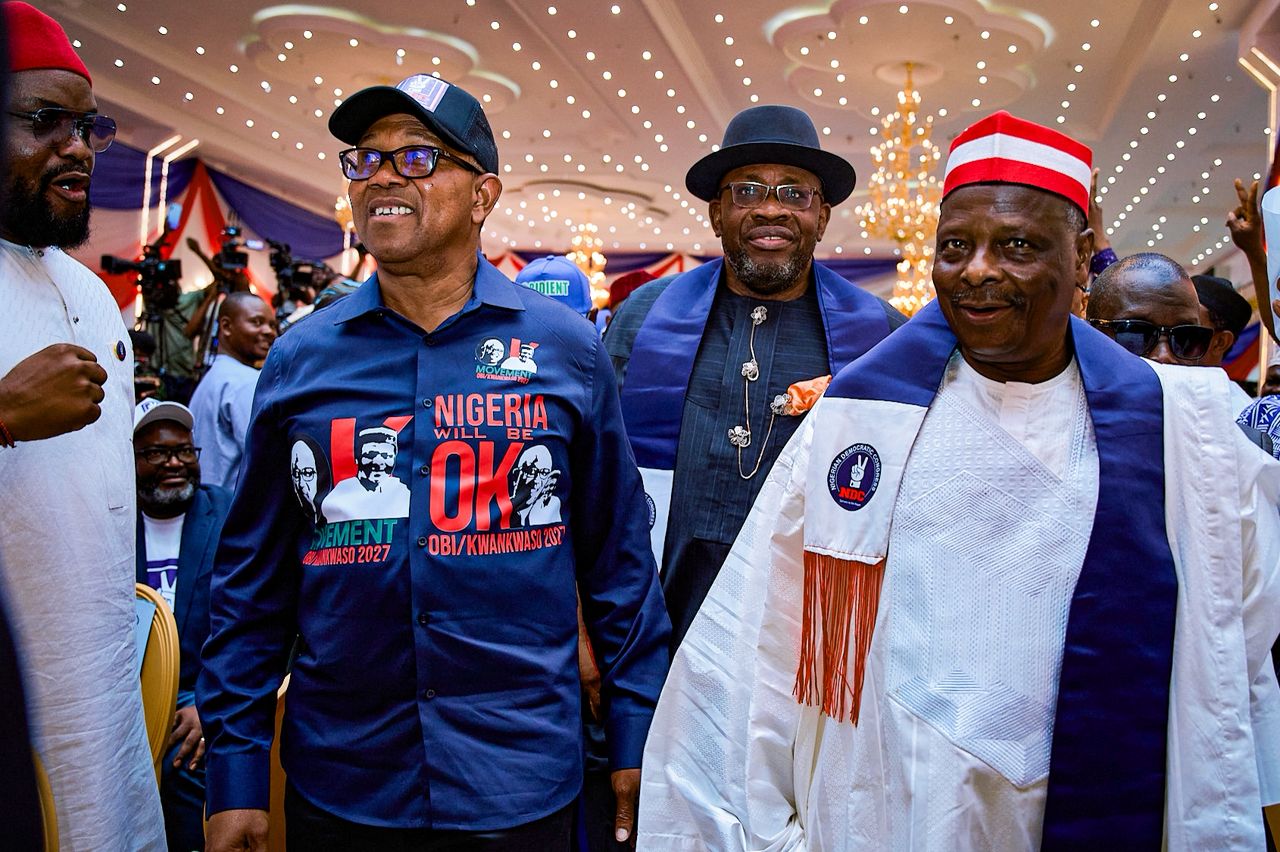
The presidential candidate of the Nigeria Democratic Congress (NDC) and former Governor of Anambra State, Peter Obi, has challenged the economic performance of President Bola Tinubu’s administration, arguing that despite claims of increased government revenue, the living conditions of ordinary Nigerians have continued to deteriorate.
In a statement released on Wednesday through his official X account, Obi expressed concern over what he described as a contradiction between the Federal Government’s reported revenue growth and the worsening economic realities facing citizens across the country.
According to Obi, President Tinubu recently highlighted the increase in government revenue from N16.8 trillion in 2022 to approximately N35 trillion in 2025 as one of the major achievements of his administration after three years in office. The former governor acknowledged that the figures indicate a rise of more than 100 percent in revenue generation but questioned why such growth has not translated into improved economic outcomes for Nigerians.
Obi argued that an administration experiencing such a significant increase in revenue should ordinarily reduce its reliance on borrowing. Instead, he alleged that the Federal Government has continued to accumulate debt at an alarming rate, despite the reported improvement in earnings.
He stated that rather than witnessing a decline in borrowing, Nigerians have seen what he described as an unprecedented expansion of the country’s debt burden.
“Shockingly, while Nigerians expected a reduction in borrowing with the exponential increase in revenue, the opposite is the case,” Obi said.
He further claimed that the Tinubu administration has become increasingly dependent on borrowing to finance government activities, resulting in a dramatic rise in Nigeria’s total debt profile.
“In just three years, President Bola Tinubu’s government seems to be obsessed with excessive and imprudent borrowing, with our total debt currently about N200 trillion—a deeply disturbing increase of over N100 trillion,” Obi stated.
The former governor argued that the growth in government revenue was not solely the result of domestic economic policies. According to him, geopolitical developments and global economic circumstances have contributed significantly to increased revenue inflows into the country.
He maintained that the administration has benefited from international and regional developments that boosted earnings but has failed to convert those gains into measurable improvements in the lives of citizens.
Obi also pointed to what he described as deteriorating socio-economic indicators under the current administration, insisting that the country’s economic condition has worsened despite the substantial rise in both revenue and public debt.
He claimed that multidimensional poverty levels have increased significantly over the past two years, rising from approximately 87 million Nigerians in 2023 to more than 140 million people in 2025.
According to him, unemployment has also continued to rise, while average income levels and economic productivity have weakened.
The former presidential candidate further noted that Nigeria’s Gross Domestic Product (GDP) per capita has declined sharply during the period under review.
He alleged that GDP per capita fell from about $1,597 in 2023 to approximately $1,223 in 2025, suggesting that economic growth has not kept pace with population expansion or translated into improved living standards.
“Alarmingly, even with the astronomical increase in both revenue and debt, almost all key socio-economic and governance indicators are worse than in 2023,” Obi stated.
Against this backdrop, he questioned the management of public resources by the Federal Government and demanded greater transparency regarding the utilisation of funds generated through revenue and borrowing.
“Where did all the money go?” Obi asked.
He called on the government to provide Nigerians with a comprehensive account of how public funds have been managed since 2023.
According to him, citizens deserve a detailed explanation regarding the country’s fiscal position, expenditure patterns and debt accumulation over the past three years.
Obi also urged the government to abandon what he described as opaque and unaccountable financial practices, insisting that public resources should be managed with greater transparency and prudence.
The statement is the latest in a series of criticisms by the former governor concerning the administration’s fiscal policies.
A day earlier, Obi had also questioned the Federal Government’s borrowing strategy, arguing that Nigeria’s debt profile had expanded at a pace that raises concerns about long-term economic sustainability.
He noted that public debt had increased by more than N100 trillion within three years and contrasted this with the approximately N49 trillion debt accumulated during the eight-year administration of former President Muhammadu Buhari.
According to Obi, the current debt trajectory is unsustainable and risks placing an even heavier burden on future generations.
However, the Presidency has rejected Obi’s claims and defended the administration’s economic record.
Officials of the Federal Government argue that a substantial portion of Nigeria’s debt obligations predates the Tinubu administration and cannot be attributed solely to policies implemented since 2023.
Responding to the allegations, the Presidency noted that the government inherited significant financial obligations from previous administrations, including approximately N20 trillion in Ways and Means advances that were later converted into formal debt instruments.
Special Assistant to the President on Social Media, Dada Olusegun, maintained that public discussions about Nigeria’s debt often overlook the fact that national debt figures include obligations accumulated by state governments over many years.
According to him, it would be inaccurate to attribute the entire debt stock exclusively to the Federal Government under President Tinubu.
Olusegun also questioned Obi’s interpretation of the debt figures, explaining that fluctuations in exchange rates have significantly increased the naira value of Nigeria’s external debt obligations.
He argued that part of the apparent rise in public debt reflects currency depreciation rather than entirely new borrowing.
The exchange between Obi and the Presidency highlights the growing debate over the state of Nigeria’s economy as citizens continue to grapple with rising inflation, high living costs, unemployment and declining purchasing power.
With economic issues expected to remain at the centre of political discourse ahead of future elections, questions surrounding government revenue, debt management, poverty levels and fiscal accountability are likely to continue attracting significant public attention.
For Obi, the central issue remains whether the substantial increase in government revenue and borrowing has delivered meaningful benefits to Nigerians. For the Presidency, the challenge is convincing citizens that ongoing economic reforms and fiscal measures will eventually translate into sustainable growth and improved living standards.