United States President Donald Trump abruptly terminated a televised interview with NBC News after being pressed on his repeated claims that recent election results in California were manipulated, adding another dramatic chapter to his often-contentious relationship with major American media organizations.
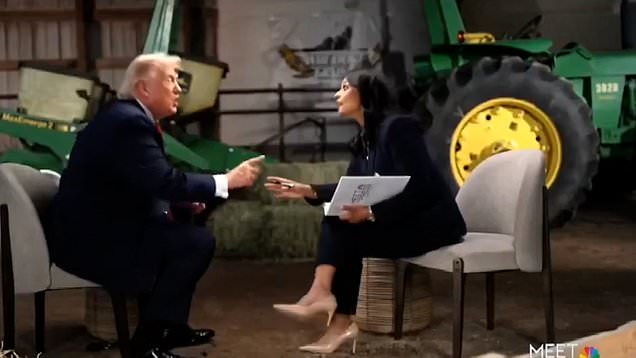
The tense exchange occurred during an interview with NBC’s Kristen Welker on the network’s flagship political programme, Meet the Press. What began as a discussion on domestic politics and foreign affairs quickly escalated into a heated confrontation after Welker questioned Trump about his allegations that delays in counting ballots in California were evidence that the election had been “rigged.”
Trump, visibly irritated by the line of questioning, launched into a broad attack on the American media, accusing major news organizations of bias and dishonesty.
“The elections are like a third-world country,” Trump said during the interview. “Your elections are crooked and you’re crooked and Meet the Press is crooked and so is ABC and CBS and CNN.”
The president continued his criticism, accusing the media of operating with a one-sided agenda.
“You are one-sided crooked networks,” Trump declared before indicating that he wanted to end the interview. “Let’s call it quits. I’ve had enough. Thank you darling, have a good time.”
As Trump prepared to leave, Welker attempted to persuade him to remain and continue the discussion, reminding the president that she had travelled a considerable distance to conduct the interview.
“I came all the way to Wisconsin for this interview,” she reportedly told him.
The appeal did little to soften Trump’s stance.
“I’ve sat in the rain with you for an hour,” Trump responded. “I’ve given you enough time. You ought to straighten out your press.”
The president then broadened his criticism beyond the network, arguing that the media was damaging public trust and weakening the country.
“You know what? A country can never be great with a dishonest press,” Trump said before ending the interview and walking away.
The dramatic conclusion quickly became one of the most talked-about political moments of the day, generating widespread discussion across television networks and social media platforms.
The confrontation also highlighted Trump’s long-running disputes with mainstream media organizations, which he has frequently accused of unfair coverage and political bias throughout his political career.
Beyond the clash over election claims, the interview also featured several controversial remarks regarding ongoing tensions in the Middle East, particularly involving Iran.
Trump made sweeping assertions about the effectiveness of recent military actions against Iranian forces, claiming that significant portions of Iran’s military infrastructure had been completely destroyed.
According to Trump, major branches of Iran’s armed forces had been rendered ineffective.
“Their navy is gone. Their air force is gone. Their anti-aircraft is gone,” he said.
The president further argued that the military pressure exerted under his administration had crippled Iran’s defensive capabilities.
“In three months, I’ve demolished the navy, the air force, anti-aircraft,” Trump said. “They have no radar. They have nothing.”
However, independent assessments and media analyses have presented a more complex picture of Iran’s military capabilities.
According to NBC’s own analysis, a substantial portion of Iran’s unconventional naval forces remains operational despite weeks of military strikes and regional hostilities. Security experts have also cautioned against characterizing Iran’s military capacity as completely eliminated, noting that Tehran continues to maintain significant military assets and strategic capabilities.
The interview also revisited one of Trump’s most prominent campaign themes: his pledge to avoid entangling the United States in new foreign wars.
Welker questioned the president about statements he made during the 2024 presidential campaign, when he repeatedly promised voters that he would keep America out of prolonged military conflicts overseas.
Responding to the question, Trump appeared to reject the suggestion that he had made an absolute commitment against future military engagements.
“I didn’t guarantee no war,” Trump said. “Why would I have built the strongest military in the world? I built our military.”
The comment immediately drew attention because it appeared to contrast with several campaign speeches in which Trump emphasized his determination to prevent American involvement in new conflicts.
During a major campaign rally in Pennsylvania in 2024, Trump had assured supporters that he would not send American troops into what he described as unnecessary foreign wars.
“I will not send you to fight and die in stupid foreign wars that never end,” Trump told supporters at the time.
He further pledged that American servicemen and women would not be deployed to conflicts in distant countries with little relevance to U.S. interests.
“I will not send our sons and daughters to go fight for a war in a country that you’ve never heard of,” he said. “We’re not going to do it. We’re going to bring our troops home, and we’re going to focus on America First.”
Similarly, following his victory in the 2024 presidential election, Trump highlighted peace and conflict resolution as central goals of his administration.
In his victory speech, he declared: “I’m not going to start a war. I’m going to stop wars.”
Those previous remarks have become a defining part of Trump’s foreign policy message, helping him appeal to voters who were weary of prolonged military engagements and expensive overseas interventions.
The latest interview, however, suggested a more nuanced position, with Trump emphasizing military strength while declining to rule out future conflicts entirely.
Political analysts noted that the exchange reflects an ongoing tension within Trump’s political brand. While he continues to promote an “America First” approach that prioritizes domestic concerns and limits foreign entanglements, he has also consistently advocated maintaining overwhelming military power as a deterrent against adversaries.
The NBC interview ultimately became notable not only for the policy issues discussed but also for the dramatic manner in which it ended. Trump’s decision to walk out underscored the increasingly adversarial relationship between the White House and sections of the American press.
As debate continues over election integrity, foreign policy, and the role of the media in American democracy, the interview is likely to remain a focal point of political discussion in the days ahead.
For supporters, Trump’s willingness to confront journalists directly reinforces his image as a leader who challenges establishment institutions. For critics, the episode raises concerns about transparency, accountability and the president’s willingness to engage with difficult questions.
Either way, the confrontation once again demonstrated that interactions between Donald Trump and the media remain among the most closely watched and polarizing aspects of contemporary American politics.