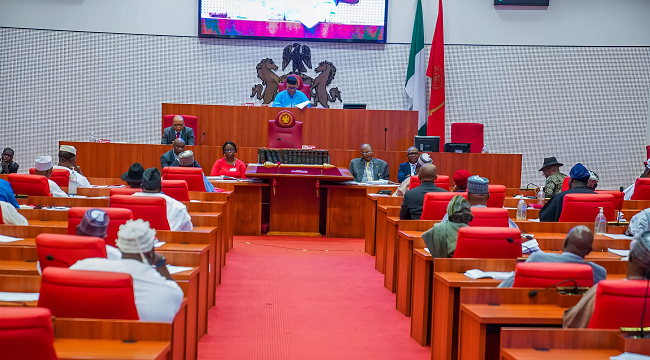
Nigeria’s Senate has approved a significant amendment to its internal rules, introducing stricter eligibility criteria for the office of Senate President and other principal leadership positions. The move, which was finalized during a closed-door session held on Tuesday, May 5, is aimed at reinforcing institutional experience, strengthening legislative hierarchy, and ensuring that only seasoned lawmakers occupy the highest offices in the chamber.
The decision marks a notable shift in the Senate’s approach to leadership selection, placing greater emphasis on continuity and parliamentary expertise. Lawmakers who participated in the deliberations indicated that the amendment was necessary to preserve the integrity of the legislative process and prevent the emergence of relatively inexperienced members in positions that require deep institutional knowledge.
Under the revised rules, only senators currently serving in the 10th National Assembly who have completed at least two terms in the Senate will be eligible to contest for principal offices, including that of Senate President. Crucially, the amendment stipulates that one of those terms must be the immediate term preceding the election, effectively excluding first-time senators and those returning after a break in service.
This provision introduces a more restrictive framework that prioritizes continuity within the chamber. By requiring that eligible candidates must be returning lawmakers from the current assembly, the Senate has narrowed the field of potential contenders to a smaller pool of experienced legislators who are already familiar with the workings, procedures, and traditions of the institution.
The amendment is captured in the updated Order 4 of the Senate Standing Rules, which now explicitly mandates that nominations for presiding officers must strictly follow the established ranking system within the chamber. According to the revised provision, adherence to ranking is no longer discretionary but compulsory.
“Nomination of Senators to serve as Presiding Officers shall be in accordance with the ranking of Senators and shall be strictly adhered to,” the rule states, signaling a firm commitment to institutional hierarchy.
The ranking structure itself has also been clearly outlined to eliminate ambiguity in future leadership contests. The order of precedence begins with former Presidents of the Senate, followed by former Deputy Presidents of the Senate. Next in line are former Principal Officers, such as Senate Leaders, Chief Whips, and Minority Leaders.
Beyond this group, eligibility extends to senators who have served at least one full term of four years. This is followed by lawmakers who previously served in the House of Representatives before transitioning to the Senate. At the lowest end of the hierarchy are first-time senators, who, under the new rules, will only be considered in the absence of all higher-ranking categories.
However, the additional requirement of two Senate terms—combined with the condition that one must be the immediate past term—effectively disqualifies most first-time entrants and limits serious contention for top offices to a select group of returning lawmakers with substantial legislative experience.
By implication, only members of the current Senate who secure re-election into the next National Assembly will be eligible to vie for the position of Senate President and other principal roles. This ensures that leadership contests will be dominated by individuals who have demonstrated both electoral viability and sustained engagement within the legislative system.
Supporters of the amendment argue that the changes will promote stability and reduce internal conflicts often associated with leadership tussles. They contend that experienced lawmakers are better equipped to manage the complexities of legislative governance, build consensus, and navigate the procedural demands of the Senate.
The move is also seen as an effort to institutionalize the principle of ranking, which has historically played a role in determining leadership positions but has not always been strictly enforced. By codifying this principle into binding rules, the Senate aims to eliminate uncertainty and ensure a more predictable and orderly transition of leadership.
Critics, however, may view the amendment as potentially exclusionary, arguing that it limits opportunities for fresh perspectives and could entrench a political elite within the chamber. Nonetheless, proponents maintain that the benefits of experience and continuity outweigh such concerns, particularly in a legislative environment that requires a high level of procedural competence.
The development comes at a time when Nigeria’s political landscape is gradually shifting in anticipation of future electoral cycles. With the new rules in place, aspiring Senate leaders will need to strategically position themselves within the framework of experience, re-election, and institutional ranking.
Ultimately, the amendment reflects a broader effort by the Senate to strengthen its internal governance structures and ensure that leadership roles are occupied by individuals with proven legislative track records. By prioritizing experience and continuity, the chamber appears determined to enhance its effectiveness and uphold the traditions that underpin parliamentary democracy in Nigeria.