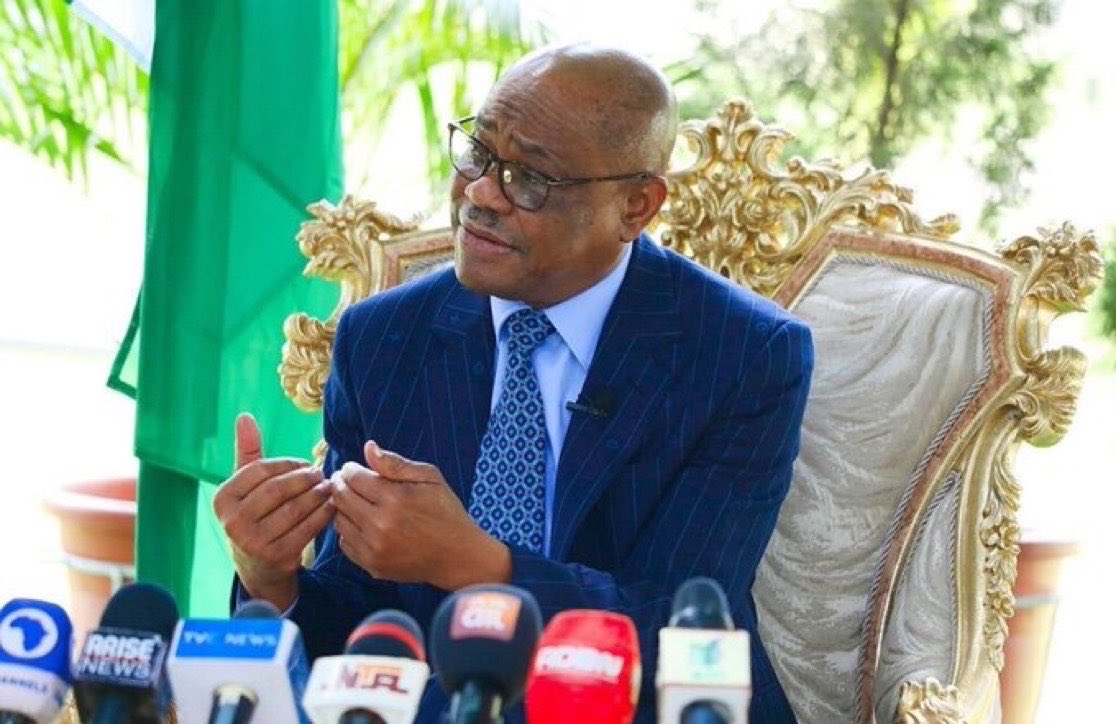
Lere Olayinka, Senior Special Assistant on Public Communications and Social Media to the Minister of the Federal Capital Territory, Nyesom Wike, has provided clarification regarding a controversial statement made by the minister during a recent media chat on Channels Television.
In a statement issued on Saturday, Olayinka explained that the minister’s remark, which referenced “shooting” television anchor Seun Okinbaloye, was not meant to be taken literally but was instead a figurative expression made in the heat of the moment.
According to him, Wike did not intend any form of threat and had already clarified his position during the live broadcast. He further revealed that both the minister and Okinbaloye had spoken privately after the programme, with the journalist reportedly understanding the context in which the comment was made.
“The Minister never meant that he would shoot Seun Okinbaloye,” Olayinka stated. “They even spoke on the phone today, and he (Okinbaloye) understood what the minister meant.”
He explained that Wike’s frustration stemmed from his perception that Okinbaloye, whom he regards highly as a professional journalist, deviated from the role of an objective interviewer during the session. According to Olayinka, the minister felt that the anchor’s line of questioning suggested a partisan stance, rather than the neutrality expected in a media interview.
Olayinka emphasized that the statement was delivered in a hyperbolic context—a rhetorical device often used to exaggerate a point for emphasis—and should not be interpreted as a literal expression of intent.
“What the minister meant, which he made clear during the media chat, was that he was displeased seeing Okinbaloye, whom he holds in high esteem, descending into the political arena by speaking as an interested party instead of maintaining the role of an interviewer,” he said.
He also noted that the atmosphere during the live programme did not reflect any sense of hostility or alarm among those present. According to him, after Wike offered further clarification on air—stating explicitly that he did not mean he would carry a gun and shoot the journalist—the comment was received with laughter by the interview panel.
Among those present during the interview was Chamberlain Usoh, Head of Channels Television’s Abuja Office, alongside other journalists, all of whom, Olayinka said, understood the remark as figurative rather than threatening.
The aide warned against what he described as attempts by some individuals and groups to deliberately misinterpret the comment for political purposes. He argued that isolating the statement from its full context and amplifying it could amount to misinformation and misrepresentation.
“After the minister’s detailed explanation of what he meant, including his clarification on live television that he did not intend any form of violence, it becomes unfair and misleading for anyone to take the statement out of context and use it for ulterior motives,” Olayinka said.
He urged members of the public to disregard narratives that portray the minister’s remark as a genuine threat, insisting that such interpretations are driven by political interests rather than facts.
“The public is therefore advised to discountenance attempts to use this comment as a tool for blackmail or propaganda by those seeking to distort the truth for political gain,” he added.
The clarification comes amid widespread reactions to the minister’s statement, which had sparked debate across media and political circles regarding the boundaries of political rhetoric and responsible public communication.
Olayinka maintained that when viewed within its proper context, the comment was a moment of emotional expression rather than a reflection of intent, and should be understood as such.