A Russian military court on Thursday sentenced 15 men to life imprisonment, including four gunmen who carried out the deadly attack on the Crocus City Hall concert venue near Moscow in March 2024. The attack left 150 people dead and more than 600 injured, making it the deadliest terrorist assault in Russia in over two decades.
The verdict was delivered at a grand military court in Moscow in the presence of relatives of victims who had gathered to witness the conclusion of the high-profile trial. The attack, which shocked the nation and drew international condemnation, was claimed by the extremist group Islamic State.
The four main perpetrators—Shamsidin Fariduni, Dalerdzhon Mirzoyev, Makhammadsobir Fayzov and Saidakrami Rachabolizoda—were among those handed life sentences. All four are citizens of Tajikistan and were found guilty of carrying out the mass shooting and arson that devastated the concert venue.
According to prosecutors, the attackers stormed the Crocus City Hall complex shortly before a scheduled performance by the Soviet-era rock band Picnic on March 22, 2024.
Witnesses reported that the gunmen opened fire indiscriminately on concertgoers, causing panic and chaos as hundreds of people attempted to flee the venue. After the initial shooting spree, the attackers set the building on fire, trapping many victims inside the burning structure.
Emergency responders later discovered numerous bodies in the charred remains of the concert hall, with several victims believed to have died from smoke inhalation or burns after being unable to escape.
Authorities confirmed that six children were among those killed, while more than 600 people sustained injuries, many of them severe.
The Crocus attack became the most devastating terrorist incident in Russia since the Beslan school siege, during which hundreds of people—mostly children—were killed in a school hostage crisis in 2004.
Alongside the four gunmen, the court sentenced 11 additional men to life imprisonment after finding them guilty of assisting the attackers and maintaining links to terrorist organisations.
Some of the accomplices were Russian citizens, while others were foreign nationals believed to have supported the planning and execution of the attack.
The court concluded that these individuals played critical roles in facilitating the operation, including providing logistical support and helping the attackers move across borders and within Russia.
Prosecutors argued that their involvement made them equally responsible for the devastating consequences of the attack.
In addition to the 15 life sentences, the court handed prison terms ranging from 19 to 22 years to four other defendants who were found to have indirect connections to the attackers.
Among those convicted were a father and his two sons, whom prosecutors said had assisted members of the terrorist network or maintained contact with the perpetrators.
Although their roles were deemed less central to the operation, the court ruled that their involvement still constituted serious criminal activity under Russia’s anti-terrorism laws.
Several relatives of those killed in the attack attended the court hearing as the verdict was announced.
Many of them had followed the lengthy investigation and trial closely, hoping for justice for their loved ones.
Among those present was Ivan Pomorin, who had been filming the concert at Crocus City Hall when the attackers struck.
“For us all, it’s like yesterday,” Pomorin told reporters after the verdict.
He said the trauma of the attack remains fresh for victims and their families, even nearly two years after the tragedy.
However, Pomorin also expressed doubts about whether the full truth behind the attack had been uncovered.
“For us, the victims and relatives of the victims, it is not clear whether everyone has been brought to justice,” he said.
“It looks like these are not the people who could organise it. The investigative committee should continue its work.”
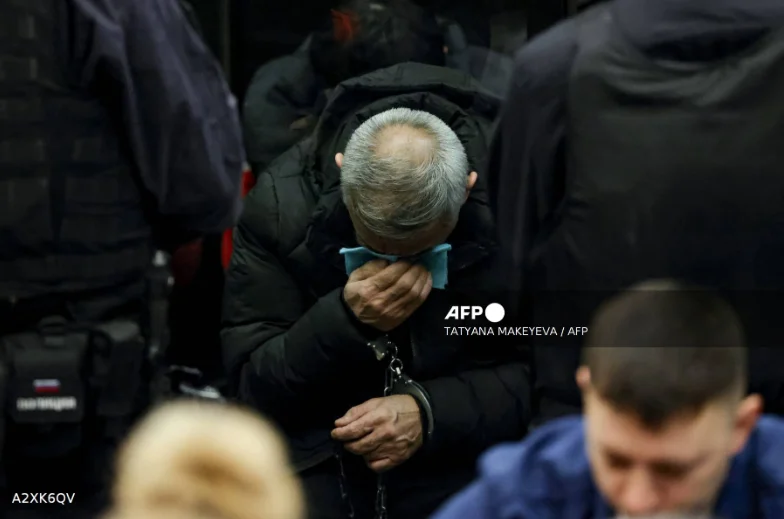
During the hearing, the four gunmen stood inside a glass defendant’s cage under heavy guard as the judge read out the sentences.
The attackers, aged between 20 and 31 at the time of the attack, had worked in various ordinary professions prior to the incident.
According to investigators, the men held jobs including taxi driving, factory work, and construction labour before becoming involved in extremist networks.
Russian media reports suggested that one of the attackers, Mirzoyev, may have been influenced by the death of his brother while fighting in Syria—an event authorities believe may have contributed to his radicalisation.
Shortly after the attack in 2024, Russian security forces arrested the suspects and brought them to court.
Images and videos circulating on social media at the time appeared to show the detainees bearing signs of physical abuse.
One suspect was reportedly brought into court in a wheelchair and appeared barely conscious, fuelling allegations that the suspects had been tortured during interrogation.
Footage allegedly linked to security agencies also showed bloody scenes from questioning sessions.
Russian authorities did not publicly confirm the allegations, but human rights organisations raised concerns about the treatment of the detainees.
In a separate development reported by the Russian state news agency TASS, two suspects reportedly asked the court for permission to fight in the war in Ukraine instead of serving life sentences.
The men—identified as Dzhabrail Aushyev and Khusein Medov—argued that they wished to redeem themselves by participating in combat.
According to a lawyer quoted by TASS, Medov told the court he wanted to “redeem his guilt with blood.”
Since launching its military campaign in Ukraine, Russia has recruited prisoners to fight on the front lines, sometimes offering reduced sentences if they survive the war.
However, it remains unclear whether the court considered or rejected the request made by the two suspects.
Following the verdict, Russia’s Investigative Committee of Russia stated that it had “reliably established” that the Crocus attack had been planned and carried out in the interests of Ukraine.
The committee also claimed that the suspects had been preparing additional attacks in the Russian republic of Dagestan.
The Kremlin had previously suggested a possible Ukrainian connection shortly after the attack, although it did not initially present concrete evidence.
Ukraine has consistently denied any involvement in the attack.
The Crocus City Hall tragedy had far-reaching consequences beyond the criminal trial.
In the aftermath of the attack, Russian authorities introduced stricter migration policies and intensified rhetoric against migrants, particularly those from Central Asia.
The crackdown strained relations with some of Russia’s traditional partners in the region, including Tajikistan, whose government urged Moscow to ensure that the rights of its citizens were respected.
Russia’s economy has historically relied on millions of migrant workers from Central Asia, many of whom work in construction, transportation, and service industries.
However, migration flows declined following the launch of Russia’s war in Ukraine and fell further after the new restrictions introduced in response to the Crocus attack.
The sentencing of the defendants came just days before the second anniversary of the March 2024 attack.
For families of the victims, the verdict represents a major step toward justice, though many continue to demand a deeper investigation into the broader networks behind the attack.
As Russia continues to grapple with security challenges amid its ongoing conflict in Ukraine, the Crocus City Hall tragedy remains one of the most painful reminders of the country’s vulnerability to terrorism in recent decades.