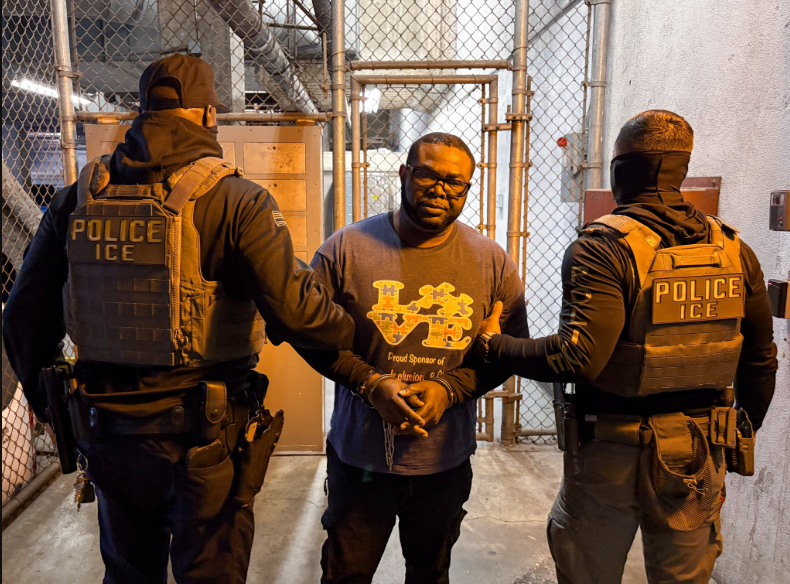
United States immigration authorities have taken into custody a 53-year-old Nigerian national in Los Angeles following a series of prior convictions related to sexual offences, including child molestation. The arrest, which was carried out by officers of Enforcement and Removal Operations, underscores ongoing efforts by U.S. immigration officials to identify, detain, and remove non-citizens with serious criminal records.
The agency disclosed the development in a public statement released on Friday via its official X (formerly Twitter) account. According to the statement, the suspect, identified as Olatunde Olusanjo, was apprehended on April 21, 2026, during an enforcement operation in Los Angeles.
Officials revealed that Olusanjo has a documented history of criminal offences, particularly those involving sexual misconduct. His record reportedly includes convictions for child molestation, sexual battery, and solicitation of lewd conduct—offences that U.S. authorities classify as serious crimes with significant legal consequences.
“Olusanjo has previous arrests for child molestation, sexual battery and soliciting lewd conduct. He is in ICE custody pending removal,” the agency stated, confirming that the suspect is currently being held while immigration proceedings are underway.
The announcement was accompanied by a short video clip showing the suspect in handcuffs as he was escorted from a vehicle belonging to U.S. Immigration and Customs Enforcement into a detention facility. The footage, which has since circulated widely online, depicts officers maintaining control of the situation as the suspect was transferred into custody.
In the video, a narrator identified Olusanjo as a Nigerian citizen and described him as a “criminal illegal alien and convicted sex offender,” language that reflects the agency’s position on individuals with prior criminal convictions who are also found to be in violation of U.S. immigration laws.
“Los Angeles ICE arrested criminal illegal alien and convicted sex offender Olatunde Abiodun Olusanjo on April 21, 2026, a citizen of Nigeria,” the narrator said in the clip. “Olusanjo’s criminal record includes child molestation, sexual battery, and sexual solicitation.”
Authorities have indicated that Olusanjo will remain in detention pending the outcome of removal proceedings, which could ultimately result in his deportation from the United States. Under U.S. immigration law, non-citizens convicted of certain categories of crimes—particularly those involving sexual offences—may be subject to mandatory detention and removal.
The case has drawn attention not only because of the nature of the alleged offences but also due to the broader context of immigration enforcement policies in the United States. Federal agencies, including ICE, have continued to prioritise the arrest and deportation of individuals deemed to pose a threat to public safety, particularly those with violent or sexual offence histories.
While the agency did not provide further details about the timeline of Olusanjo’s prior convictions or his immigration status, such cases typically involve individuals who may have overstayed visas, entered the country unlawfully, or violated the terms of their residency. In many instances, cooperation between local law enforcement and federal immigration authorities plays a role in identifying and apprehending such individuals.
The arrest also comes amid ongoing national debates over immigration enforcement, public safety, and the balance between due process and security concerns. Advocates of stricter immigration controls often point to cases involving individuals with criminal records as justification for robust enforcement measures. On the other hand, critics argue that public communications around such arrests should be handled carefully to avoid stigmatizing entire communities or nationalities.
As of the time of reporting, no additional statements have been issued by legal representatives or family members of the suspect. It also remains unclear whether Olusanjo has secured legal counsel to contest the removal proceedings or challenge any aspects of his detention.
U.S. immigration authorities have reiterated that individuals in custody are entitled to due process under the law, including the right to appear before an immigration judge. The outcome of such proceedings will determine whether Olusanjo is deported or allowed to remain in the country under any legal provision.
For now, the case stands as another example of the intersection between criminal justice and immigration enforcement in the United States, highlighting the legal and administrative processes that follow the arrest of non-citizens with prior convictions.