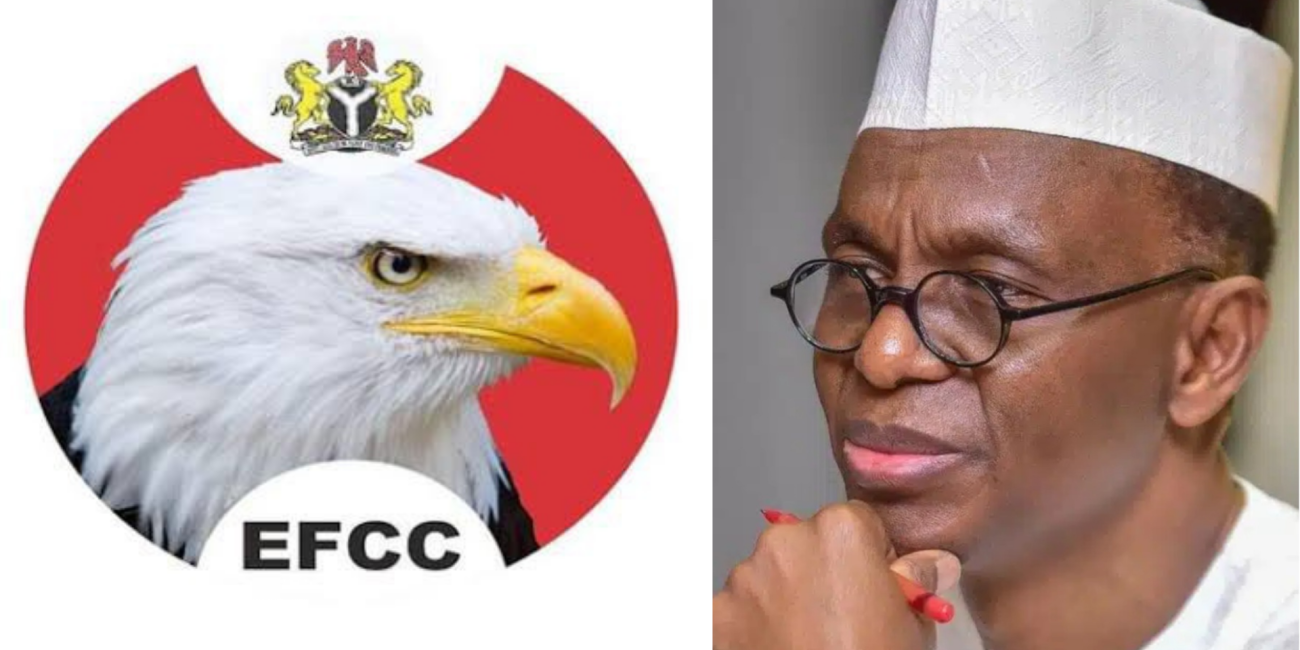
The Economic and Financial Crimes Commission (EFCC) has detained former Kaduna State governor, Nasir El-Rufai, as part of an ongoing investigation into alleged financial misconduct during his tenure in office.
Sources within the anti-graft agency confirmed that El-Rufai presented himself at the EFCC headquarters in Abuja on Monday following an invitation by investigators probing alleged financial improprieties linked to his administration between 2015 and 2023.
Shortly after his arrival, operatives of the commission reportedly took him into custody. A senior official, who spoke on condition of anonymity, confirmed that the former governor would remain in detention pending the continuation of interrogation.
“He is in our custody and is going to spend the night here,” the source disclosed.
The former governor is expected to face further questioning on Tuesday, and insiders indicated that his release would depend on the outcome of ongoing interrogations and the progress made by investigators handling the case.
Assembly Indictment and Alleged N423bn Diversion
El-Rufai’s detention comes on the heels of earlier recommendations by the Kaduna State House of Assembly, which in 2024 indicted him over allegations involving the diversion of approximately N423 billion in public funds during his administration.
The state lawmakers had accused the former governor and certain officials who served under him of financial mismanagement, alleged money laundering activities, and breaches of procurement and fiscal responsibility laws. In its report, the Assembly urged anti-corruption agencies, including the EFCC, to initiate a comprehensive criminal investigation into the financial dealings of the administration.
The Assembly’s probe had reportedly examined state finances, loan acquisitions, contractual obligations, and expenditure patterns over the eight-year period of El-Rufai’s governorship. The findings triggered widespread political debate in Kaduna and beyond, with supporters of the former governor dismissing the allegations as politically motivated, while critics called for full accountability.
The EFCC has not, as of the time of filing this report, issued an official public statement detailing the specific allegations under investigation or the terms of El-Rufai’s detention. However, the development signals a significant escalation in the legal scrutiny facing one of Nigeria’s most prominent and controversial political figures.
Political Profile and National Relevance
El-Rufai, 65, governed Kaduna State from 2015 to 2023 under the platform of the All Progressives Congress (APC). Known for his assertive reform agenda and outspoken political style, he remains a key actor in national politics and a chieftain of the African Democratic Congress (ADC).
Throughout his tenure, El-Rufai pursued policies aimed at restructuring the state’s civil service, reforming education, and expanding infrastructure. However, his administration also faced criticism over debt accumulation, security challenges, and allegations of opaque financial practices.
The current EFCC probe adds a new dimension to the post-office challenges confronting the former governor, whose influence within opposition politics has remained visible in recent months.
Fresh Federal Charges Over Alleged Phone Interception
In a separate but related legal development, the Federal Government is also preparing to arraign El-Rufai before the Federal High Court of Nigeria sitting in Abuja over allegations of unlawful interception of phone communications belonging to the National Security Adviser, Nuhu Ribadu.
Court documents reportedly marked FHC/CR/99/2026 list the Federal Republic of Nigeria as complainant, with El-Rufai named as the sole defendant. The charge sheet, dated February 16, 2026, outlines allegations stemming from statements the former governor allegedly made during a televised interview.
According to the prosecution, El-Rufai made incriminating admissions on February 13, 2026, while appearing as a guest on Prime Time, a current affairs programme broadcast by Arise TV in Abuja.
Count One of the charge alleges that El-Rufai admitted to unlawfully intercepting the phone communications of the National Security Adviser. Prosecutors argue that such actions contravene Section 12(1) of the Cybercrimes (Prohibition, Prevention, etc.) Amendment Act, 2024.
Under the provisions of the amended law, unlawful interception of electronic communications is considered a serious offence, attracting penalties that may include imprisonment and fines upon conviction.
Legal analysts note that the cybercrime charge, if proven, could carry significant consequences independent of the financial misconduct investigation currently being handled by the EFCC.
Mounting Legal Pressure
The convergence of corruption allegations and cybercrime charges represents mounting legal pressure on the former governor. Observers say the dual proceedings — one administrative and investigative through the EFCC, and the other judicial through the Federal High Court — could shape the political and legal trajectory of one of Nigeria’s most recognisable political figures.
While neither the EFCC nor the Office of the Attorney-General of the Federation has publicly elaborated on the evidence underpinning the charges, sources familiar with the investigation suggest that documentary records, financial transactions, and electronic communications are central to the ongoing inquiries.
Supporters of El-Rufai have argued that the actions against him are politically motivated, especially given his recent alignment with opposition elements. They maintain that he has consistently defended his administration’s record and remains prepared to contest the allegations in court.
Critics, however, insist that the rule of law must take its course and that public officials should be held accountable for their stewardship of public resources.
Awaiting Official Clarification
As of press time, the EFCC had yet to issue a formal statement outlining the scope of the investigation, the precise allegations under examination, or the conditions attached to El-Rufai’s detention. Similarly, there has been no official confirmation regarding the scheduled date for his arraignment at the Federal High Court.
The unfolding developments have generated intense public interest, particularly given El-Rufai’s prominence in Nigeria’s political landscape and his history of sharp commentary on governance and national security matters.
With investigations continuing and court proceedings imminent, attention now turns to whether the anti-graft agency will file formal charges related to the alleged N423 billion diversion and how the cybercrime case will proceed before the Federal High Court.
For now, the former Kaduna governor remains in EFCC custody as investigators press ahead with interrogation, marking a critical moment in the legal and political scrutiny surrounding his post-governorship career.