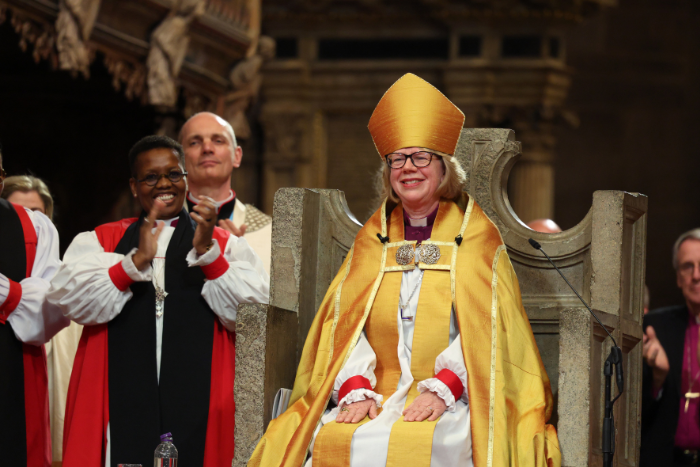
In a historic and symbolic moment for the global Anglican community, Sarah Mullally has been formally enthroned as the new Archbishop of Canterbury, becoming the first woman to occupy one of the most influential positions in global Christianity.
At 63, Mullally’s elevation marks a significant shift for the Church of England and the wider Anglican Communion, which spans more than 85 million members worldwide. Her appointment comes at a time when the church is seeking renewal and restoration following a period of deep controversy.
The ceremony took place at the iconic Canterbury Cathedral, a historic site in southeast England that has served as the spiritual heart of Anglicanism for centuries. The event drew about 2,000 attendees, including senior clergy, dignitaries, and members of the British royal family such as Prince William and Catherine Princess of Wales.
The enthronement followed centuries-old traditions, blending solemn ritual with symbolic meaning. As part of the ceremony, Mullally approached the cathedral’s west door and struck it three times with a staff, formally requesting entry. The act, steeped in history, represents humility and a willingness to serve.
Dressed in striking deep yellow-gold robes, she was welcomed by a group of local schoolchildren — a gesture meant to reflect the church’s connection to the community and future generations. The children asked her a simple but profound question: why she had come.
Her response captured the essence of her new role.
“I am sent as archbishop to serve you, to proclaim the love of Christ and with you to worship and love him with heart and soul, mind and strength,” she said.
The ceremony reached its climax as Mullally was seated in two distinct thrones within the cathedral. Each carries its own meaning: one represents her role as the Bishop of the Diocese of Canterbury, while the other signifies her broader responsibility as the spiritual leader of Anglicans around the world.
Mullally’s journey to the highest office in the Church of England is both unconventional and inspiring. Before entering ordained ministry, she worked as a nurse and midwife, professions that grounded her in care, compassion, and service to others.
Those who know her say her background in healthcare has deeply shaped her leadership style — one that emphasises empathy, listening, and practical support. Her experience on the frontlines of human vulnerability is expected to influence how she navigates the complex challenges facing the church today.
Her rise through the ranks of the church has been steady, marked by a reputation for thoughtful leadership and a commitment to reform. Her appointment is widely seen as both a recognition of her personal journey and a reflection of broader changes within Anglicanism.
Mullally steps into the role at a particularly sensitive moment. Her predecessor, Justin Welby, resigned in November 2024 following a damaging abuse scandal that shook public confidence in the Church of England.
The controversy centred on revelations that the church had covered up a series of abuse cases dating back to the 1970s. A subsequent report found that Welby had failed to report the allegations to authorities when they came to his attention in 2013.
The findings sparked widespread criticism and renewed scrutiny of how the church handles safeguarding issues. Under mounting pressure, Welby stepped down, creating a leadership vacuum and intensifying calls for accountability and reform.
In her early remarks and interviews, Mullally has made it clear that addressing these concerns will be a central focus of her leadership.
She has pledged to prioritise the safety of church members and rebuild trust with victims and survivors of abuse. Her tone has been one of acknowledgment and determination rather than defensiveness.
“I will do all I can to ensure that the Church becomes safer and also responds well to victims and survivors of abuse,” she said.
Speaking in a recent interview with the BBC, Mullally emphasised the need for a cultural shift within the church — one that is more attentive, compassionate, and responsive to those who have suffered harm.
She described the church as being on a journey toward becoming more “trauma-informed,” meaning it seeks to better understand the experiences of survivors and provide appropriate support.
Listening, she suggested, will be key.
“The Church is seeking to become more trauma informed, listening to survivors and victims of abuse,” she said.
Mullally’s appointment is being widely interpreted as a turning point — not just because she is the first woman to hold the position, but because of what her leadership represents.
For many within the Anglican Communion, her enthronement signals a willingness to embrace change while still holding on to tradition. It also reflects ongoing conversations within the church about inclusion, gender equality, and the future direction of religious leadership.
Her role extends far beyond England. As Archbishop of Canterbury, she is considered the symbolic head of the worldwide Anglican Communion, providing spiritual guidance to millions of believers across different cultures, continents, and theological perspectives.
Balancing these diverse expectations will not be easy. The global Anglican community is not monolithic, and issues such as doctrine, social values, and governance often generate debate and division.
Yet, Mullally’s supporters believe her background and temperament may help her navigate these complexities with sensitivity and balance.
As she begins her tenure, expectations are high. Many are watching to see how she will address long-standing issues within the church, from safeguarding reforms to broader questions about relevance in a rapidly changing world.
Her emphasis on service, compassion, and accountability suggests a leadership style rooted in both faith and practical action.
For now, her historic enthronement stands as a powerful moment — one that blends tradition with transformation, and signals the beginning of a new chapter for one of the world’s oldest religious institutions.
From her early days as a nurse and midwife to her new role at the helm of global Anglicanism, Sarah Mullally’s journey reflects a profound shift in both leadership and perspective. As she takes her seat in Canterbury, she does so not only as a trailblazer, but as a figure tasked with guiding the church through one of the most challenging periods in its modern history.
Watch Video: