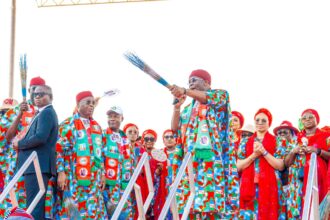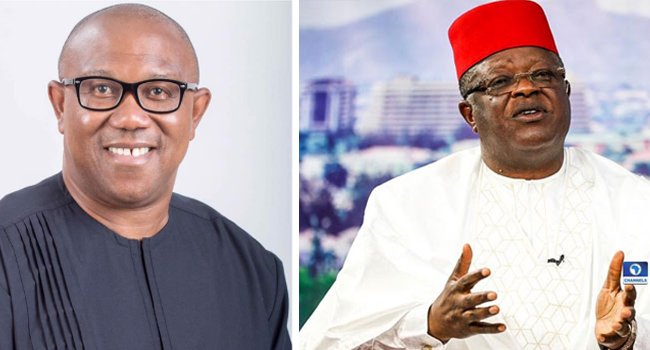
The video, which has attracted attention on social media, shows a gathering of supporters singing and dancing while Umahi, dressed in traditional attire and wearing a red cap, appears to lead the performance.
The song has been identified by social media commentators as an adaptation of NDC Ka Mma, a campaign song popularised in support of Obi and the NDC ahead of the 2027 general elections.
In the version circulating online, the allegation is that references to Obi in the original campaign composition were replaced with Umahi’s name to promote the Minister politically.
The development has triggered reactions among supporters of different political parties, with some accusing the Works Minister and his associates of borrowing an opposition campaign song rather than creating an original musical composition for their political mobilisation.
Others have treated the development as an example of how campaign music and popular cultural expressions are increasingly becoming tools of political competition ahead of the 2027 elections.
Umahi recently attended an All Progressives Congress (APC) town hall meeting at the Ecumenical Centre in Abakaliki, Ebonyi State, where he called on residents of the South-East to support President Bola Tinubu’s re-election bid.
At the meeting, the former Ebonyi State governor described himself as the “lion of the South-East” and questioned Peter Obi’s political standing in the region.
He also argued that the South-East should support Tinubu for another four years, maintaining that political cooperation with other regions would improve the zone’s prospects of producing a future Nigerian president.
The alleged adaptation of the NDC campaign song has therefore attracted additional political attention, particularly because of the ongoing exchanges between Umahi and Obi over their respective political positions and ambitions.
The controversy comes amid growing use of campaign songs, social media videos and entertainment-driven political messaging by parties seeking to attract supporters and build grassroots momentum ahead of the 2027 general elections.
With political mobilisation increasingly extending into music and popular culture, the incident has renewed conversations about originality, intellectual property and the creative strategies adopted by political parties in promoting their candidates.