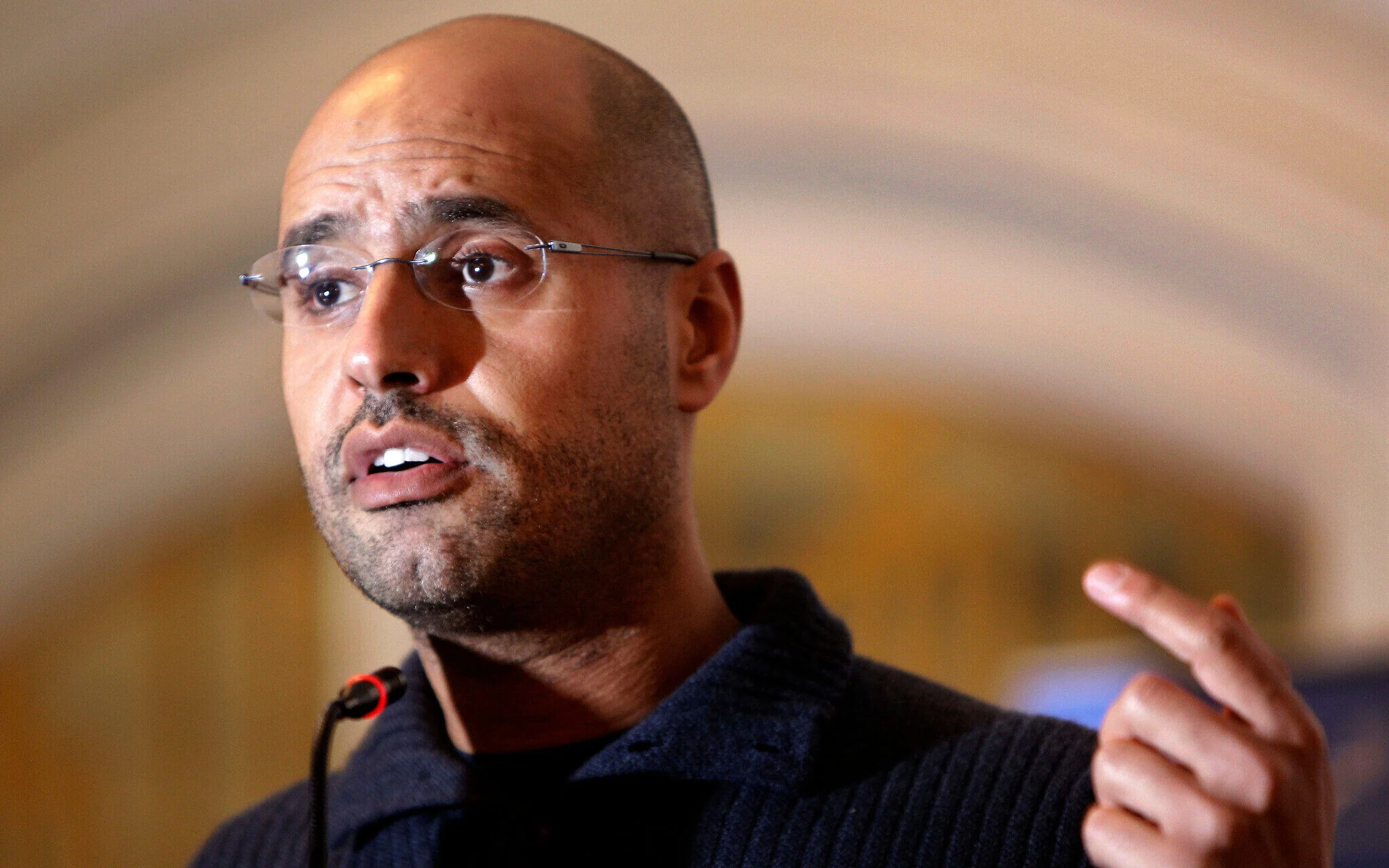
Saif al-Islam Gaddafi, the most prominent son of Libya’s former longtime ruler Muammar Gaddafi, has been killed in the western Libyan town of Zintan, according to officials close to him and multiple local media reports. His death marks a dramatic and violent end to the life of one of the most polarising figures to emerge from Libya’s turbulent post-Gaddafi era.
The death of the 53-year-old was announced on Tuesday by his lawyer, Khaled al-Zaidi, and his political adviser, Abdulla Othman, in separate posts on Facebook. Neither provided detailed circumstances surrounding the killing, but their announcements were later corroborated by Libyan media outlets and political figures.
Libyan news platform Fawasel Media quoted Othman as saying that Saif al-Islam Gaddafi was killed by armed men who attacked his residence in Zintan, located about 136 kilometres (85 miles) southwest of the capital, Tripoli. According to the report, the assailants stormed his home and fatally shot him before fleeing the scene.
In a subsequent statement released by Gaddafi’s political team, the killing was described as a “cowardly and treacherous assassination.” The statement alleged that four masked men forced their way into the house and confronted Saif al-Islam, who reportedly resisted the attackers. It further claimed that the assailants disabled the home’s security cameras “in a desperate attempt to conceal traces of their heinous crimes.”
The killing has prompted calls for accountability from across Libya’s fragmented political landscape. Khaled al-Mishri, former head of the Tripoli-based High State Council—an institution aligned with the internationally recognised government—called for an “urgent and transparent investigation” into the assassination. In a social media post, he warned that the failure to uncover the truth would further undermine public confidence in Libya’s already fragile security and judicial institutions.
Although Saif al-Islam Gaddafi never held an official government position, he was widely regarded as his father’s heir apparent from the early 2000s until the collapse of the Gaddafi regime in 2011. During that period, he served as a key political interlocutor and de facto second-in-command, particularly in Libya’s engagement with Western governments.
Born in June 1972 in Tripoli, Saif al-Islam was the second-born son of Muammar Gaddafi, who ruled Libya for more than four decades. Unlike many of his siblings, he was groomed for leadership and cultivated an international profile. Western-educated, fluent in English and polished in public appearances, he projected a reformist image that contrasted sharply with the repressive nature of his father’s rule.
Educated at the London School of Economics, Saif al-Islam authored an academic dissertation focused on the role of civil society in reforming global governance. In the early 2000s, he became the public face of Libya’s efforts to rehabilitate its international standing after years of sanctions and isolation. He played a central role in negotiations that led to Libya’s abandonment of its weapons of mass destruction programme and helped broker compensation for the families of victims of the 1988 bombing of Pan Am Flight 103 over Lockerbie, Scotland.
During this period, he openly spoke about political reform, constitutional governance and human rights, raising hopes—both inside and outside Libya—that the country might gradually transition away from authoritarianism. Many Western governments and analysts viewed him as a potential reformer who could modernise Libya from within.
Those expectations collapsed in 2011 when a popular uprising erupted against Muammar Gaddafi’s rule as part of the Arab Spring. Rather than siding with protesters or pursuing reform, Saif al-Islam firmly aligned himself with his father and the regime. He emerged as one of the most hardline defenders of the government, issuing chilling warnings to opponents.
In an infamous televised address during the uprising, he threatened that “rivers of blood” would flow if the rebellion continued, describing protesters as “rats” and vowing that the regime would fight “to the last man, woman and bullet.” Speaking to Reuters at the time, he declared: “We fight here in Libya, we die here in Libya.”
Human rights groups accused him of playing a key role in directing violence against protesters. By February 2011, he was placed under United Nations sanctions, subjected to a travel ban and later indicted by the International Criminal Court (ICC) on charges of crimes against humanity related to the violent suppression of the uprising.
Following the fall of Tripoli to rebel forces and the killing of Muammar Gaddafi in October 2011, Saif al-Islam attempted to flee Libya disguised as a Bedouin tribesman, reportedly heading toward neighbouring Niger. He was captured on a desert road by fighters from the Abu Bakr al-Siddiq Brigade and taken to Zintan, where he remained in detention for years.
In 2015, a court in Tripoli sentenced him to death in absentia, while negotiations continued between Libyan authorities and the ICC over jurisdiction. In 2017, he was released under a general amnesty declared by authorities aligned with the eastern-based administration, though the legality and scope of that release remained disputed.
After his release, Saif al-Islam largely disappeared from public view, living under protection in Zintan and reportedly avoiding public appearances due to fears of assassination. Despite this, he re-emerged politically in November 2021 when he controversially announced his candidacy in Libya’s long-delayed presidential election. The move sparked outrage among anti-Gaddafi factions and reignited deep divisions over Libya’s past and future.
Though the election was eventually postponed indefinitely, his candidacy underscored the enduring influence—and controversy—of the Gaddafi name in Libyan politics.
Saif al-Islam Gaddafi’s killing adds another chapter to Libya’s long cycle of political violence and unresolved grievances. More than a decade after the fall of his father, the country remains deeply divided, with rival governments, militias and foreign interests competing for power. His death is likely to intensify debates about justice, reconciliation and accountability in a nation still struggling to emerge from the shadow of its turbulent history.