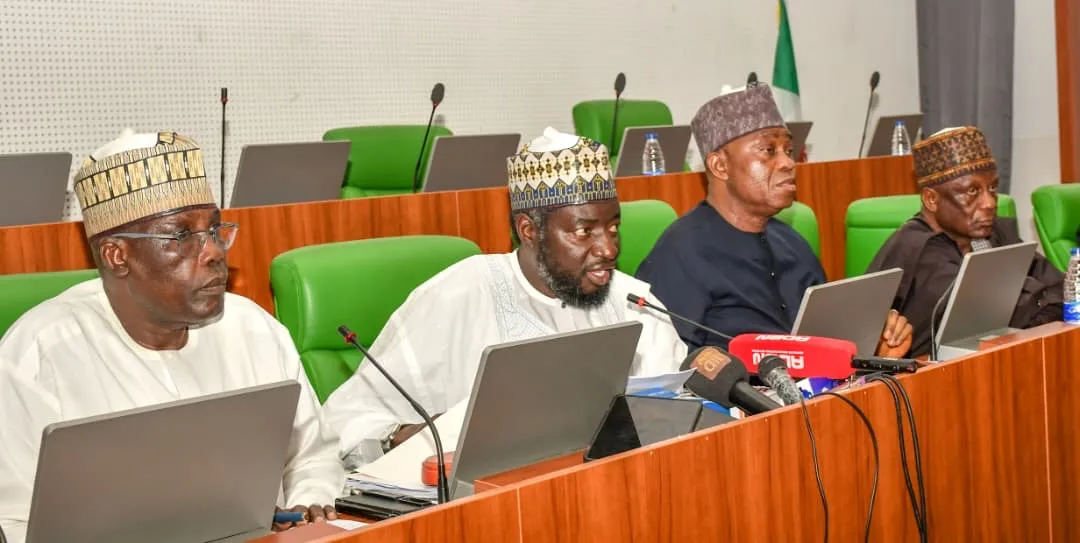
The House of Representatives ad hoc committee investigating the purported establishment and activities of the Presidential Foreign Intervention Promotion Council (PFIPC) says it has uncovered an elaborate scheme allegedly involving forged presidential documents, altered legislative records and the unauthorised use of the names and identities of senior government officials.
The committee, chaired by Yusuf Gagdi, disclosed the findings on Wednesday in Abuja while presenting its preliminary report after weeks of investigation into how the purported organisation allegedly operated within the federal bureaucracy despite the government’s position that it was never legally established.
According to the committee, about 39 individuals were presented or represented as employees of the organisation, while approximately 58 bank accounts were linked through Bank Verification Number (BVN) and other identifying information associated with Adeniyi Adeyemi, who presented himself as the council’s Director-General.
The lawmakers said their findings were based on oral testimony, documentary evidence, financial records and submissions from government institutions, private organisations, purported employees and individuals who claimed to have been victims of the organisation’s activities.
The committee stressed that its findings remained preliminary and should not be interpreted as the final position of the House.
No Legal Instrument Established PFIPC
One of the central findings of the investigation was that the committee could not identify any valid legal instrument establishing the PFIPC.
It said it found no Act of the National Assembly, gazetted enactment, presidential executive order, administrative instrument or other lawful authority creating the organisation.
The committee also said government institutions that appeared before it could not produce authentic records showing that the organisation had been established, approved or authorised by President Bola Tinubu, the Federal Executive Council, the National Assembly, the Office of the Secretary to the Government of the Federation or any other competent authority.
It noted that the organisation operated under different names, including the Presidential Foreign Intervention Promotion Council and the Presidential Economic Advisory Council.
According to the committee, the inconsistencies in the organisation’s identity, combined with documentary evidence presented during the investigation, cast serious doubt on its claim to legitimate government status.
The investigation followed a motion sponsored by Gagdi and adopted by the House on July 8 after lawmakers raised concerns over the inclusion of the purported council in the 2026 Appropriation Act.
The budget was reported to contain an allocation of approximately ₦1.3 billion to the Presidential Economic Advisory Council/Presidential Foreign Intervention Promotion Council under the Presidency. The committee was also mandated to investigate an alleged ₦27.4 billion take-off grant associated with the organisation.
However, lawmakers said they were still determining whether any appropriation, warrant, cash backing or actual release of funds had been made to the purported agency.
Alleged Forgery of Presidential Documents
A major aspect of the investigation concerns an appointment letter allegedly used by Adeyemi to establish himself as the Director-General of the organisation.
The document purportedly indicated that Adeyemi had been appointed by the Presidency and carried the authority and signature of the Chief of Staff to the President, Femi Gbajabiamila.
The committee said evidence obtained from the State House showed that no such appointment was made or approved.
It further said Gbajabiamila neither issued nor signed the document.
According to the lawmakers, the letterhead was not authentic State House letterhead, while the reference number, format, language and other administrative features differed from those used in genuine official correspondence.
Gagdi said the committee therefore preliminarily considered the appointment letter to have been fabricated and falsely attributed to the Presidency.
He described any attempt to manufacture an official presidential document as a serious threat to the integrity of government institutions, while stressing that criminal liability would ultimately have to be determined through the appropriate legal process.
Purported Executive Order Also Questioned
The committee also investigated a document described as “Presidential Executive Order No. 5 of 24 February 2026”, which was reportedly presented as the legal foundation for the organisation.
Gagdi said evidence before the committee indicated that the document was neither issued nor approved through lawful presidential procedures.
The lawmakers described the alleged fabrication of an executive instrument as particularly serious because executive orders carry the authority of the President.
They said any attempt to manufacture such a document to obtain official recognition, financial benefits or public confidence would represent a serious assault on the integrity of executive authority.
Alleged Mutilation of National Assembly Act
The committee said it also uncovered a document presented as an Act of the National Assembly establishing the purported organisation.
It found that neither chamber of the National Assembly had passed the document, that it had not received presidential assent and that it had not been gazetted as an Act of the Federation.
The document, according to the committee, also failed to conform to the numbering, certification and publication characteristics of genuine Acts of Parliament.
More significantly, lawmakers alleged that portions of an existing legislative instrument relating to another institution had been electronically altered or substituted to create the appearance that Parliament had enacted legislation establishing the PFIPC or PEAC.
Government Code and Federal Office
The investigation further identified a letter dated November 7, 2024, purportedly written by the State House to the Office of the Accountant-General of the Federation requesting the creation of an administrative code for the PFIPC.
The letter was allegedly signed by a person identified as Akambi Adewale, described as a director of Administration and Support Services for the Permanent Secretary.
The committee said the State House established that the office was not constituted in the manner stated and that no officer known as Adewale served in the purported capacity.
It therefore concluded that the letter was neither issued nor authorised by the State House.
The lawmakers said the use of fictitious offices, names and designations appeared to have been intended to mislead an important financial institution of government.
The committee also questioned how the purported organisation managed to secure office accommodation within the Federal Secretariat Complex in Abuja.
It said the organisation occupied space without lawful allocation from the Office of the Head of the Civil Service of the Federation and that some officials allegedly facilitated access to accommodation previously assigned to another government office.
Seven Government-Style Number Plates
The committee also examined how the purported agency obtained official-looking vehicle registration plates.
According to the preliminary findings, documents were presented to the Federal Road Safety Corps (FRSC), which subsequently processed seven special number plates for the organisation.
The vehicles reportedly included a 2024 bulletproof Lexus LX, two Toyota Land Cruiser SUVs and four Toyota Hilux vehicles.
The committee said the plates, numbered PFIPC 01 to PFIPC 07, helped reinforce the organisation’s appearance as a legitimate government institution.
Lawmakers said they were investigating the applications and approvals to determine the roles played by officials and other individuals involved.
39 Staff, 58 Bank Accounts
The committee also said about 39 people had been presented as employees of the purported organisation across various cadres.
It is investigating how the individuals were recruited, who issued their appointment letters and identity cards, whether they received salaries or allowances and whether any applicants were required to pay money to secure employment.
The lawmakers said they would distinguish between individuals who were themselves deceived and those who knowingly participated in or benefited from the alleged scheme.
Financial records also reportedly revealed about 58 bank accounts linked through BVN and other identifying details to Adeyemi.
The committee said several accounts were associated with multiple companies, agencies, foundations and other entities, although it cautioned that the identification of an account or organisation did not by itself establish illegality.
It said investigators were reconciling registration documents, beneficial ownership information, account mandates and transaction histories to establish ownership and control.
Alleged ₦400 Million Transaction
The committee also received testimony from businessman Gbenga Collins, who alleged that he paid about ₦400 million to Adeyemi after being offered a government contract to renovate and furnish an official residence.
Collins said the money was paid in five instalments between May and July 2025. Four payments totalling ₦380 million allegedly went into an account belonging to World Entrepreneurs Limited, while another ₦20 million was paid into an Access Bank account belonging to Sunshine Confectionery and Catering Services.
He said Adeyemi’s office at the Federal Secretariat, government-style vehicles and other representations led him to believe he was dealing with a legitimate government official.
The committee said it was tracing the funds and investigating the beneficial owners of the accounts involved.
It also noted conflicting accounts surrounding the transaction. Adeyemi reportedly described the money to the ICPC as a loan, while Collins told the House committee that he paid it in connection with a purported government contract.
Gbajabiamila Cleared in Preliminary Findings
The committee also considered allegations previously made by Adeyemi against Gbajabiamila.
Adeyemi had alleged that the Chief of Staff demanded a percentage of a purported ₦27.3 billion take-off grant and that ₦400 million had been paid through a proxy.
Gbajabiamila denied the allegations and subsequently filed a ₦15 billion defamation suit against Adeyemi.
The committee said its preliminary findings did not establish that Gbajabiamila authorised, approved or participated in the activities of the purported organisation.
Instead, it said available evidence indicated that the Chief of Staff alerted security and investigative agencies after concerns about the organisation were brought to his attention.
Calls for Stronger Government Controls
The committee commended the police, DSS, EFCC, ICPC and Office of the National Security Adviser for their contributions and urged the agencies to conclude their investigations, preserve evidence, trace suspected proceeds and prosecute anyone against whom sufficient admissible evidence is established.
Adeyemi is already facing an eight-count criminal charge before the Federal High Court in Abuja over allegations connected to the purported agency. His arraignment has reportedly been delayed, with the court fixing September 30 for the proceedings.
Beyond the alleged activities surrounding PFIPC, the House committee said the investigation had exposed weaknesses in government’s internal control systems.
It recommended stronger verification procedures for newly established government institutions, official correspondence, presidential appointments, administrative and budget codes, government accommodation and special vehicle registrations.
The committee also proposed a centralised digital platform through which citizens and institutions could independently verify the legal existence, establishing instrument and status of every federal government agency.
The lawmakers maintained that the apparent success of the purported organisation could not have resulted from forged documents alone, arguing that weaknesses within government verification and administrative systems may also have contributed to its ability to project an appearance of legitimacy.