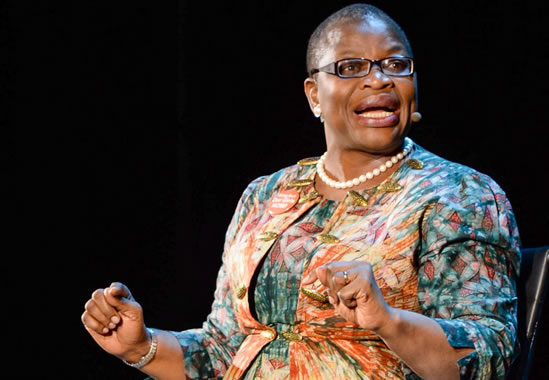
Former Minister of Education, Dr Oby Ezekwesili, has criticised Nigeria’s political and economic system, arguing that the country has developed a culture in which questionable wealth is often celebrated while individuals who create value through productive activities struggle to achieve economic success.
Ezekwesili made the remarks during an interview on News Central’s 60 Minutes with Mr. Kay, where she examined the relationship between leadership, political culture, wealth creation and governance in Nigeria.
The former minister argued that Nigeria’s leadership recruitment system has evolved in a manner that can reward individuals who lack the character and values necessary to provide responsible governance.
According to her, the problem goes beyond the conduct of individual politicians and is deeply rooted in the structures through which political leaders emerge and exercise power.
She said the processes for recruiting leaders had, over time, been shaped by the interests and values of those who have controlled political power.
“The processes for leadership recruitment have in many ways been designed in the image of those who have held the levers of power,” Ezekwesili said.
She explained that when political structures deliberately or indirectly create obstacles for people of integrity, the result is a political environment in which questionable behaviour becomes an advantage rather than a liability.
According to her, such a system eventually develops a marketplace for misconduct because individuals realise that unethical behaviour can provide political and economic rewards.
“When you have that kind of a distortion where bad behaviour is what your political system rewards, there will be a market for bad behaviour. And then good behaviour is punished,” she said.
Ezekwesili’s comments highlight a longstanding concern about the relationship between political power and wealth accumulation in Nigeria.
She questioned the sources of wealth of some of the country’s richest individuals, arguing that a significant number of wealthy Nigerians cannot easily demonstrate that their fortunes were built through productive economic activities such as manufacturing, innovation, entrepreneurship or other forms of value creation.
“Look at just bring line up all the people who are wealthy in our country today and try to trace their wealth to any productive activity. None. Maybe a few,” she said.
The former minister suggested that the connection between government and personal wealth accumulation had become deeply embedded in Nigerian society.
She argued that individuals can enter public office with limited personal wealth and emerge from political positions significantly richer, while questions about the origins of such wealth are frequently ignored.
Rather than demanding explanations or subjecting sudden wealth to rigorous public scrutiny, Ezekwesili said society often celebrates individuals who accumulate substantial fortunes, regardless of whether their wealth can be linked to legitimate productive activities.
She described this attitude as one of the factors that have contributed to the distortion of Nigeria’s political and economic system.
“This is what grounded the Nigerian society,” she said, suggesting that the problem is not limited to Nigeria but is replicated in several other African countries.
For Ezekwesili, the challenge is therefore not simply a question of replacing individual political leaders. She argued that Nigeria needs to redesign the systems and incentives that determine who gains access to political power and what behaviour is rewarded once individuals assume office.
She maintained that good governance does not happen automatically and cannot be achieved merely by hoping that competent and honest leaders will emerge.
“Nothing happens that is not made to happen,” she said.
The former minister explained that achieving good governance requires deliberate institutional design, effective rules, accountability mechanisms and citizens who are willing to demand responsible leadership.
“To get good governance is a design. You have to design for you to then end up with good governance. If you don’t design for good governance, you will have the kind of governance that we have,” she said.
Her argument places emphasis on the role of institutions in determining political outcomes. Where systems reward corruption, patronage and the abuse of public resources, she argued, those behaviours are likely to become entrenched.
Conversely, a system designed to reward competence, transparency, integrity and productive economic activity can create incentives for leaders and citizens to pursue legitimate development.
Ezekwesili also urged Africans to reject political apathy and the belief that governance problems will resolve themselves without deliberate action.
She argued that citizens have an important role to play in challenging dysfunctional political structures and demanding accountability from those entrusted with public office.
The former minister’s position suggests that Nigeria’s development crisis cannot be separated from the incentives embedded within its political system. If political power remains one of the most attractive routes to wealth and influence, while productive enterprise receives inadequate rewards, the country risks reinforcing a cycle in which public office becomes an avenue for private enrichment.
She therefore called for a fundamental rethink of the country’s leadership recruitment process and broader governance architecture.
Such a transformation, she argued, would require citizens to demand institutions that reward ethical conduct and productive contribution rather than political connections and questionable accumulation of wealth.
Ultimately, Ezekwesili’s comments centred on the need to change the rules and incentives that shape Nigerian society.
For her, the country cannot expect different outcomes while maintaining systems that reward the same behaviours responsible for its governance challenges.
The task, therefore, is not merely to identify individuals responsible for Nigeria’s problems but to redesign institutions so that integrity, competence, accountability and productivity become the qualities most valued in leadership and economic life.
Without such deliberate reforms, she warned, Nigeria could continue to reproduce a political culture in which bad behaviour is rewarded, good behaviour is punished and wealth remains disconnected from productive economic activity.