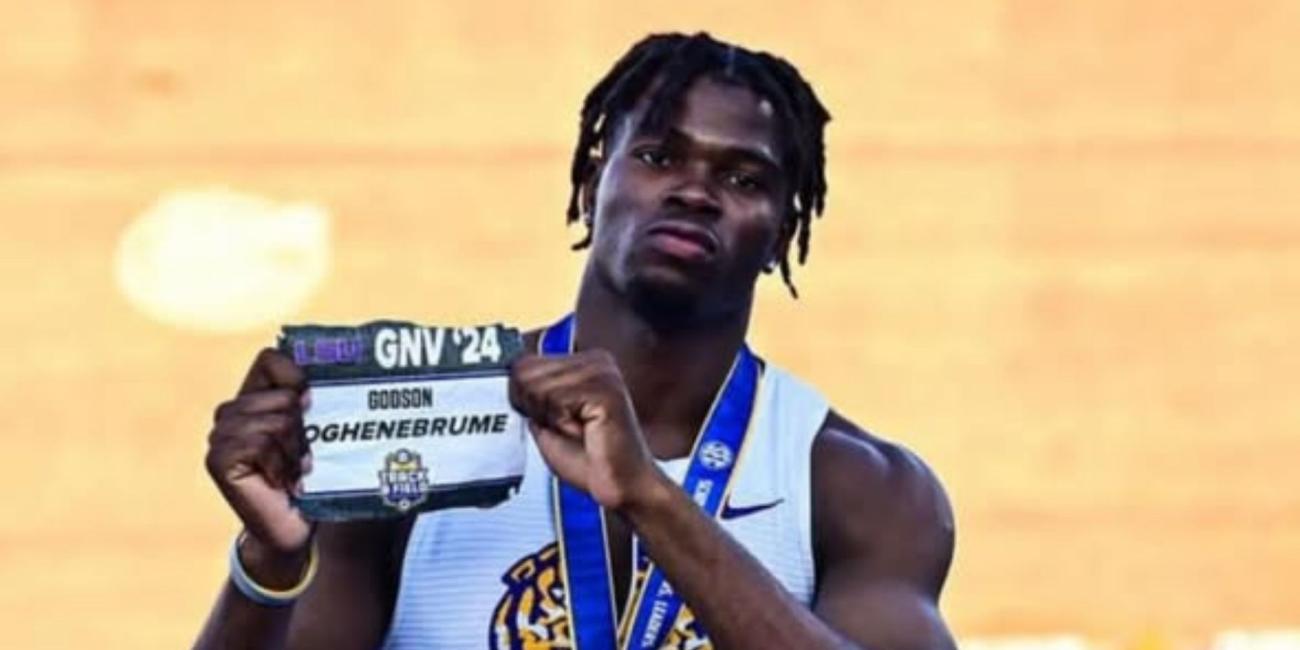
Former Nigerian sprint sensation and Olympic hopeful, Godson Oghenebrume, has been sentenced to 27 months in federal prison in the United States after pleading guilty to illegally possessing a firearm while residing in the country on a student visa.
The 23-year-old athlete, once regarded as one of Nigeria’s brightest sprinting prospects, was sentenced by U.S. Chief Judge Shelly D. Dick following his conviction for possession of a firearm by a non-immigrant visa holder, an offence under U.S. federal law.
In addition to serving his prison term, Oghenebrume will face removal proceedings and is expected to be deported from the United States after completing his sentence, according to an announcement by U.S. Attorney Kurt L. Wall.
The conviction represents a dramatic fall from grace for an athlete whose performances on the track had positioned him among Nigeria’s most promising young sprinters.
Before his legal troubles, Oghenebrume had established an impressive athletics career. He recorded a personal best of 9.90 seconds in the 100 metres, won a silver medal at the National Collegiate Athletic Association (NCAA) Championships, represented Nigeria in international competitions and secured an athletics scholarship to Louisiana State University (LSU), one of the United States’ leading collegiate sports institutions.
His rapid rise had fuelled expectations that he would become a key member of Nigeria’s sprint team at future World Championships and Olympic Games.
However, those ambitions have now been overshadowed by a criminal conviction that could permanently end his athletic career in the United States.
According to court documents, Oghenebrume admitted during his guilty plea that he unlawfully possessed a Glock Model 43X 9mm pistol on February 7, 2025, while he was legally present in the United States under an F-1 student visa.
Federal law generally prohibits individuals admitted under certain non-immigrant visas from possessing firearms unless specific legal exemptions apply.
Investigators said the events leading to his arrest began on the night of February 7 at his apartment in Baton Rouge, Louisiana.
According to the court filings, Oghenebrume was inside the apartment with another woman when his former girlfriend, who is also the mother of their infant child, arrived at the residence carrying the baby.
The unexpected visit reportedly led to a heated confrontation outside the apartment complex.
During the argument, and while the infant was present, Oghenebrume allegedly discharged the firearm.
Authorities said he subsequently returned inside the apartment, but the situation escalated after his former girlfriend entered the residence and found him with the other woman in the living room.
Another argument broke out, eventually spilling outside the apartment building.
According to investigators, Oghenebrume fired the weapon several more times as his former girlfriend fled the scene.
The gunfire reportedly endangered residents of the apartment complex, with investigators later discovering multiple bullet impacts on the walls of nearby buildings.
The presence of stray bullets in a populated residential area heightened concerns about the potential consequences of the shooting.
Court records also allege that during the confrontation, Oghenebrume smashed his former girlfriend’s mobile phone and took custody of their infant child, who had remained present throughout the incident.
Unable to retrieve the baby herself, the woman reportedly sought assistance from the other female occupant of the apartment.
According to investigators, the woman agreed to help and successfully recovered the infant from Oghenebrume before law enforcement officers arrived at the scene.
The child was subsequently taken to safety.
Deputies from the East Baton Rouge Sheriff’s Office responded to reports of gunfire at the apartment complex.
Authorities said that when officers arrived, Oghenebrume failed to comply with their initial commands.
Instead, investigators alleged that he walked away from the deputies and threw the Glock pistol into nearby shrubs before eventually being taken into custody without further resistance.
Law enforcement officers later recovered the firearm from the location where it had been discarded.
During the investigation, deputies also interviewed a neighbour who reported hearing multiple gunshots during the incident.
The neighbour told investigators that the sound of the gunfire had been so loud that his ears continued ringing afterwards, highlighting the danger posed to residents living in the area.
Following his arrest, Oghenebrume was advised of his constitutional rights before being questioned by detectives.
According to investigators, he admitted firing the weapon during the confrontation.
Court documents state that when detectives asked why he discharged the firearm, Oghenebrume replied that he wanted his former girlfriend to leave the apartment complex.
Investigators quoted him as saying that “he had wanted his ex-girlfriend to go home and that he had shot the gun to scare her away.”
The statement formed part of the evidence presented during the federal prosecution.
Before the incident, Oghenebrume had earned widespread recognition within Nigerian athletics for his exceptional speed and remarkable performances on the track.
His personal best time of 9.90 seconds in the 100 metres placed him among the fastest Nigerian sprinters of his generation.
His achievements also included winning an NCAA silver medal while competing for Louisiana State University, where he trained alongside some of the best collegiate athletes in the United States.
Sports enthusiasts had viewed him as one of Nigeria’s emerging stars capable of strengthening the country’s sprint team at major international competitions.
His scholarship to LSU was widely regarded as an important opportunity to combine academic development with elite athletic training.
However, his legal troubles have now overshadowed those accomplishments, replacing sporting headlines with criminal proceedings.
Announcing the conclusion of the case, U.S. Attorney Kurt L. Wall commended the efforts of the agencies involved in the investigation.
He praised investigators from the U.S. Department of Homeland Security’s Homeland Security Investigations division, the Bureau of Alcohol, Tobacco, Firearms and Explosives (ATF), and the East Baton Rouge Sheriff’s Office for their work in bringing the case to a successful conclusion.
The prosecution was handled by Assistant United States Attorneys Jeremy S. Johnson and Lyman E. Thornton III.
Federal authorities said the prosecution formed part of Operation Take Back America, a nationwide initiative of the U.S. Department of Justice aimed at strengthening immigration enforcement, dismantling transnational criminal organisations and prosecuting violent crimes involving non-citizens.
Officials said the initiative seeks to deploy federal law enforcement resources to address illegal immigration, combat organised criminal networks and improve public safety across the United States.
With his prison sentence now imposed and deportation proceedings expected to commence after his release, Oghenebrume’s once-promising athletics career has suffered a devastating setback.
For an athlete who once carried the hopes of becoming one of Nigeria’s leading sprinters on the world stage, the conviction marks a dramatic reversal of fortune, bringing an abrupt halt to a career that had shown immense promise both on the track and in collegiate athletics.