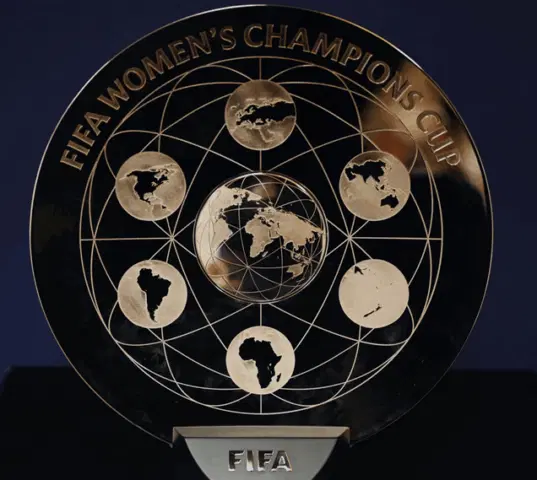
FIFA has taken a major step in advancing women’s club football by unveiling a prize pool of nearly four million dollars for the inaugural FIFA Women’s Champions Cup, a move widely regarded as a landmark moment for the global women’s game. The announcement sets a new financial benchmark, underscoring FIFA’s growing commitment to elevating women’s football to greater competitive and commercial heights.
Under the prize structure released by the world football governing body, the champions of the tournament will earn an unprecedented 2.3 million dollars, the largest single prize payout ever awarded in women’s club football. The runners up in the final, scheduled for Sunday, February 1, 2026, at the Arsenal Stadium in London, will receive one million dollars, further highlighting the scale of FIFA’s financial investment in the competition.
Clubs eliminated at the semi final stage will not go home empty handed, as each of the two losing semi finalists will receive 200,000 dollars. Auckland United FC of New Zealand and Wuhan Chegu Jiangda WFC of China, who exited the competition in the opening round, will each earn 100,000 dollars. In total, the six participating teams will share close to four million dollars based on their performance in the tournament.
FIFA confirmed the details of the prize fund on Friday through its official X handle, drawing widespread reactions from stakeholders across the football world. Many have described the announcement as a clear signal of FIFA’s intent to accelerate the professionalisation and global appeal of women’s club football.
Commenting on the prize structure, FIFA Secretary General Mattias Grafström said the financial commitment reflects the organisation’s growing confidence in the development and commercial potential of women’s football worldwide. He described the prize fund as a strong statement of belief in the women’s game and an important step in closing the long standing gap between men’s and women’s football at the elite club level.
According to Grafström, the Women’s Champions Cup aligns with FIFA’s broader strategy to strengthen elite women’s football through increased investment, improved competition structures, and enhanced global visibility. He stressed that meaningful financial incentives are critical to driving competitiveness, attracting sponsors, and enabling clubs to invest more in player welfare, infrastructure, and grassroots development.
The FIFA Secretary General also noted that the Women’s Champions Cup is part of a wider transformation agenda for women’s football. This agenda includes improvements to the Women’s International Match Calendar, aimed at better balancing club and international commitments, as well as the introduction of new top tier competitions to create a more coherent and competitive global ecosystem.
One of the most anticipated elements of this long term strategy is the FIFA Women’s Club World Cup, which is scheduled to debut in 2028. FIFA has positioned the Women’s Champions Cup as a foundational competition that will help prepare clubs, players, and confederations for the demands of a fully fledged global club championship in the coming years.
The Women’s Champions Cup brings together champion clubs from each of FIFA’s confederations to compete for an intercontinental title, offering a rare opportunity for top women’s teams from different regions to test themselves against one another. By doing so, the competition aims to raise standards, promote cross continental exposure, and foster greater tactical and cultural exchange within the women’s game.
The semi final matches will be played at the Brentford Stadium in London on Wednesday, January 28. In one semi final, Gotham FC of the United States will face Brazil’s Corinthians, a clash that pits two of the most successful clubs in their respective regions against each other. Gotham FC, champions of the North American confederation, are known for their strong squad depth and competitive pedigree, while Corinthians bring South America’s flair and experience to the contest.
In the other semi final, Arsenal Women will take on Morocco’s ASFAR in what is expected to be a highly anticipated encounter. Arsenal, one of Europe’s most established women’s clubs, will enjoy home support in London, while ASFAR represent the growing strength and ambition of African women’s football. Their presence in the tournament highlights the expanding reach of the women’s game beyond its traditional power bases.
The final, to be staged at the Arsenal Stadium on February 1, is expected to attract significant global attention, not only because of the quality of football on display but also due to the historic prize at stake. For the eventual champions, the 2.3 million dollar reward represents more than financial gain; it symbolises recognition of the value and potential of women’s club football on the world stage.
Observers note that the prize pool, while still below that of equivalent men’s competitions, marks a substantial leap forward and sets a new reference point for future tournaments. It is also expected to encourage domestic leagues and confederations to increase their own investments in women’s football, knowing that international success now comes with meaningful financial returns.
Beyond the immediate impact on participating clubs, FIFA’s move is widely seen as a catalyst for broader change within the women’s game. Increased prize money can help clubs improve player salaries, expand youth academies, enhance medical and training facilities, and invest in marketing and fan engagement, all of which contribute to the long term sustainability of women’s football.
As the countdown to the semi finals continues, anticipation is building around what promises to be a defining tournament in the evolution of women’s club football. With record breaking prize money, elite clubs from across the globe, and a clear strategic vision from FIFA, the inaugural Women’s Champions Cup is set to make history and redefine expectations for the women’s game at club level.