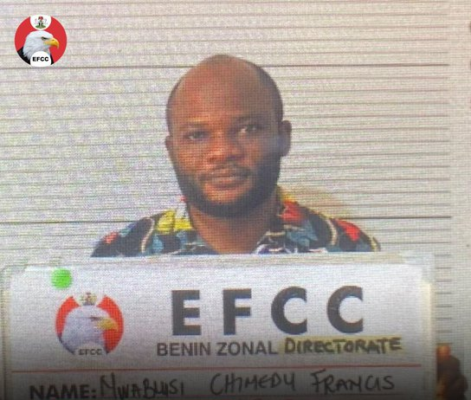
The Economic and Financial Crimes Commission (EFCC) has secured the conviction and sentencing of a man, Chinedu Francis Nwabuisi, to two years’ imprisonment for converting ₦21.9 million mistakenly credited to his bank account for personal use.
The commission disclosed this in a statement issued on Tuesday, November 10, 2026.
According to the EFCC, Justice Irele Ifijeh of the Edo State High Court sitting in Benin City found Nwabuisi guilty and sentenced him to two years in prison without an option of fine.
The commission explained that the money, precisely ₦21,939,732.27, was mistakenly transferred into Nwabuisi’s account following a system glitch at First Bank Plc.
Nwabuisi was subsequently arraigned by the EFCC’s Benin Zonal Directorate after allegedly converting the funds to his personal use instead of reporting the erroneous transaction or returning the money.
During the trial, prosecution counsel, M.S. Dahiru, presented two witnesses, including a senior official of First Bank and an operative of the EFCC.
The prosecution also tendered several documentary exhibits, which were admitted by the court as evidence in support of the case.
In his defence, Nwabuisi reportedly told the court that he believed the money represented proceeds from his Point of Sale (POS) business operated in partnership with the bank.
However, after considering the evidence presented by the prosecution and the defendant’s explanation, Justice Ifijeh convicted him of the offence.
The court consequently sentenced him to two years’ imprisonment without the option of a fine.
In addition to the prison sentence, the court ordered Nwabuisi to refund the entire sum to First Bank Plc.
The EFCC said the judge specifically directed him to restitute the complainant, First Bank Plc, with ₦21,939,732.27.
The commission’s latest disclosure underscores the legal consequences of knowingly converting funds mistakenly transferred into a bank account, rather than taking steps to notify the financial institution and return the money.
The conviction also serves as a reminder that an erroneous bank transfer does not automatically make the recipient the rightful owner of the funds.