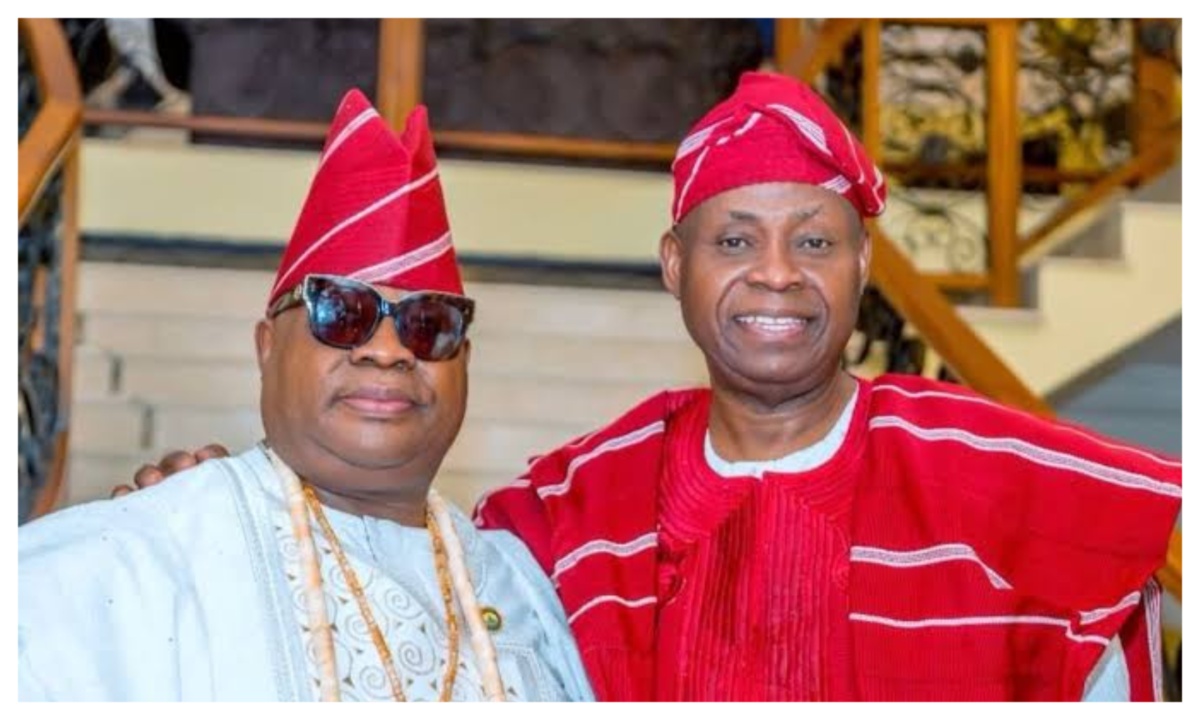
Businessman Deji Adeleke, father of Afrobeats star Davido, has alleged that the All Progressives Congress (APC) spent about N60 billion on vote-buying during the recently concluded Osun State governorship election.
Adeleke, who is the elder brother of Governor Ademola Adeleke, also claimed that the party offered as much as N50,000 for individual votes in some parts of the state during the August 15 election.
He made the allegations while speaking in Osogbo, the Osun State capital, where he reflected on the election and the eventual victory of his younger brother.
According to him, reports about the alleged amount of money being deployed by the APC during the election prompted him to seek divine intervention. He said he went into his room, knelt down and prayed that voters would accept the money allegedly offered to them but still cast their ballots for Governor Adeleke.
“On the day of the election, when I heard about the kind of money they were spending, I went back to my little corner in my room and I knelt down and I prayed to God Almighty,” Adeleke said.
He added: “I said, ‘God Almighty, let people collect their money but still vote for Ademola Adeleke.’”
Adeleke further claimed that the APC spent approximately N60 billion during the election and alleged that vote-buying reached N50,000 per voter in some locations.
“They spent N60 billion as we heard. Some places they bought votes for as high as N50,000, for one single vote,” he alleged.
The claims come after a closely watched governorship election in which Governor Ademola Adeleke, the candidate of the Accord Party, was declared the winner by the Independent National Electoral Commission (INEC).
Adeleke secured 511,067 votes to defeat the APC candidate, Bola Oyebamiji, who polled 444,815 votes, according to the final results announced by INEC.
The election was characterised by intense political competition, with the major political parties mobilising supporters across the state’s local government areas.
The campaign period and voting day were also marked by allegations of intimidation, violence, vote-buying and other electoral irregularities from rival political camps.
While Adeleke’s camp celebrated the outcome as a victory for democracy and the will of the people, allegations of financial inducement have continued to generate debate over the integrity of Nigeria’s electoral process.
Vote-buying remains a major concern in Nigerian elections, with political parties and candidates frequently accused of offering cash or other incentives to voters in exchange for electoral support.
However, allegations of vote-buying require independent verification, and Adeleke’s claim that the APC spent N60 billion has not been independently established in the information available.
The businessman nonetheless expressed satisfaction with the election outcome, attributing his brother’s victory partly to the decision of voters to exercise their franchise according to their preferred candidate.
His account also highlighted the increasingly important role of money in Nigerian elections and the challenges confronting efforts to ensure that electoral choices are based on policies, competence and candidates’ records rather than financial inducements.
Governor Adeleke’s victory has been described by his supporters as a reaffirmation of his popularity among the people of Osun State. The result has also intensified political discussions ahead of the 2027 general elections, with opposition figures presenting the Osun outcome as evidence that voters can resist political pressure and financial inducement at the ballot box.
Watch video: