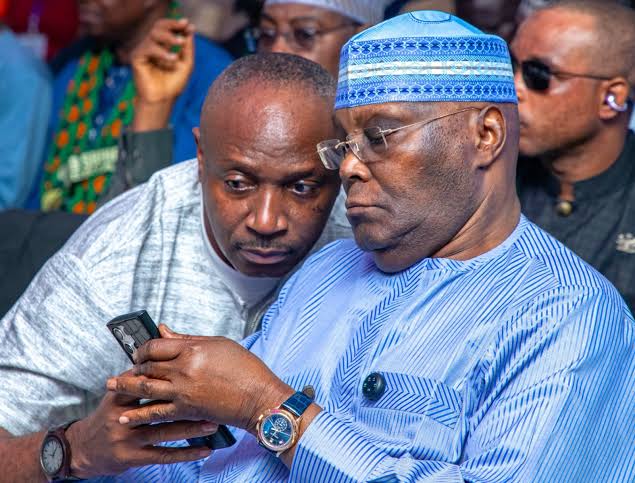
The presidential candidate of the African Democratic Congress (ADC), Atiku Abubakar, has renewed his criticism of President Bola Tinubu over alleged discrepancies in the academic certificate submitted to the Independent National Electoral Commission (INEC), arguing that political leaders should be subjected to the same standards required of ordinary Nigerians seeking employment.
Atiku made the remarks on Wednesday during an engagement with members of the ADC Youth Wing, where he said questions surrounding different versions of the certificate deserved public explanation and should not be dismissed because the individual involved occupies the nation’s highest office.
According to the former Vice President, reports suggesting that different versions of the certificate contain varying dates, signatures and descriptions of the degree raise concerns that would ordinarily attract scrutiny if they involved an average Nigerian applying for a job.
He maintained that the issue goes beyond partisan politics and touches on the broader question of accountability and equal treatment before the law.
Atiku said Nigeria has developed a culture in which those in positions of authority are allegedly held to different standards from ordinary citizens, a situation he described as harmful to democratic governance and public confidence in institutions.
Addressing the youths, he asked them to imagine presenting two versions of an academic certificate bearing different dates and signatures while applying for employment.
“They would ask you to explain yourself. They might even reject your application,” he said.
He added that serious questions allegedly remain about the certificate presented by President Tinubu to INEC, including reported differences in dates, signatures and the description of the degree awarded.
“One version reportedly says June 22, another June 27; questions have also been raised about the signatures and the description of the degree,” Atiku stated.
The ADC candidate stressed that he was not demanding that Nigerians automatically accept his interpretation of the controversy. Rather, he said he was calling for consistency in the standards applied to public officials and ordinary citizens.
“I am not asking you to accept my conclusion. I am asking something much simpler: if a young Nigerian would be required to explain such discrepancies before getting an ordinary job, why should the man seeking Nigeria’s highest job be exempt from the same standard?” he asked.
Atiku argued that Nigeria must abandon what he described as a two-tier system in which public office holders are treated differently from the rest of the population.
“That is part of the Nigeria we must change—a Nigeria where there is one standard for those in power and another for everyone else,” he said.
Beyond the certificate controversy, the former Vice President used the event to unveil what he described as a “covenant” with Nigerian youths ahead of the 2027 presidential election. He promised that, if elected, his administration would give young Nigerians a greater role in governance, economic development and national decision-making.
He said his proposed government would expand access to financing for young entrepreneurs, artisans, farmers, technology founders and participants in the creative industry. According to him, economic opportunity should be determined by the quality of ideas rather than political connections or access to influential patrons.
“Your surname, political connection or ability to find a godfather should not determine whether a good idea receives an opportunity to succeed,” Atiku said.
He also promised comprehensive reforms in the education sector, arguing that the current system is preparing young Nigerians for an economy that has already changed.
According to him, greater emphasis would be placed on science, technology, vocational education, agriculture, digital skills, entrepreneurship and critical thinking so that graduates can compete in a rapidly evolving global economy.
Atiku further pledged to treat broadband access and digital connectivity as essential national infrastructure. He said young Nigerians in rural and urban communities alike should have equal opportunities to participate in the digital economy.
On political participation, he promised that at least 30 per cent of ADC legislative candidates would be below the age of 40, while a significant number would be below 30.
“When I speak about youth inclusion, I do not mean ceremonial appointments or creating a few positions with impressive titles. I mean real responsibility, political representation, economic opportunity and a genuine voice in government,” he said.
The former Vice President urged young Nigerians to prepare themselves for leadership rather than merely complain about the current political class.
“Do not simply complain about the people making decisions. Prepare yourselves to replace those who are failing you,” he told the gathering.
He also encouraged youths to hold political leaders accountable and not to offer blind support to any politician, including himself.
“I want your support, but I also want your scrutiny. That is how democratic institutions become stronger,” Atiku said.
Concluding his remarks, the ADC presidential candidate criticised the economic situation under the Tinubu administration, saying many young Nigerians are struggling with unemployment, rising living costs and limited opportunities.
He argued that effective leadership should be judged not by the ability to explain hardship but by the capacity to reduce it and improve the living conditions of citizens.